Department of Clinical Science, Division of Pediatrics, Karolinska Institutet, Karolinska University Hospital Huddinge, Stockholm, Sweden.
Int J Obes (Lond). 2011 Jan;35(1):46-52. doi: 10.1038/ijo.2010.189. Epub 2010 Sep 21.
To explore the relationship between severity of obesity at age 7 and age 15, age at onset of obesity, and parental body mass index (BMI) in obese children and adolescents.
Longitudinal cohort study.
Obese children (n = 231) and their parents (n = 462) from the Swedish National Childhood Obesity Centre.
Multivariate regression analyses were applied with severity of obesity (BMI standard deviation score (BMI SDS)) and onset of obesity as dependent variables. The effect of parental BMI was evaluated and in the final models adjusted for gender, parental education, age at onset of obesity, severity of obesity at age 7 and obesity treatment.
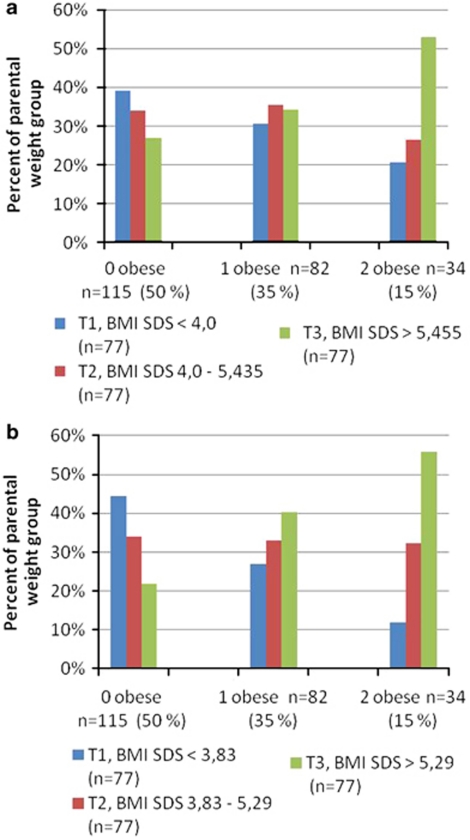
For severity of obesity at age 7, a positive correlation with maternal BMI was indicated (P = 0.05). Severity of obesity at this age also showed a strong negative correlation with the age at onset of obesity. Severity of obesity at age 15 was significantly correlated with both maternal and paternal BMI (P < 0.01). In addition, BMI SDS at age 15 differed by gender (higher for boys) and was positively correlated with severity of obesity at age 7 and negatively correlated with treatment. Also, a negative correlation was indicated at this age for parental education. No correlation with age at onset was found at age 15. For age at onset of obesity there was no relevant correlation with parental BMI. Children within the highest tertile of the BMI SDS range were more likely to have two obese parents.
The impact of parental BMI on the severity of obesity in children is strengthened as the child grows into adolescence, whereas the age at onset is probably of less importance than previously thought. The influence of parental relative weight primarily affects the severity of childhood obesity and not the timing.
探讨肥胖儿童和青少年 7 岁和 15 岁时肥胖严重程度、肥胖起始年龄与父母体重指数(BMI)之间的关系。
纵向队列研究。
来自瑞典国家儿童肥胖中心的肥胖儿童(n=231)及其父母(n=462)。
采用多元回归分析,以肥胖严重程度(BMI 标准差评分(BMI SDS))和肥胖起始年龄为因变量。评估了父母 BMI 的影响,并在最终模型中调整了性别、父母教育程度、肥胖起始年龄、7 岁时肥胖严重程度和肥胖治疗。
对于 7 岁时的肥胖严重程度,与母亲 BMI 呈正相关(P=0.05)。此时肥胖的严重程度也与肥胖起始年龄呈强烈负相关。15 岁时的肥胖严重程度与母亲和父亲的 BMI 均显著相关(P<0.01)。此外,15 岁时的 BMI SDS 也与性别有关(男孩更高),并与 7 岁时的肥胖严重程度呈正相关,与治疗呈负相关。此外,在这个年龄还存在与父母教育程度的负相关。在 15 岁时,与肥胖起始年龄没有相关性。对于肥胖起始年龄,与父母 BMI 没有相关性。BMI SDS 范围最高三分位数的儿童更有可能有两位肥胖的父母。
随着孩子成长为青少年,父母 BMI 对儿童肥胖严重程度的影响会增强,而肥胖起始年龄的重要性可能不如以前认为的那么重要。父母相对体重的影响主要影响儿童肥胖的严重程度,而不是发病时间。