Ehrlich Joshua R, Radcliffe Nathan M
Department of Ophthalmology, Weill Cornell Medical College, New York, NY, USA.
Clin Ophthalmol. 2010 Sep 7;4:971-6. doi: 10.2147/opth.s12420.
To determine if clinical evaluation of parapapillary atrophy (PPA) significantly improves the ability to distinguish open-angle glaucoma (OAG) patients from glaucoma suspects.
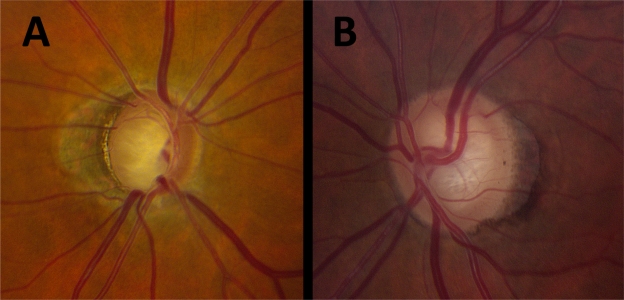
Patients in this study were under evaluation for glaucoma and had open angles, at least one reliable 24-2 SITA-standard automatic perimetry, and digital stereophotographs of the optic disc. PPA was identified clinically as a parapapillary region of absent (βPPA) or hyper/hypopigmented (αPPA) retinal pigment epithelium. A single masked observer evaluated photos for: vertical cup-to-disc ratio (CDR), clock hours of total and βPPA, βPPA as percentage width of the optic disc, presence or absence of βPPA at each disc quadrant, and ordinal rating of total PPA. Generalized linear models were used to determine odds of an abnormal or borderline glaucoma hemifield test (GHT) as a function of PPA variables and covariates; model fit was assessed using the log-likelihood ratio test.
Of 410 consecutive patients, 540 eyes (of 294 patients) met inclusion criteria. Mean age was greater among patients with abnormal compared with normal GHT (P < 0.001), but sex and race/ethnicity did not differ between groups (P ≥ 0.22). Age, central corneal thickness (CCT) and CDR (P ≤ 0.006), but not intraocular pressure (IOP) (P = 0.71), were significant univariable predictors of the odds of an abnormal GHT. All PPA parameters significantly predicted GHT (P ≤ 0.03), except presence of temporal βPPA (P = 0.25). Adjustment for age, CCT, IOP, and CDR reduced the association between PPA and GHT, and model fit was not greatly improved by addition of PPA variables.
Addition of most PPA parameters to a model already containing commonly assessed variables including age, CCT, IOP, and CDR does not significantly improve the ability to distinguish OAG patients from glaucoma suspects.
确定视乳头旁萎缩(PPA)的临床评估是否能显著提高区分开角型青光眼(OAG)患者与青光眼可疑者的能力。
本研究中的患者正在接受青光眼评估,具有开角、至少一次可靠的24-2 SITA标准自动视野检查以及视盘的数字立体照片。临床上将PPA识别为视网膜色素上皮缺失(βPPA)或色素沉着过度/色素沉着不足(αPPA)的视乳头旁区域。一名单盲观察者评估照片的以下指标:垂直杯盘比(CDR)、总PPA和βPPA的钟点数、βPPA占视盘宽度的百分比、每个视盘象限βPPA的有无以及总PPA的序数评分。使用广义线性模型确定异常或临界青光眼半视野检查(GHT)的几率作为PPA变量和协变量的函数;使用对数似然比检验评估模型拟合度。
在410例连续患者中,540只眼(294例患者)符合纳入标准。与GHT正常的患者相比,GHT异常的患者平均年龄更大(P < 0.001),但两组之间的性别和种族/民族无差异(P≥0.22)。年龄、中央角膜厚度(CCT)和CDR(P≤0.006)是GHT异常几率的显著单变量预测因素,但眼压(IOP)不是(P = 0.71)。除颞侧βPPA的存在(P = 0.25)外,所有PPA参数均显著预测GHT(P≤0.03)。对年龄、CCT、IOP和CDR进行调整后,PPA与GHT之间的关联减弱,并且添加PPA变量后模型拟合度没有显著改善。
在一个已经包含年龄、CCT、IOP和CDR等常用评估变量的模型中添加大多数PPA参数,并不会显著提高区分OAG患者与青光眼可疑者的能力。