Laboratório de Bioquímica Redox, Programa de Biologia Molecular e Biotecnologia, Instituto de Bioquímica Médica, Universidade Federal do Rio de Janeiro, Rio de Janeiro, Brazil.
PLoS One. 2010 Sep 13;5(9):e12694. doi: 10.1371/journal.pone.0012694.
Hemozoin (Hz) is a heme crystal that represents a vital pathway for heme disposal in several blood-feeding organisms. Recent evidence demonstrated that β-hematin (βH) (the synthetic counterpart of Hz) formation occurs under physiological conditions near synthetic or biological hydrophilic-hydrophobic interfaces. This seems to require a heme dimer acting as a precursor of Hz crystals that would be formed spontaneously in the absence of the competing water molecules bound to the heme iron. Here, we aimed to investigate the role of medium polarity on spontaneous βH formation in vitro.
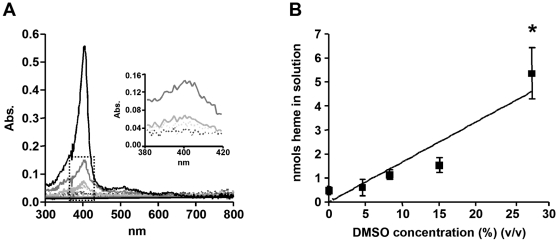
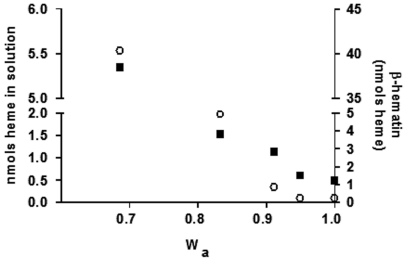
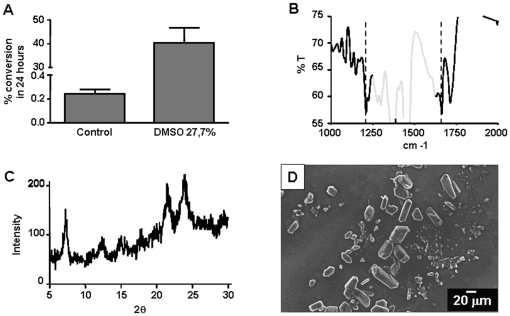
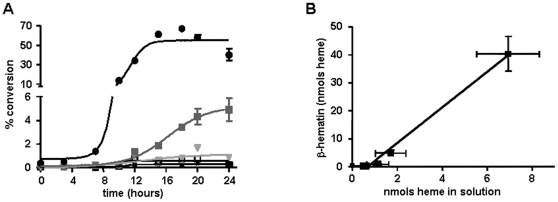
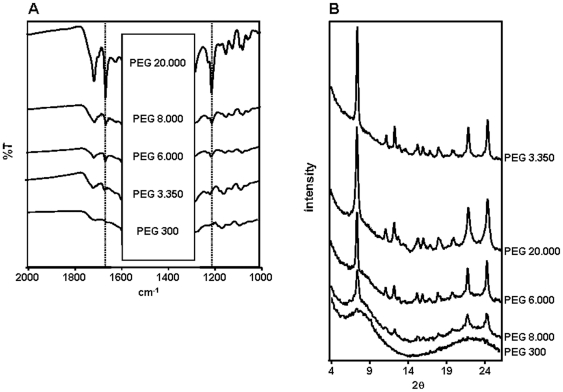
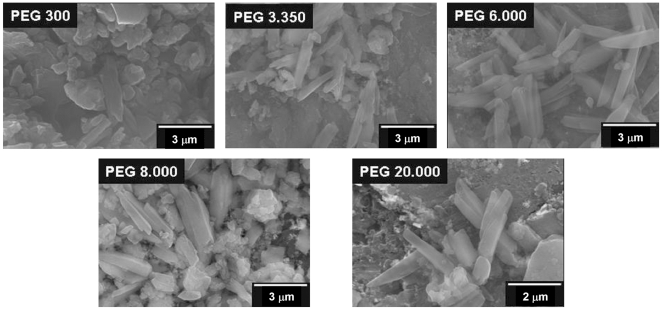
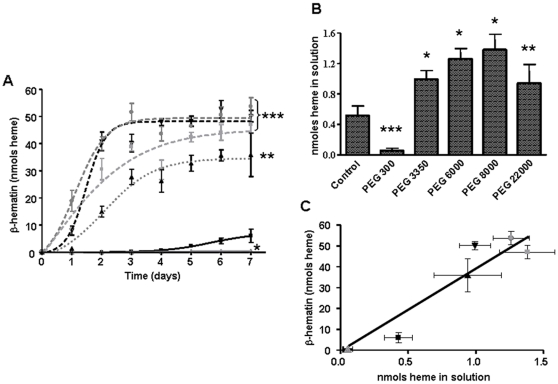
METHODOLOGY/PRINCIPAL FINDINGS: We assessed the effect of water content on spontaneous βH formation by using the aprotic solvent dimethylsulfoxide (DMSO) and a series of polyethyleneglycols (PEGs). We observed that both DMSO and PEGs (3.350, 6.000, 8.000, and 22.000) increased the levels of soluble heme under acidic conditions. These compounds were able to stimulate the production of βH crystals in the absence of any biological sample. Interestingly, the effects of DMSO and PEGs on βH formation were positively correlated with their capacity to promote previous heme solubilization in acidic conditions. Curiously, a short chain polyethyleneglycol (PEG 300) caused a significant reduction in both soluble heme levels and βH formation. Finally, both heme solubilization and βH formation strongly correlated with reduced medium water activity provided by increased DMSO concentrations.
The data presented here support the notion that reduction of the water activity is an important mechanism to support spontaneous heme crystallization, which depends on the previous increase of soluble heme levels.
血晶(Hz)是一种血红素晶体,代表了几种吸血生物中血红素处理的重要途径。最近的证据表明,β-血卟啉(βH)(Hz 的合成对应物)在靠近合成或生物亲水性-疏水性界面的生理条件下形成。这似乎需要一个血红素二聚体作为 Hz 晶体的前体,在没有与血红素铁结合的竞争水分子的情况下,Hz 晶体将自发形成。在这里,我们旨在研究介质极性对体外自发βH 形成的作用。
方法/主要发现:我们通过使用非质子溶剂二甲亚砜(DMSO)和一系列聚乙二醇(PEG)评估了水含量对自发βH 形成的影响。我们观察到,DMSO 和 PEG(3.350、6.000、8.000 和 22.000)都在酸性条件下增加了可溶血红素的水平。这些化合物能够在没有任何生物样品的情况下刺激βH 晶体的产生。有趣的是,DMSO 和 PEG 对βH 形成的影响与其在酸性条件下促进先前血红素溶解的能力呈正相关。有趣的是,短链聚乙二醇(PEG 300)导致可溶血红素水平和βH 形成均显著降低。最后,血红素溶解和βH 形成与通过增加 DMSO 浓度提供的降低的介质水活度强烈相关。
这里提出的数据支持这样一种观点,即降低水活度是支持自发血红素结晶的重要机制,这取决于先前增加的可溶血红素水平。