Nutrition, Metabolism and Genomics Group, Division of Human Nutrition, Wageningen University, Wageningen, The Netherlands.
Diabetes. 2010 Dec;59(12):3181-91. doi: 10.2337/db10-0224. Epub 2010 Sep 21.
Nonalcoholic fatty liver disease (NAFLD) is linked to obesity and diabetes, suggesting an important role of adipose tissue in the pathogenesis of NAFLD. Here, we aimed to investigate the interaction between adipose tissue and liver in NAFLD and identify potential early plasma markers that predict nonalcoholic steatohepatitis (NASH).
C57Bl/6 mice were chronically fed a high-fat diet to induce NAFLD and compared with mice fed a low-fat diet. Extensive histological and phenotypical analyses coupled with a time course study of plasma proteins using multiplex assay were performed.
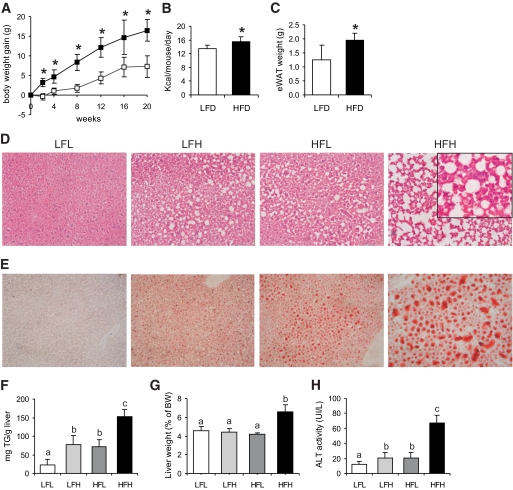
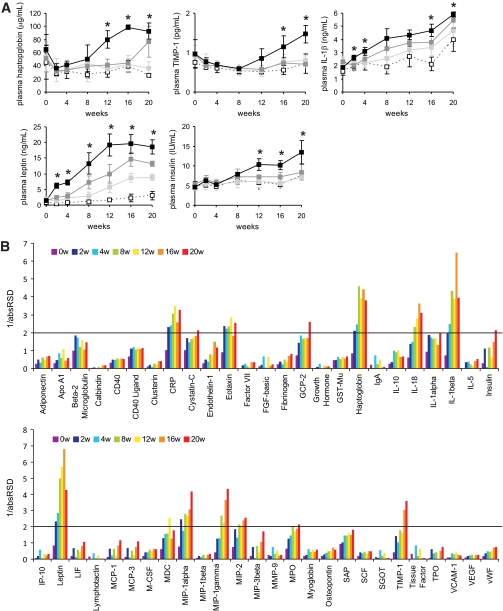
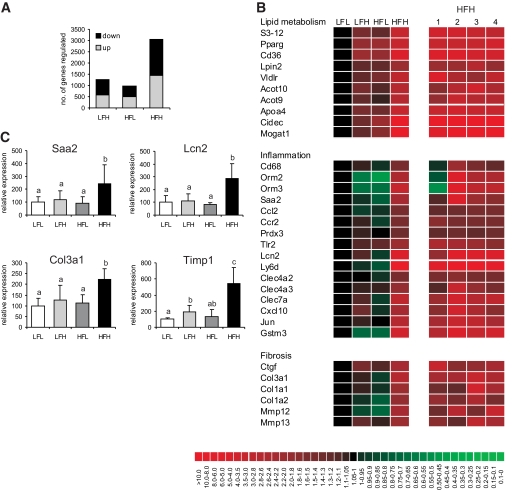
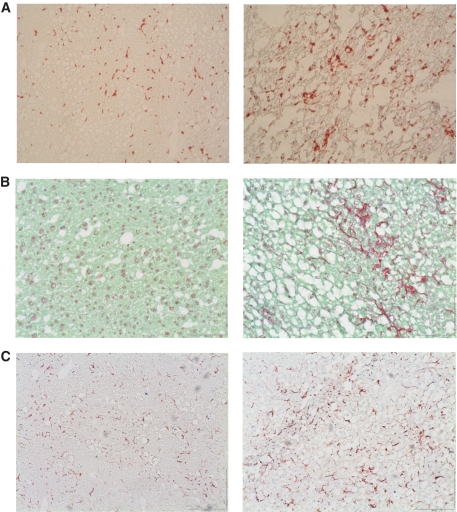
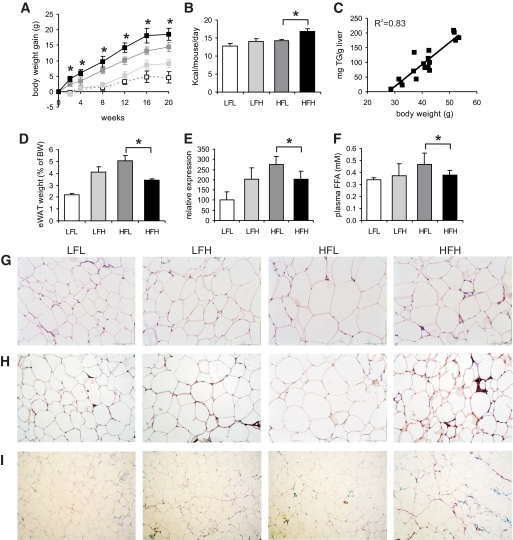
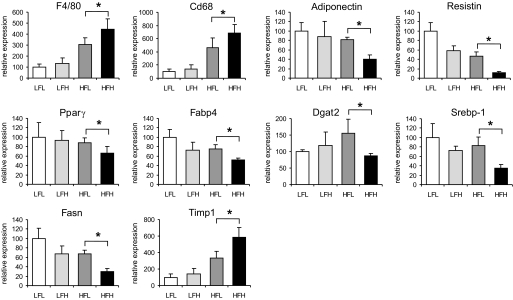
Mice exhibited pronounced heterogeneity in liver histological scoring, leading to classification into four subgroups: low-fat low (LFL) responders displaying normal liver morphology, low-fat high (LFH) responders showing benign hepatic steatosis, high-fat low (HFL) responders displaying pre-NASH with macrovesicular lipid droplets, and high fat high (HFH) responders exhibiting overt NASH characterized by ballooning of hepatocytes, presence of Mallory bodies, and activated inflammatory cells. Compared with HFL responders, HFH mice gained weight more rapidly and exhibited adipose tissue dysfunction characterized by decreased final fat mass, enhanced macrophage infiltration and inflammation, and adipose tissue remodeling. Plasma haptoglobin, IL-1β, TIMP-1, adiponectin, and leptin were significantly changed in HFH mice. Multivariate analysis indicated that in addition to leptin, plasma CRP, haptoglobin, eotaxin, and MIP-1α early in the intervention were positively associated with liver triglycerides. Intermediate prognostic markers of liver triglycerides included IL-18, IL-1β, MIP-1γ, and MIP-2, whereas insulin, TIMP-1, granulocyte chemotactic protein 2, and myeloperoxidase emerged as late markers.
Our data support the existence of a tight relationship between adipose tissue dysfunction and NASH pathogenesis and point to several novel potential predictive biomarkers for NASH.
非酒精性脂肪性肝病(NAFLD)与肥胖和糖尿病有关,提示脂肪组织在 NAFLD 发病机制中起重要作用。在这里,我们旨在研究 NAFLD 中脂肪组织与肝脏的相互作用,并确定预测非酒精性脂肪性肝炎(NASH)的潜在早期血浆标志物。
用高脂肪饮食慢性喂养 C57Bl/6 小鼠以诱导 NAFLD,并与低脂肪饮食喂养的小鼠进行比较。进行广泛的组织学和表型分析,并使用多重分析对血浆蛋白进行时间过程研究。
小鼠的肝组织学评分表现出明显的异质性,导致分为四个亚组:低脂低(LFL)应答者表现出正常的肝形态,低脂高(LFH)应答者表现出良性肝脂肪变性,高脂肪低(HFL)应答者表现出前 NASH 伴大泡性脂肪滴,以及高脂肪高(HFH)应答者表现出明显的 NASH,其特征为肝细胞气球样变、Mallory 小体和活化的炎症细胞。与 HFL 应答者相比,HFH 小鼠体重增加更快,并表现出脂肪组织功能障碍,表现为最终脂肪质量减少、巨噬细胞浸润和炎症增强以及脂肪组织重塑。HFH 小鼠的血浆触珠蛋白、IL-1β、TIMP-1、脂联素和瘦素明显改变。多元分析表明,除瘦素外,干预早期的血浆 CRP、触珠蛋白、嗜酸性粒细胞趋化因子、MIP-1α 与肝甘油三酯呈正相关。肝甘油三酯的中间预后标志物包括 IL-18、IL-1β、MIP-1γ 和 MIP-2,而胰岛素、TIMP-1、粒细胞趋化蛋白 2 和髓过氧化物酶则是晚期标志物。
我们的数据支持脂肪组织功能障碍与 NASH 发病机制之间存在紧密关系,并指出了几种新的潜在预测 NASH 的生物标志物。