Department of Pathology, Josephine Nefkens Institute, Erasmus MC-University Medical Center Rotterdam, Rotterdam, 3000 CA, The Netherlands.
Br J Cancer. 2010 Oct 12;103(8):1284-91. doi: 10.1038/sj.bjc.6605884. Epub 2010 Sep 21.
Breast cancer anti-oestrogen resistance 4 (BCAR4) was identified in a search for genes involved in anti-oestrogen resistance in breast cancer. We explored whether BCAR4 is predictive for tamoxifen resistance and prognostic for tumour aggressiveness, and studied its function.
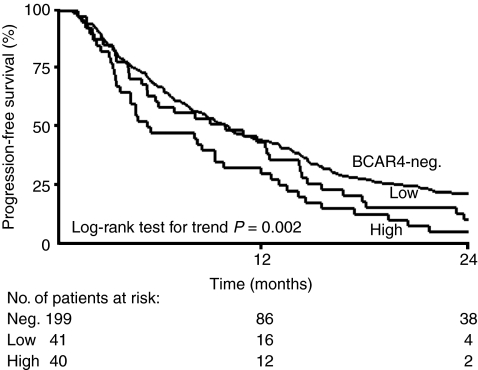
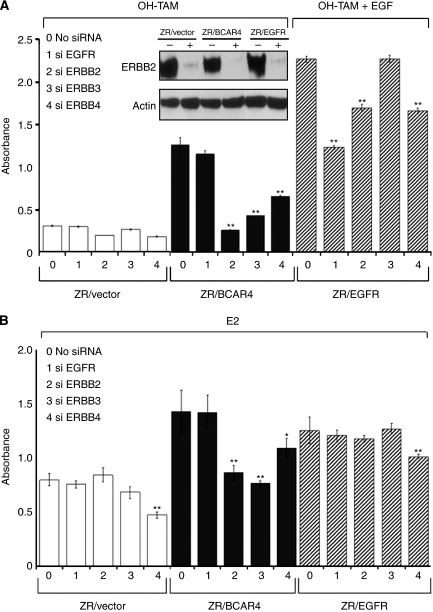
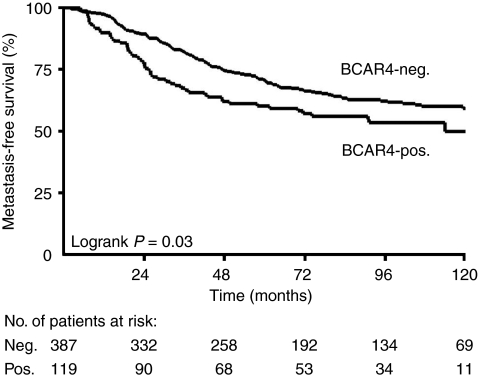
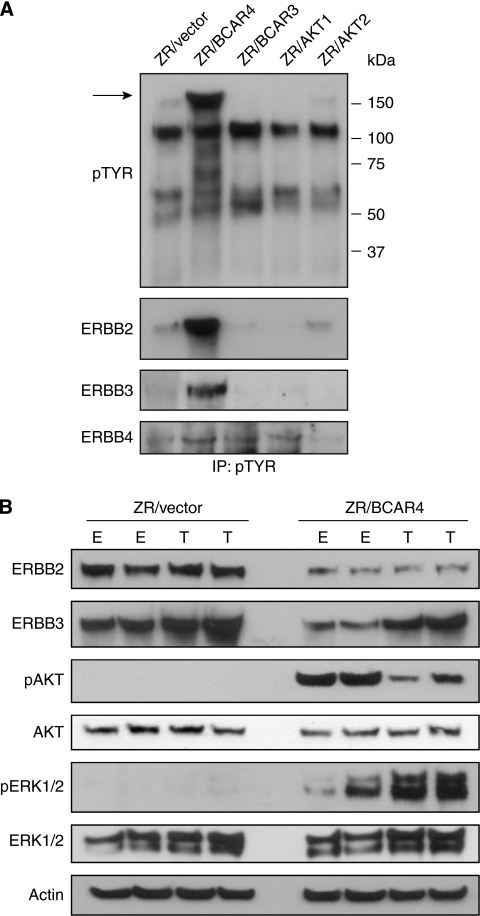
BCAR4 mRNA levels were measured in primary breast tumours, and evaluated for association with progression-free survival (PFS) and clinical benefit in patients with oestrogen receptor (ERα)-positive tumours receiving tamoxifen as first-line monotherapy for advanced disease. In a separate cohort of patients with lymph node-negative, ERα-positive cancer, and not receiving systemic adjuvant therapy, BCAR4 levels were evaluated for association with distant metastasis-free survival (MFS). The function of BCAR4 was studied with immunoblotting and RNA interference in a cell model.
Multivariate analyses established high BCAR4 mRNA levels as an independent predictive factor for poor PFS after start of tamoxifen therapy for recurrent disease. High BCAR4 mRNA levels were associated with poor MFS and overall survival, reflecting tumour aggressiveness. In BCAR4-expressing cells, phosphorylation of v-erb-b2 erythroblastic leukaemia viral oncogene homolog (ERBB)2, ERBB3, and their downstream mediators extracellular signal-regulated kinase 1/2 and v-akt murine thymoma viral oncogene homolog (AKT) 1/2, was increased. Selective knockdown of ERBB2 or ERBB3 inhibited proliferation, confirming their role in BCAR4-induced tamoxifen resistance.
BCAR4 may have clinical relevance for tumour aggressiveness and tamoxifen resistance. Our cell model suggests that BCAR4-positive breast tumours are driven by ERBB2/ERBB3 signalling. Patients with such tumours may benefit from ERBB-targeted therapy.
乳腺癌抗雌激素抵抗 4 (BCAR4)是在寻找参与乳腺癌抗雌激素耐药的基因时发现的。我们探讨了 BCAR4 是否可预测他莫昔芬耐药和肿瘤侵袭性的预后,并研究了其功能。
在原发性乳腺癌中测量了 BCAR4 mRNA 水平,并评估其与接受他莫昔芬作为一线单药治疗晚期疾病的雌激素受体(ERα)阳性肿瘤患者的无进展生存期(PFS)和临床获益的相关性。在另一组未接受系统辅助治疗的淋巴结阴性、ERα阳性癌症患者中,评估了 BCAR4 水平与无远处转移生存期(MFS)的相关性。在细胞模型中,通过免疫印迹和 RNA 干扰研究了 BCAR4 的功能。
多变量分析确定高 BCAR4 mRNA 水平是接受他莫昔芬治疗复发疾病后 PFS 不良的独立预测因素。高 BCAR4 mRNA 水平与较差的 MFS 和总生存期相关,反映了肿瘤的侵袭性。在 BCAR4 表达细胞中,v-erb-b2 红细胞白血病病毒致癌基因同源物(ERBB)2、ERBB3 及其下游介质细胞外信号调节激酶 1/2 和 v-akt 鼠胸腺瘤病毒致癌基因同源物(AKT)1/2 的磷酸化增加。选择性敲低 ERBB2 或 ERBB3 抑制了增殖,证实了它们在 BCAR4 诱导的他莫昔芬耐药中的作用。
BCAR4 可能与肿瘤侵袭性和他莫昔芬耐药性具有临床相关性。我们的细胞模型表明,BCAR4 阳性的乳腺癌是由 ERBB2/ERBB3 信号驱动的。此类肿瘤患者可能受益于 ERBB 靶向治疗。