Department of Health Management and Health Economics, University of Oslo, PO Box 1089, Blindern, N-0317 Oslo, Norway.
BMJ. 2010 Sep 22;341:c4715. doi: 10.1136/bmj.c4715.
To determine whether a general societal preference for prioritising treatment of rare diseases over common ones exists and could provide a justification for accepting higher cost effectiveness thresholds for orphan drugs.
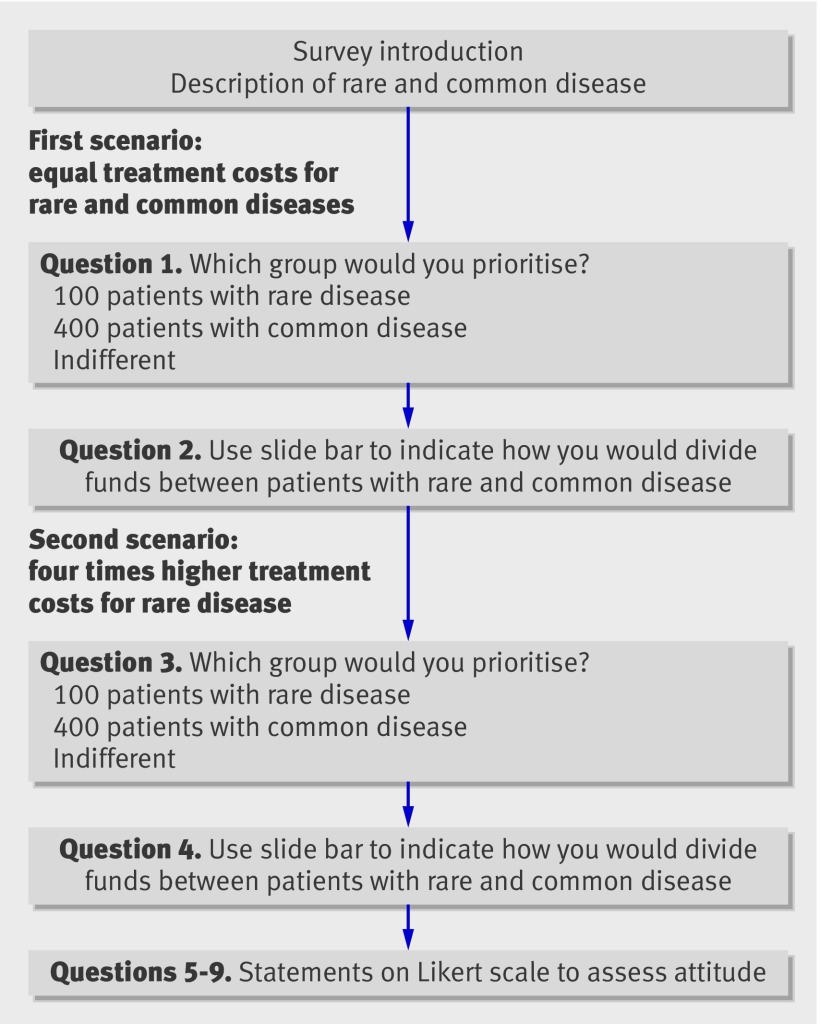
Cross sectional survey using a web based questionnaire.
Norway.
Random sample of 1547 Norwegians aged 40-67.
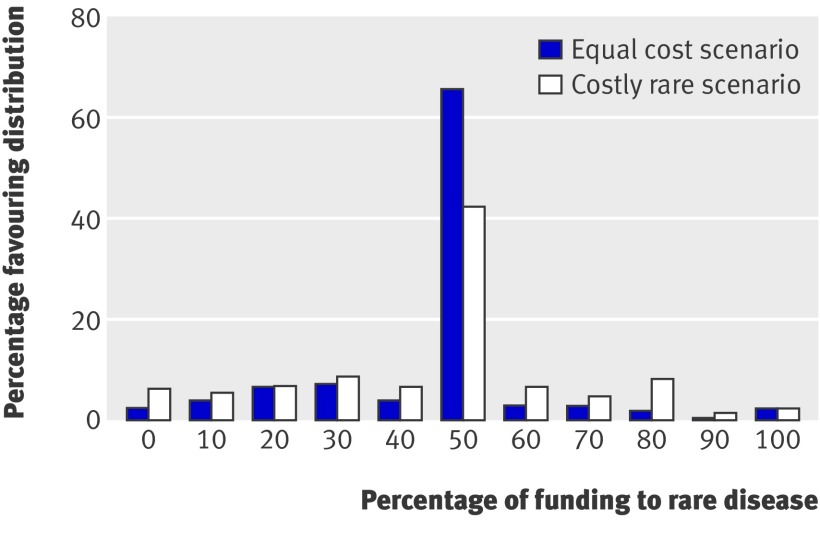
Choice between funding treatment for a rare disease versus a common disease and how funds should be allocated if it were not possible to treat all patients, for each of two scenarios: identical treatment costs per patient and higher costs for the rare disease. Respondents rated five statements concerning attitudes to equity on a five point Likert scale (5=completely agree).
For the equal cost scenario, 11.2% (9.6% to 12.8%) of respondents favoured treating the rare disease, 24.9% (21.7% to 26.0%) the common disease, and 64.9% (62.6% to 67.3%) were indifferent. When the rare disease was four times more costly to treat, the results were, respectively, 7.4% (6.1% to 8.7%), 45.3% (42.8% to 47.8%), and 47.3% (44.8% to 49.8%). Rankings for attitude on a Likert scale indicated strong support for the statements "rare disease patients should have the right to treatment even if more expensive" (mean score 4.5, SD 0.86) and "resources should be used to provide the greatest possible health benefits" (3.9, 1.23).
Despite strong general support for statements expressing a desire for equal treatment rights for patients with rare diseases, there was little evidence that a societal preference for rarity exists if treatment of patients with rare diseases is at the expense of treatment of those with common diseases.
确定是否存在一种普遍的社会偏好,即优先治疗罕见病而非常见病,并为接受更高成本效益阈值的孤儿药提供依据。
使用基于网络的问卷调查进行横断面调查。
挪威。
随机抽取的 1547 名年龄在 40-67 岁的挪威人。
在两种情况下,为罕见病和常见病提供治疗的选择,以及如果不能为所有患者提供治疗,资金应如何分配:每位患者的治疗成本相同和罕见病的治疗成本更高。受访者在五点李克特量表上对五项关于公平态度的陈述进行评分(5=完全同意)。
在成本相同的情况下,11.2%(9.6%至 12.8%)的受访者赞成治疗罕见病,24.9%(21.7%至 26.0%)赞成治疗常见病,64.9%(62.6%至 67.3%)则持中立态度。当罕见病的治疗费用高出四倍时,结果分别为 7.4%(6.1%至 8.7%)、45.3%(42.8%至 47.8%)和 47.3%(44.8%至 49.8%)。李克特量表上的态度排名表明,人们强烈支持“罕见病患者即使费用更高也应有治疗权”(平均得分 4.5,标准差 0.86)和“资源应用于提供尽可能大的健康效益”(3.9,1.23)这两个陈述。
尽管人们普遍强烈支持表达对罕见病患者平等治疗权利的愿望的陈述,但如果治疗罕见病患者的费用是以牺牲治疗常见病患者为代价的,那么社会对罕见病的偏好几乎不存在。