Bayliss Andrew P, Schuch Stefanie, Tipper Steven P
School of Psychology, University of Queensland, St. Lucia, Australia.
Vis cogn. 2010 Sep;18(8):1214-1232. doi: 10.1080/13506285.2010.484657. Epub 2010 Aug 19.
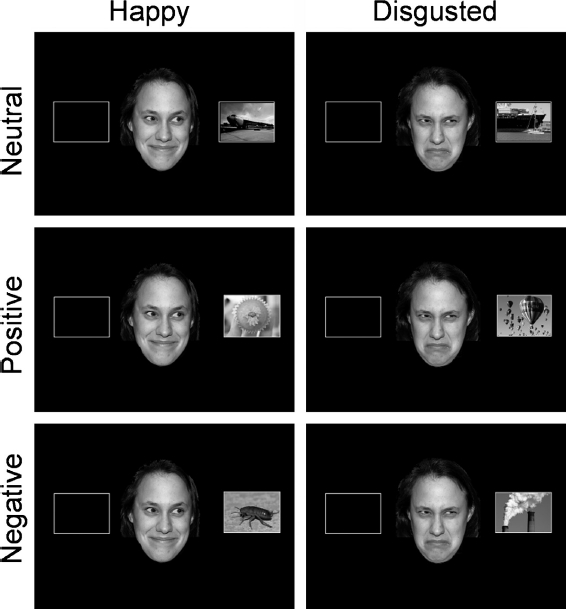
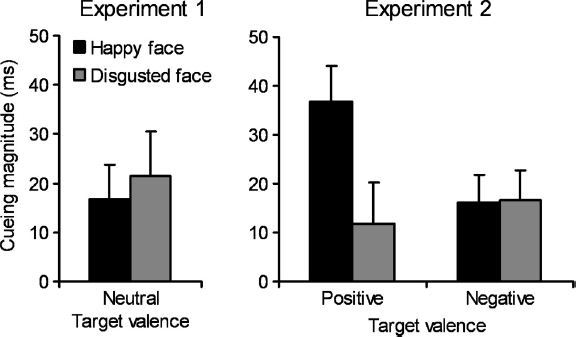
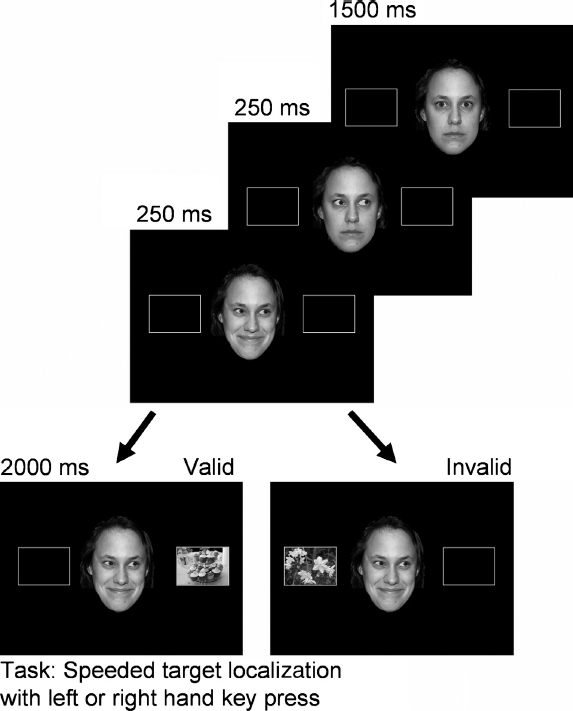
When we observe someone shift their gaze to a peripheral event or object, a corresponding shift in our own attention often follows. This social orienting response, joint attention, has been studied in the laboratory using the gaze cueing paradigm. Here, we investigate the combined influence of the emotional content displayed in two critical components of a joint attention episode: The facial expression of the cue face, and the affective nature of the to-be-localized target object. Hence, we presented participants with happy and disgusted faces as cueing stimuli, and neutral (Experiment 1), pleasant and unpleasant (Experiment 2) pictures as target stimuli. The findings demonstrate an effect of 'emotional context' confined to participants viewing pleasant pictures. Specifically, gaze cueing was boosted when the emotion of the gazing face (i.e., happy) matched that of the targets (pleasant). Demonstrating modulation by emotional context highlights the vital flexibility that a successful joint attention system requires in order to assist our navigation of the social world.
当我们观察到某人将目光转向周边的事件或物体时,我们自己的注意力往往也会随之发生相应的转移。这种社会定向反应,即共同注意,已经在实验室中通过注视线索范式进行了研究。在此,我们研究了共同注意事件的两个关键组成部分所显示的情感内容的综合影响:提示面孔的面部表情以及待定位目标物体的情感性质。因此,我们向参与者呈现了开心和厌恶的面孔作为提示刺激,以及中性(实验1)、愉悦和不愉悦(实验2)的图片作为目标刺激。研究结果表明,“情感背景”的影响仅限于观看愉悦图片的参与者。具体而言,当注视面孔的情绪(即开心)与目标的情绪(愉悦)相匹配时,注视线索效应会增强。情感背景的调节作用表明,一个成功的共同注意系统需要至关重要的灵活性,以便帮助我们在社交世界中导航。