Institute for Psychology, University of Lübeck, Ratzeburger Allee 160, 23562, Lübeck, Germany.
Charité-Universitätsmedizin Berlin, Corporate member of Freie Universität Berlin, Humboldt-Universität zu Berlin, and Berlin Institute of Health, Neuroscience Research Center, 10117, Berlin, Germany.
Sci Rep. 2019 Apr 3;9(1):5604. doi: 10.1038/s41598-019-41815-9.
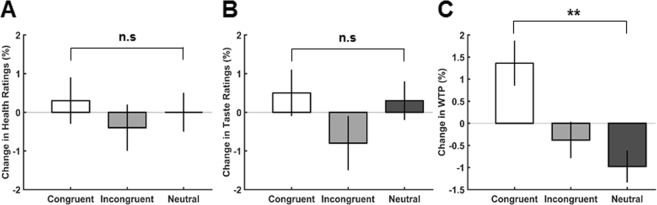
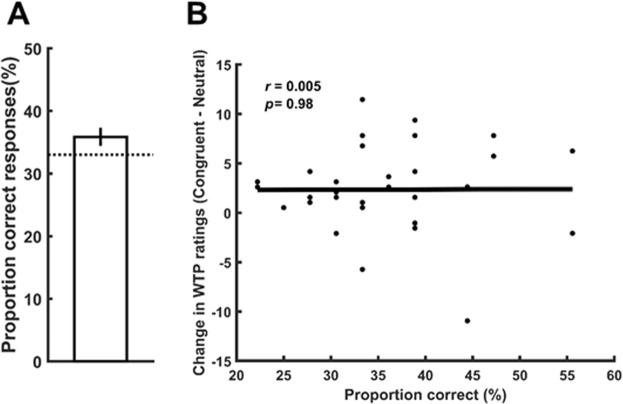
In our information-rich environment, the gaze direction of another indicates their current focus of attention. Following the gaze of another, results in gaze-evoked shifts in joint attention, a phenomenon critical for the functioning of social cognition. Previous research in joint attention has shown that objects that are attended by another are more liked than ignored objects. Here, we investigated this effect of gaze-cueing on participants' preferences for unknown food items. Participants provided their willingness to pay (WTP), taste and health preferences for food items before and after a standard gaze-cueing paradigm. We observed a significant effect of gaze-cueing on participants' WTP bids. Specifically, participants were willing to pay more money for the food items that were looked at by another person. In contrast, there was a decrease in preference for the food items that were ignored by another person. Interestingly, this increase in WTP occurred without participants' awareness of the contingency between the cue and target. These results highlight the influence of social information on human choice behavior and lay the foundation for experiments in neuromarketing and consumer decision making.
在信息丰富的环境中,他人的目光方向表示他们当前的注意力焦点。跟随他人的目光会导致共同注意的目光诱发转移,这是社会认知功能的关键现象。先前关于共同注意的研究表明,被他人关注的物体比被忽视的物体更受欢迎。在这里,我们研究了这种注视提示对参与者对未知食物偏好的影响。在标准的注视提示范式之前和之后,参与者提供了他们对食物的支付意愿 (WTP)、味觉和健康偏好。我们观察到注视提示对参与者的 WTP 出价有显著影响。具体来说,参与者愿意为被另一个人注视的食物支付更多的钱。相比之下,对于被另一个人忽视的食物,参与者的偏好则下降。有趣的是,这种 WTP 的增加是在参与者没有意识到线索和目标之间的关联的情况下发生的。这些结果强调了社会信息对人类选择行为的影响,为神经营销和消费者决策制定实验奠定了基础。