Department of Cell Biology, The University of Alabama at Birmingham, Birmingham, Alabama, USA.
PLoS One. 2010 Sep 17;5(9):e12672. doi: 10.1371/journal.pone.0012672.
Gene-based therapy is a new paradigm for the treatment of Parkinson disease (PD) and offers considerable promise for precise targeting and flexibility to impact multiple pathobiological processes for which small molecule agents are not available. Some success has been achieved utilizing adeno-associated virus for this approach, but it is likely that the characteristics of this vector system will ultimately create barriers to progress in clinical therapy. Adenovirus (Ad) vector overcomes limitations in payload size and targeting. The cellular tropism of Ad serotype 5 (Ad5)-based vectors is regulated by the Ad attachment protein binding to its primary cellular receptor, the coxsackie and adenovirus receptor (CAR). Many clinically relevant tissues are refractory to Ad5 infection due to negligible CAR levels but can be targeted by tropism-modified, CAR-independent forms of Ad. Our objective was to evaluate the role of CAR protein in transduction of dopamine (DA) neurons in vivo.
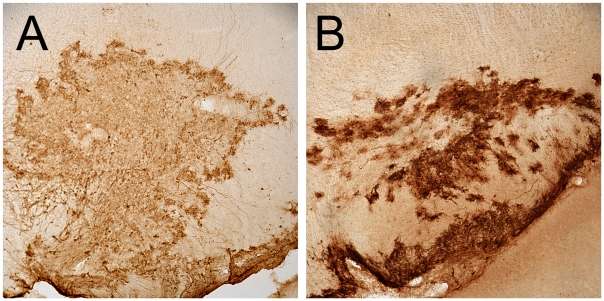
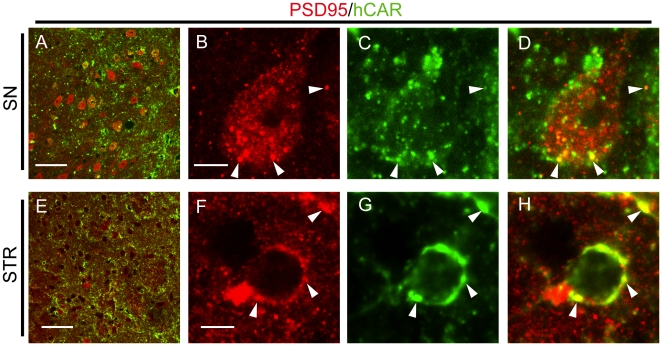
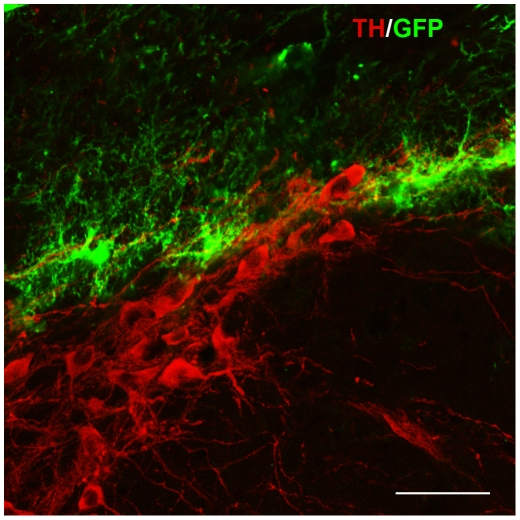
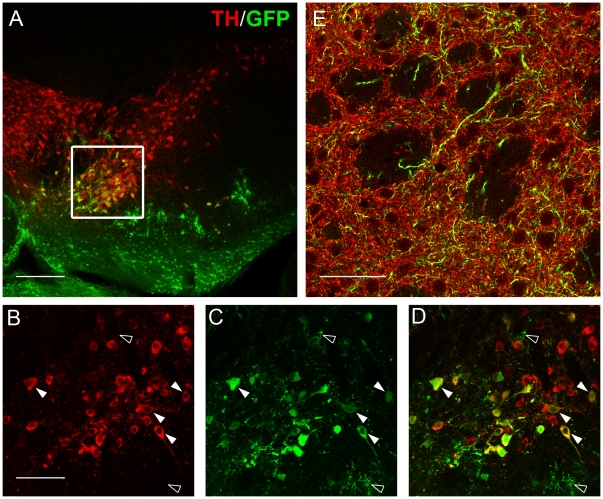
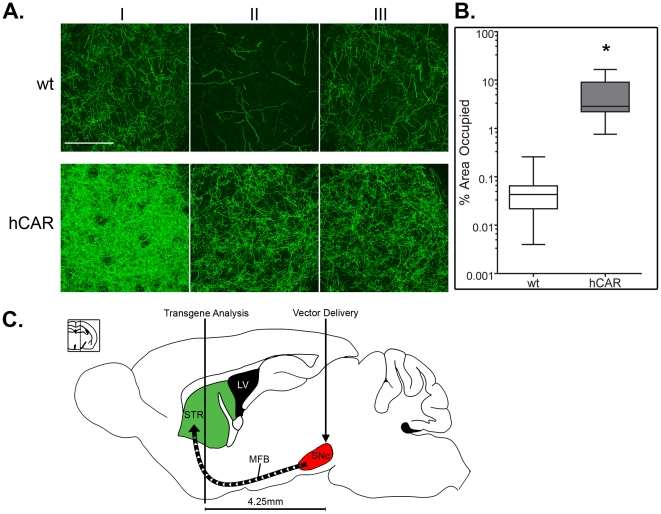
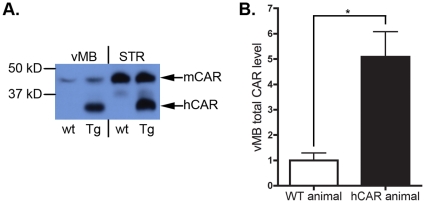
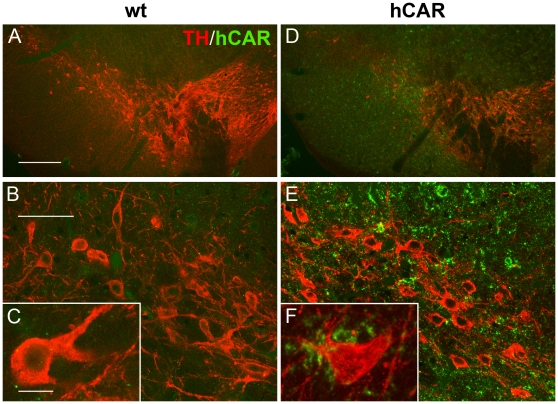
METHODOLOGY/PRINCIPAL FINDINGS: Ad5 was delivered to the substantia nigra (SN) in wild type (wt) and CAR transgenic animals. Cellular tropism was assessed by immunohistochemistry (IHC) in the SN and striatal terminals. CAR expression was assessed by western blot and IHC. We found in wt animals, Ad5 results in robust transgene expression in astrocytes and other non-neuronal cells but poor infection of DA neurons. In contrast, in transgenic animals, Ad5 infects SNc neurons resulting in expression of transduced protein in their striatal terminals. Western blot showed low CAR expression in the ventral midbrain of wt animals compared to transgenic animals. Interestingly, hCAR protein localizes with markers of post-synaptic structures, suggesting synapses are the point of entry into dopaminergic neurons in transgenic animals.
CONCLUSIONS/SIGNIFICANCE: These findings demonstrate that CAR deficiency limits infection of wild type DA neurons by Ad5 and provide a rationale for the development of tropism-modified, CAR-independent Ad-vectors for use in gene therapy of human PD.
基因治疗是治疗帕金森病 (PD) 的一种新范例,为针对多种生物病理学过程提供了精确靶向和灵活性的巨大潜力,而小分子药物对此无能为力。利用腺相关病毒 (AAV) 已经取得了一些成功,但这种载体系统的特性很可能最终会成为临床治疗进展的障碍。腺病毒 (Ad) 载体克服了载物大小和靶向的限制。Ad 血清型 5 (Ad5) 载体的细胞嗜性受 Ad 附着蛋白与主要细胞受体柯萨奇病毒和腺病毒受体 (CAR) 结合的调节。由于 CAR 水平极低,许多临床上相关的组织对 Ad5 感染具有抗性,但可以通过改变 CAR 非依赖性的转导特性来靶向这些组织。我们的目的是评估 CAR 蛋白在体内多巴胺 (DA) 神经元转导中的作用。
方法/主要发现:将 Ad5 递送至野生型 (wt) 和 CAR 转基因动物的黑质 (SN)。通过 SN 和纹状体末端的免疫组织化学 (IHC) 评估细胞嗜性。通过 Western blot 和 IHC 评估 CAR 表达。我们发现,在 wt 动物中,Ad5 导致星形胶质细胞和其他非神经元细胞中强大的转基因表达,但 DA 神经元感染不良。相比之下,在转基因动物中,Ad5 感染 SNc 神经元,导致其纹状体末端转导蛋白的表达。Western blot 显示 wt 动物中腹侧中脑的 CAR 表达低于转基因动物。有趣的是,hCAR 蛋白与突触后结构标志物定位在一起,这表明在转基因动物中,突触是 DA 神经元进入的部位。
结论/意义:这些发现表明,CAR 缺乏限制了 Ad5 对野生型 DA 神经元的感染,并为开发用于人类 PD 基因治疗的 CAR 非依赖性、转导特性改变的 Ad 载体提供了依据。