
改良的基因编码、FlincG 型荧光生物传感器,用于神经 cGMP 成像。
Improved genetically-encoded, FlincG-type fluorescent biosensors for neural cGMP imaging.
机构信息
Wolfson Institute for Biomedical Research, University College London London, UK.
出版信息
Front Mol Neurosci. 2013 Sep 24;6:26. doi: 10.3389/fnmol.2013.00026. eCollection 2013.
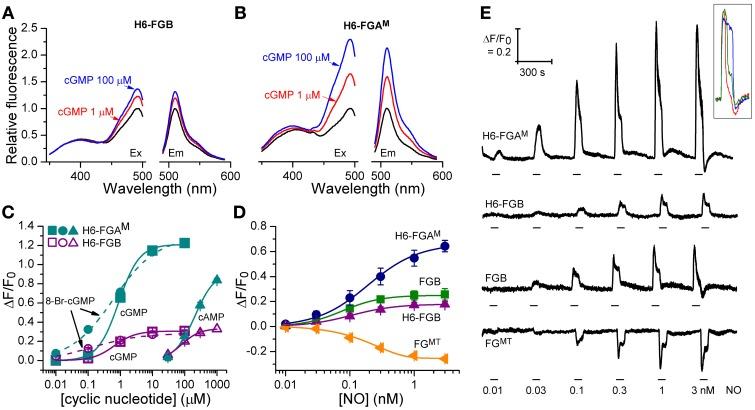
Genetically-encoded biosensors are powerful tools for understanding cellular signal transduction mechanisms. In aiming to investigate cGMP signaling in neurones using the EGFP-based fluorescent biosensor, FlincG (fluorescent indicator for cGMP), we encountered weak or non-existent fluorescence after attempted transfection with plasmid DNA, even in HEK293T cells. Adenoviral infection of HEK293T cells with FlincG, however, had previously proved successful. Both constructs were found to harbor a mutation in the EGFP domain and had a tail of 17 amino acids at the C-terminus that differed from the published sequence. These discrepancies were systematically examined, together with mutations found beneficial for the related GCaMP family of Ca(2+) biosensors, in a HEK293T cell line stably expressing both nitric oxide (NO)-activated guanylyl cyclase and phosphodiesterase-5. Restoring the mutated amino acid improved basal fluorescence whereas additional restoration of the correct C-terminal tail resulted in poor cGMP sensing as assessed by superfusion of either 8-bromo-cGMP or NO. Ultimately, two improved FlincGs were identified: one (FlincG2) had the divergent tail and gave moderate basal fluorescence and cGMP response amplitude and the other (FlincG3) had the correct tail, a GCaMP-like mutation in the EGFP region and an N-terminal tag, and was superior in both respects. All variants tested were strongly influenced by pH over the physiological range, in common with other EGFP-based biosensors. Purified FlincG3 protein exhibited a lower cGMP affinity (0.89 μM) than reported for the original FlincG (0.17 μM) but retained rapid kinetics and a 230-fold selectivity over cAMP. Successful expression of FlincG2 or FlincG3 in differentiated N1E-115 neuroblastoma cells and in primary cultures of hippocampal and dorsal root ganglion cells commends them for real-time imaging of cGMP dynamics in neural (and other) cells, and in their subcellular specializations.
基因编码的生物传感器是理解细胞信号转导机制的有力工具。为了使用基于 EGFP 的荧光生物传感器 FlincG(cGMP 的荧光指示剂)研究神经元中的 cGMP 信号,我们尝试用质粒 DNA 转染后发现荧光很弱或根本没有,即使在 HEK293T 细胞中也是如此。然而,FlincG 的腺病毒感染先前已被证明在 HEK293T 细胞中是成功的。这两种构建体都被发现 EGFP 结构域发生突变,并且在 C 末端有 17 个氨基酸的尾巴,与已发表的序列不同。这些差异与为相关的 GCaMP 家族 Ca(2+)生物传感器发现的有益突变一起,在稳定表达一氧化氮 (NO) 激活的鸟苷酸环化酶和磷酸二酯酶-5 的 HEK293T 细胞系中进行了系统检查。恢复突变的氨基酸可改善基础荧光,而进一步恢复正确的 C 末端尾巴则会导致 cGMP 检测不佳,这可通过 8-溴-cGMP 或 NO 的超流来评估。最终,鉴定出两种改良的 FlincG:一种(FlincG2)具有发散的尾巴,给予适度的基础荧光和 cGMP 响应幅度,另一种(FlincG3)具有正确的尾巴、EGFP 区域的 GCaMP 样突变和 N 端标签,在这两方面都表现出色。所有测试的变体在生理范围内的 pH 值都受到强烈影响,这与其他基于 EGFP 的生物传感器相同。纯化的 FlincG3 蛋白表现出比原始 FlincG(0.17 μM)更低的 cGMP 亲和力(0.89 μM),但保留了快速动力学和对 cAMP 的 230 倍选择性。FlincG2 或 FlincG3 在分化的 N1E-115 神经母细胞瘤细胞和海马和背根神经节细胞的原代培养中的成功表达,使其适用于神经(和其他)细胞中 cGMP 动力学的实时成像,以及它们的亚细胞特化。




 Zotero 插件