Department of Physical Medicine and Rehabilitation, Oslo University Hospital, Ullevaal, and Medical Faculty, University of Oslo, Norway.
BMC Musculoskelet Disord. 2010 Sep 23;11:218. doi: 10.1186/1471-2474-11-218.
Shoulder pain is a common complaint in primary health care and has an unfavourable outcome in many patients. The objectives were to identify predictors for pain and disability (SPADI) and work status in patients with subacromial shoulder pain.
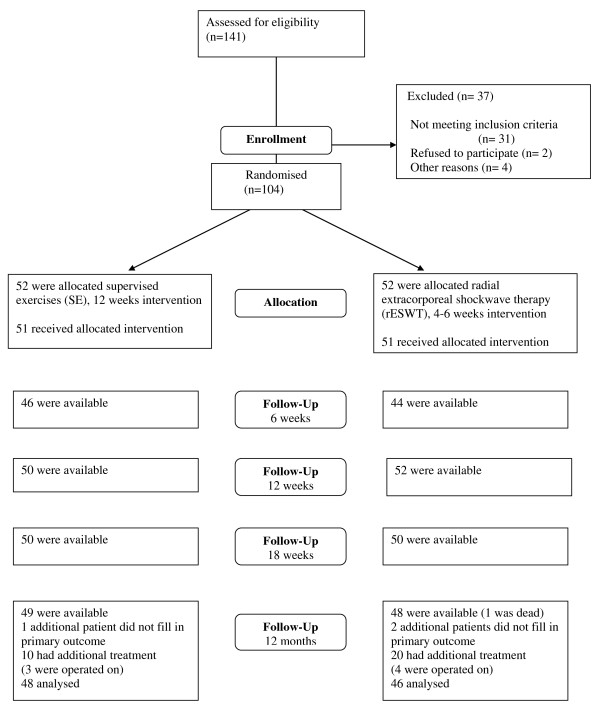
Secondary analyses of data from a randomized clinical controlled trial were performed. Outcome measures were the absolute values of the combined Shoulder Pain and Disability Index (SPADI) and work status 1 year after treatment with supervised exercises (SE) or radial extracorporeal shockwave therapy (rESWT). Predictors of outcome were investigated using multiple linear regression (SPADI) and logistic regression (work status).
104 patients were included. Low education (≤ 12 years), previous shoulder pain, and a high baseline SPADI score predicted poor results with these variables explaining 29.9% of the variance in SPADI score at 1 year. Low education and poor self-reported health status predicted a work status of "not working": Odds Ratio, OR = 4.3(95% CI (1.3 to 14.9)), p = 0.02 for education, and OR = 1.06 (95% CI (1.0 to 1.1)), p = 0.001 for self-reported health status, respectively. Adjustments for age, gender, and treatment group were performed, but did not change the results.
Education was the most consistent predictor of pain and disability, and work status at 1 year follow-up. Also, baseline SPADI score, previous shoulder pain and self-reported health status predicted outcome.
Clinical trials NCT00653081.
肩部疼痛是基层医疗保健中的常见问题,许多患者的预后不佳。本研究旨在确定肩峰下疼痛患者的疼痛和残疾(SPADI)以及工作状态的预测因素。
对一项随机对照临床试验的二级数据分析。治疗后 1 年的结局指标为综合肩痛和残疾指数(SPADI)的绝对值和工作状态。使用多元线性回归(SPADI)和逻辑回归(工作状态)来分析预测结果的因素。
共纳入 104 例患者。低教育程度(≤12 年)、既往肩部疼痛和较高的基线 SPADI 评分是这些变量解释 SPADI 评分在 1 年时的变异性的 29.9%的不良结果的预测因素。低教育程度和较差的自我报告健康状况预测工作状态为“不工作”:OR=4.3(95%CI(1.3 至 14.9),p=0.02)和 OR=1.06(95%CI(1.0 至 1.1),p=0.001),分别为教育和自我报告的健康状况。尽管进行了年龄、性别和治疗组的调整,但并未改变结果。
教育是疼痛和残疾以及 1 年随访时工作状态的最一致预测因素。此外,基线 SPADI 评分、既往肩部疼痛和自我报告的健康状况也可预测结局。
临床试验 NCT00653081。