Louwerens Jan K G, Kuijer P Paul F M, Sierevelt Inger N, van den Bekerom Michel P J, van Royen Barend J, Eygendaal Denise, van Noort Arthur
Department of Orthopaedic Surgery, Spaarne Gasthuis, Hoofddorp.
Coronel Institute of Occupational Health, Amsterdam UMC, University of Amsterdam, Amsterdam Public Health Research Institute, Amsterdam.
Arthrosc Sports Med Rehabil. 2020 Oct 5;2(6):e821-e827. doi: 10.1016/j.asmr.2020.07.021. eCollection 2020 Dec.
To examine the impact of rotator cuff calcific tendinitis on patients' self-reported work ability and sick leave, to compare work ability and sick leave with shoulder function after minimally invasive treatment, and to assess which prognostic factors influence the change in work ability.
A prospective cohort was analyzed in this study. The primary outcome measure was the single-question work ability score (0-10 points). Secondary outcome measures were quality and quantity of work, sick leave, functional outcome, and radiographic resorption. Potential predictive factors (treatment method, age, sex, resorption of the calcific deposit, physical work load, and work status) were tested in a statistical model. Follow-up was at 6 months and 1 year.
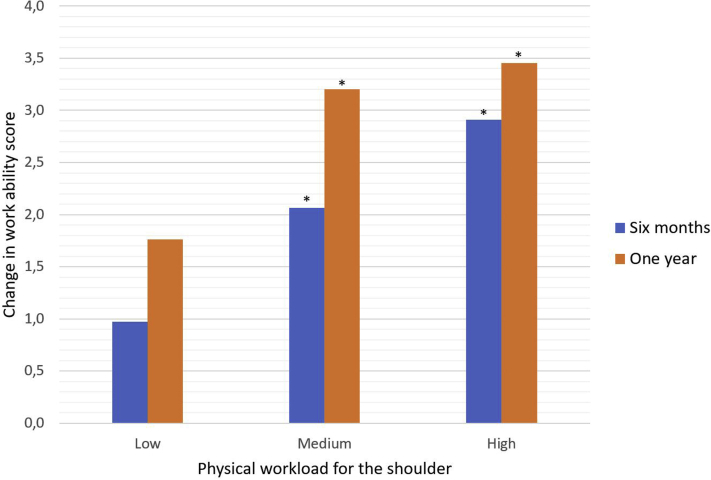
The study cohort consisted of 67 patients. The mean age was 49.6 ± 6.4 years and 45 (67%) were female. Physical workload was categorized as light (58%), medium (24%), and heavy (18%). Work ability score improved from a mean of 6.1 ± 2.8 to 8.5 ± 2.0 points after 1 year. Treatment with minimally invasive treatment techniques was associated with a reduction in partial or full-time sick leave from 28% to 6%. The mean days of sick leave a month declined from 3.3 to 0.8 days. Functional disability was greater in patients with partial or full-time sick leave. The physical workload turned out to be the most important patient associated factor predicting change in work ability.
This study supports the hypothesis that rotator cuff calcific tendinitis has a significant impact on work ability and sick leave. Minimally invasive treatment resulted in a clinically relevant improvement in work ability score and decline in sick leave. In particular, patients with medium and high physically demanding work for the shoulder benefit from minimally invasive treatment to improve their work ability.
Level II, prospective comparative study.
探讨肩袖钙化性肌腱炎对患者自我报告的工作能力和病假的影响,比较微创治疗后工作能力和病假与肩部功能的关系,并评估哪些预后因素会影响工作能力的变化。
本研究分析了一个前瞻性队列。主要结局指标是单问题工作能力评分(0 - 10分)。次要结局指标包括工作质量和数量、病假、功能结局以及影像学吸收情况。在统计模型中测试了潜在的预测因素(治疗方法、年龄、性别、钙化沉积物的吸收情况、体力工作负荷和工作状态)。随访时间为6个月和1年。
研究队列包括67例患者。平均年龄为49.6±6.4岁,45例(67%)为女性。体力工作负荷分为轻(58%)、中(24%)和重(18%)。1年后工作能力评分从平均6.1±2.8分提高到8.5±2.0分。采用微创治疗技术与部分或全时病假从28%降至6%相关。每月平均病假天数从3.3天降至0.8天。部分或全时病假的患者功能残疾程度更高。体力工作负荷是预测工作能力变化的最重要的患者相关因素。
本研究支持肩袖钙化性肌腱炎对工作能力和病假有显著影响这一假设。微创治疗导致工作能力评分在临床上有显著改善,病假减少。特别是,对肩部体力要求高的中、重度工作的患者从微创治疗中受益,从而提高了他们的工作能力。
二级,前瞻性比较研究。