International Epidemiology Institute, Rockville, MD, USA;
Clin Epidemiol. 2009 Aug 9;1:33-43. doi: 10.2147/clep.s4759.
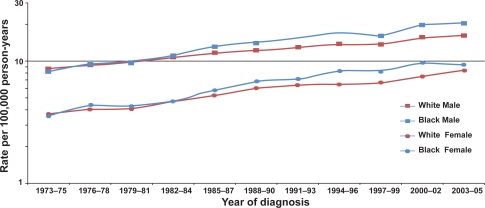
Incidence rates of renal cell cancer, which accounts for 85% of kidney cancers, have been rising in the United States and in most European countries for several decades. Family history is associated with a two- to four-fold increase in risk, but the major forms of inherited predisposition together account for less than 4% of renal cell cancers. Cigarette smoking, obesity, and hypertension are the most consistently established risk factors. Analgesics have not been convincingly linked with renal cell cancer risk. A reduced risk of renal cell cancer among statin users has been hypothesized but has not been adequately studied. A possible protective effect of fruit and vegetable consumption is the only moderately consistently reported dietary finding, and, with the exception of a positive association with parity, evidence for a role of hormonal or reproductive factors in the etiology of renal cell cancer in humans is limited. A recent hypothesis that moderate levels of alcohol consumption may be protective for renal cell cancer is not strongly supported by epidemiologic results, which are inconsistent with respect to the categories of alcohol consumption and the amount of alcohol intake reportedly associated with decreased risk. For occupational factors, the weight of the evidence does not provide consistent support for the hypotheses that renal cell cancer may be caused by asbestos, gasoline, or trichloroethylene exposure. The established determinants of renal cell cancer, cigarette smoking, obesity, and hypertension, account for less than half of these cancers. Novel epidemiologic approaches, including evaluation of gene-environment interactions and epigenetic mechanisms of inherited and acquired increased risk, are needed to explain the increasing incidence of renal cell cancer.
在美国和大多数欧洲国家,肾细胞癌(占肾癌的 85%)的发病率在几十年来一直在上升。家族史与风险增加 2 到 4 倍相关,但主要形式的遗传易感性加起来不到 4%的肾细胞癌。吸烟、肥胖和高血压是最一致确定的风险因素。镇痛药与肾细胞癌风险之间的关联尚未得到令人信服的证明。有人假设他汀类药物使用者患肾细胞癌的风险降低,但尚未进行充分研究。水果和蔬菜摄入可能具有保护作用,这是唯一一项中度一致的饮食发现,除了与生育次数呈正相关外,人类肾细胞癌病因中激素或生殖因素的作用证据有限。最近提出的适度饮酒可能对肾细胞癌具有保护作用的假说,并没有得到流行病学结果的有力支持,这些结果在饮酒类别和据称与风险降低相关的饮酒量方面不一致。关于职业因素,没有充分的证据支持肾细胞癌可能是由石棉、汽油或三氯乙烯暴露引起的假说。已经确定的肾细胞癌决定因素,如吸烟、肥胖和高血压,不到这些癌症的一半。需要新的流行病学方法,包括评估基因-环境相互作用和遗传和获得性风险增加的表观遗传机制,以解释肾细胞癌发病率的上升。