Center for Cognitive Neuroscience, Duke University, Durham, NC 27708, USA.
Neuropsychologia. 2011 Mar;49(4):640-50. doi: 10.1016/j.neuropsychologia.2010.09.009. Epub 2010 Sep 30.
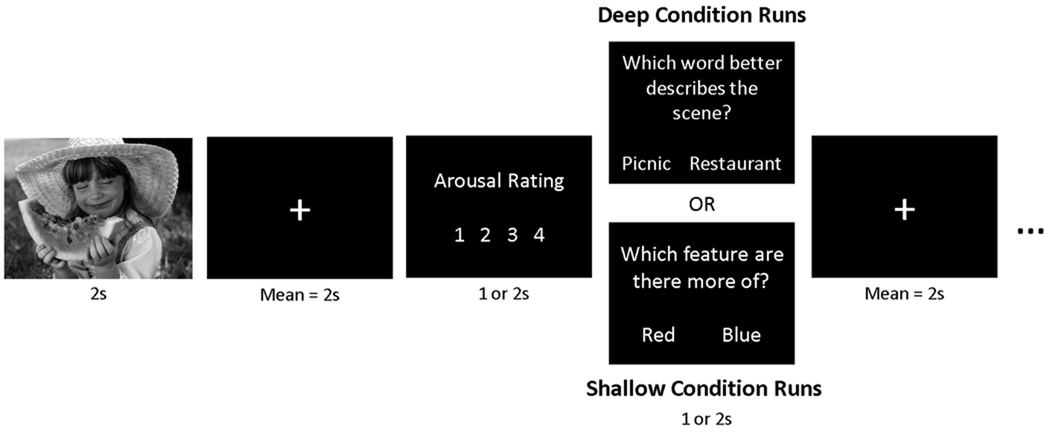
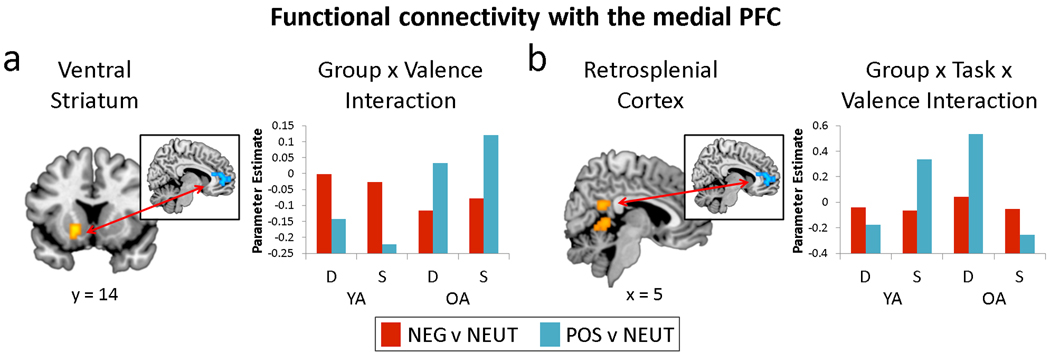
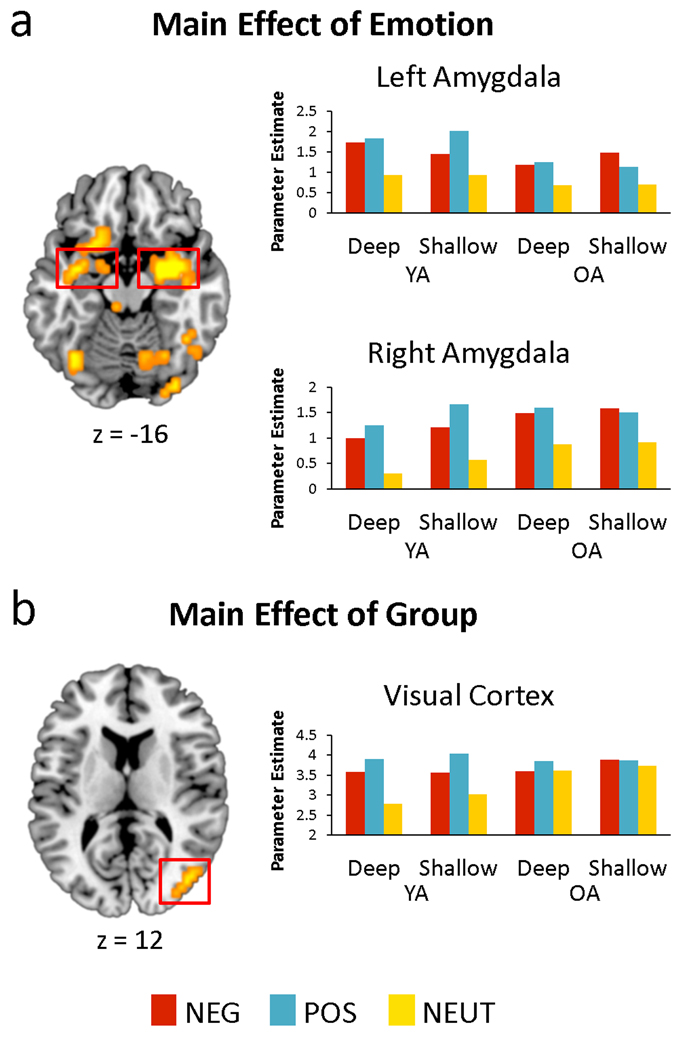
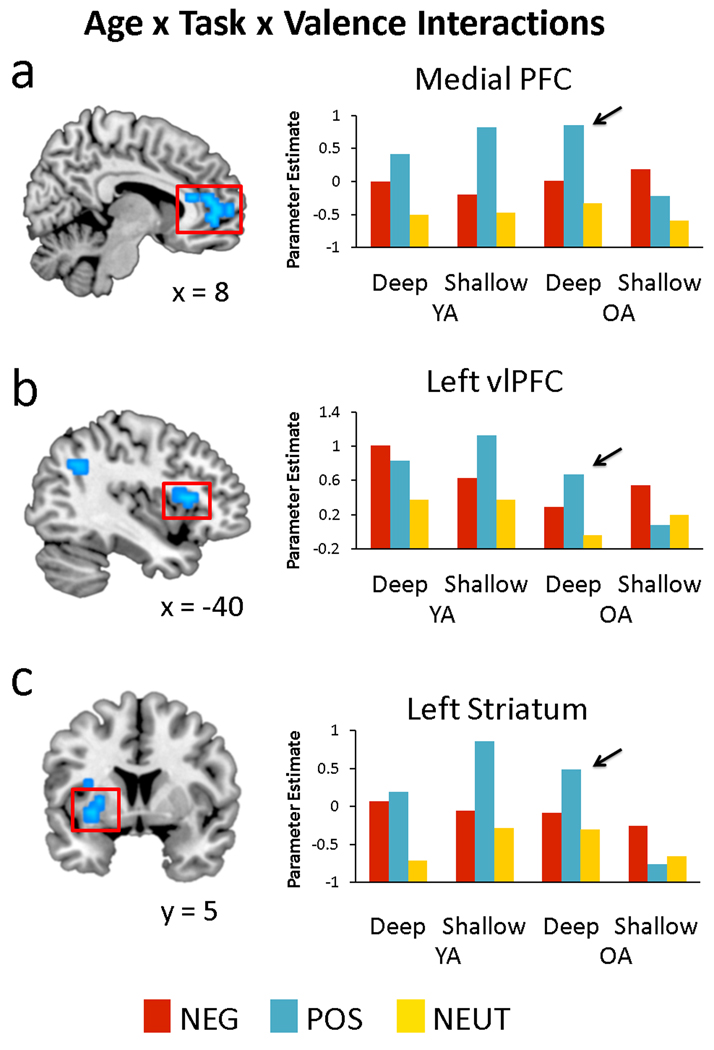
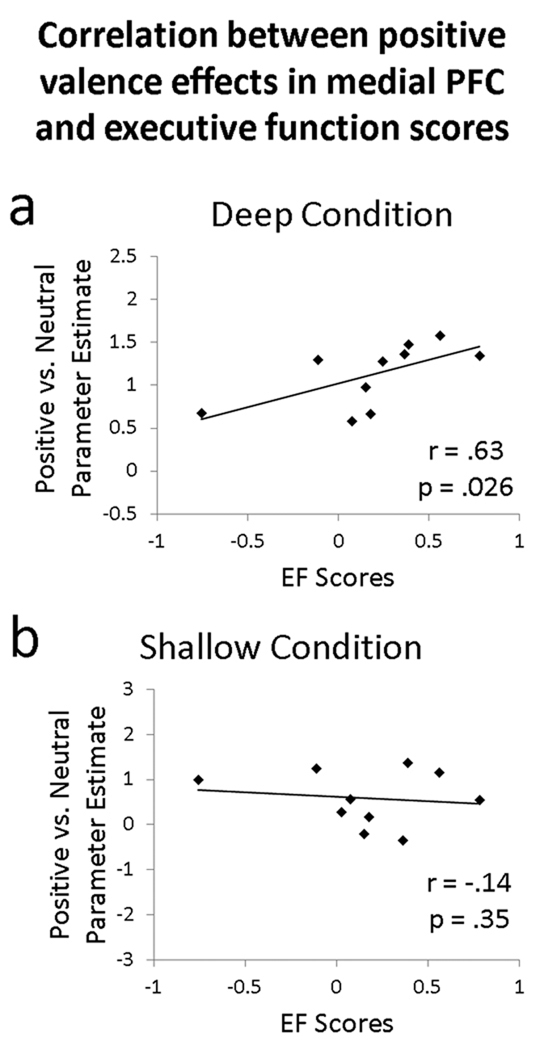
The neural correlates of emotion processing have been shown to vary with age: older adults (OAs) exhibit increased frontal activations and, under some circumstances, decreased amygdala activations relative to young adults (YAs) during emotion processing. Some of these differences are additionally modulated by valence, with age-related biases toward positive versus negative stimuli, and are thought to depend on OAs' capacity for controlled elaboration. However, the role of semantic elaboration in mediating valence effects in the aging brain has not yet been explicitly tested. In the present study, YAs and OAs were scanned while they viewed negative, neutral, and positive pictures during either a deep, elaborative task or a shallow, perceptual task. fMRI results reveal that emotion-related activity in the amygdala is preserved in aging and insensitive to elaboration demands. This study provides novel evidence that differences in valence processing are modulated by elaboration: relative to YAs, OAs show enhanced activity in the medial prefrontal cortex (PFC) and ventrolateral PFC in response to positive versus negative stimuli, but only during elaborative processing. These positive valence effects are predicted by individual differences in executive function in OAs for the deep but not shallow task. Finally, psychophysiological interaction analyses reveal age effects on valence-dependent functional connectivity between medial PFC and ventral striatum, as well as age and task effects on medial PFC-retrosplenial cortex interactions. Altogether, these findings provide support for the hypothesis that valence shifts in the aging brain are mediated by controlled processes such as semantic elaboration, self-referential processing, and emotion regulation.
与年轻人(YAs)相比,老年人(OAs)在情绪处理过程中表现出额叶激活增加,在某些情况下,杏仁核激活减少。这些差异中的一些还受到效价的调节,与年龄相关的对正性与负性刺激的偏见,并且被认为取决于 OAs 进行控制加工的能力。然而,语义加工在调节老化大脑中的效价效应中的作用尚未得到明确测试。在本研究中,当 YAs 和 OAs 观看负性、中性和正性图片时,他们在深度、详尽的任务或浅层、感知的任务中进行扫描。fMRI 结果表明,杏仁核中与情绪相关的活动在衰老过程中得到保留,并且不受加工要求的影响。这项研究提供了新的证据,表明效价处理的差异受加工的调节:与 YAs 相比,OAs 在对正性与负性刺激的反应中表现出内侧前额叶皮层(mPFC)和腹外侧前额叶皮层(vIPFC)的活动增强,但仅在详尽的加工过程中。在深度任务中,但在浅层任务中,OAs 的执行功能的个体差异预测了这些正性效价效应。最后,心理生理相互作用分析揭示了年龄对 mPFC 与腹侧纹状体之间的效价依赖功能连接的影响,以及年龄和任务对 mPFC-后扣带回皮层相互作用的影响。总之,这些发现为以下假设提供了支持,即衰老大脑中的效价变化是由控制过程介导的,例如语义加工、自我参照加工和情绪调节。