Division of Laboratory Sciences, National Center for Environmental Health, Centers for Disease Control and Prevention, Atlanta, Georgia 30341, USA.
Environ Health Perspect. 2011 Jan;119(1):50-5. doi: 10.1289/ehp.1002316. Epub 2010 Sep 22.
High-molecular-weight phthalates, such as diisononyl phthalate (DINP) and diisodecyl phthalate (DIDP), are used primarily as polyvinyl chloride plasticizers.
We assessed exposure to DINP and DIDP in a representative sample of persons ≥ 6 years of age in the U.S. general population from the 2005-2006 National Health and Nutrition Examination Survey (NHANES).
We analyzed 2,548 urine samples by using online solid-phase extraction coupled to isotope dilution high-performance liquid chromatography-tandem mass spectrometry.
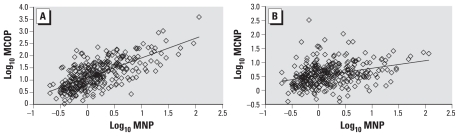
We detected monocarboxyisooctyl phthalate (MCOP), a metabolite of DINP, and monocarboxyisononyl phthalate (MCNP), a metabolite of DIDP, in 95.2% and 89.9% of the samples, respectively. We detected monoisononyl phthalate (MNP), a minor metabolite of DINP, much less frequently (12.9%) and at concentration ranges (> 0.8 µg/L-148.1 µg/L) much lower than MCOP (> 0.7 µg/L- 4,961 µg/L). Adjusted geometric mean concentrations of MCOP and MCNP were significantly higher (p < 0.01) among children than among adolescents and adults.
The general U.S. population, including children, was exposed to DINP and DIDP. In previous NHANES cycles, the occurrence of human exposure to DINP by using MNP as the sole urinary biomarker has been underestimated, thus illustrating the importance of selecting the most adequate biomarkers for exposure assessment.
高分子量邻苯二甲酸酯,如邻苯二甲酸二异壬酯(DINP)和邻苯二甲酸二异癸酯(DIDP),主要用作聚氯乙烯增塑剂。
我们评估了美国普通人群中≥6 岁人群中 DINP 和 DIDP 的暴露情况,该人群来自于 2005-2006 年全国健康和营养调查(NHANES)。
我们通过在线固相萃取结合同位素稀释高效液相色谱-串联质谱法分析了 2548 份尿液样本。
我们分别在 95.2%和 89.9%的样本中检测到了邻苯二甲酸二异壬酯(DINP)的代谢产物单羧基异辛基邻苯二甲酸酯(MCOP)和邻苯二甲酸二异癸酯(DIDP)的代谢产物单羧基异壬基邻苯二甲酸酯(MCNP)。我们较少地检测到 DINP 的次要代谢产物单异壬基邻苯二甲酸酯(MNP)(12.9%),且浓度范围(>0.8µg/L-148.1µg/L)比 MCOP(>0.7µg/L-4961µg/L)低得多。MCOP 和 MCNP 的调整几何均数浓度在儿童中显著高于青少年和成年人(p<0.01)。
包括儿童在内的美国普通人群接触了 DINP 和 DIDP。在之前的 NHANES 周期中,仅使用 MNP 作为唯一尿液生物标志物来评估 DINP 人体暴露情况被低估了,这表明选择最适合暴露评估的生物标志物非常重要。