Department of Molecular Pharmacology, University of Groningen, The Netherlands.
Respir Res. 2010 Sep 28;11(1):130. doi: 10.1186/1465-9921-11-130.
Acetylcholine, the primary parasympathetic neurotransmitter in the airways, plays an important role in bronchoconstriction and mucus production. Recently, it has been shown that acetylcholine, by acting on muscarinic receptors, is also involved in airway inflammation and remodelling. The mechanism(s) by which muscarinic receptors regulate inflammatory responses are, however, still unknown.
The present study was aimed at characterizing the effect of muscarinic receptor stimulation on cytokine secretion by human airway smooth muscle cells (hASMc) and to dissect the intracellular signalling mechanisms involved. hASMc expressing functional muscarinic M2 and M3 receptors were stimulated with the muscarinic receptor agonist methacholine, alone, and in combination with cigarette smoke extract (CSE), TNF-α, PDGF-AB or IL-1β.
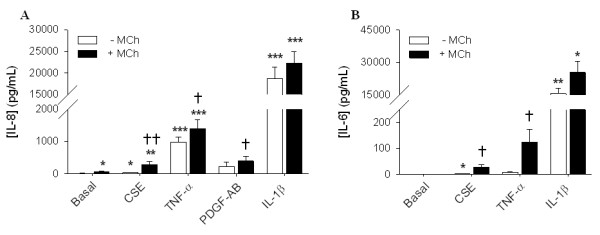
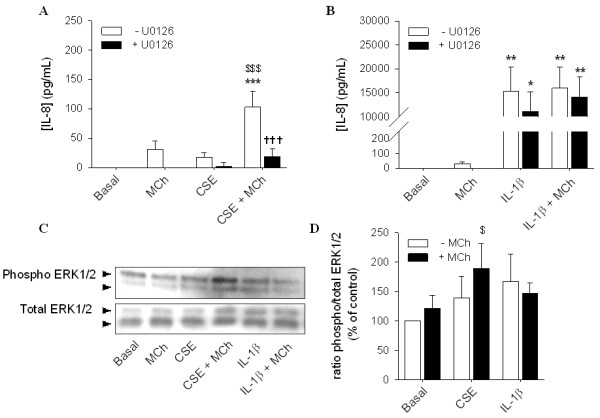
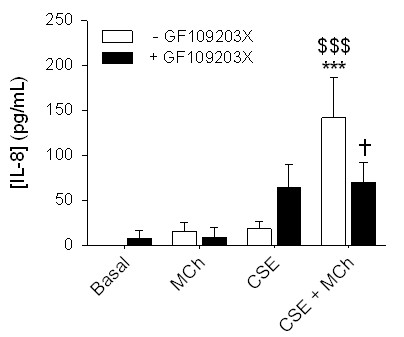
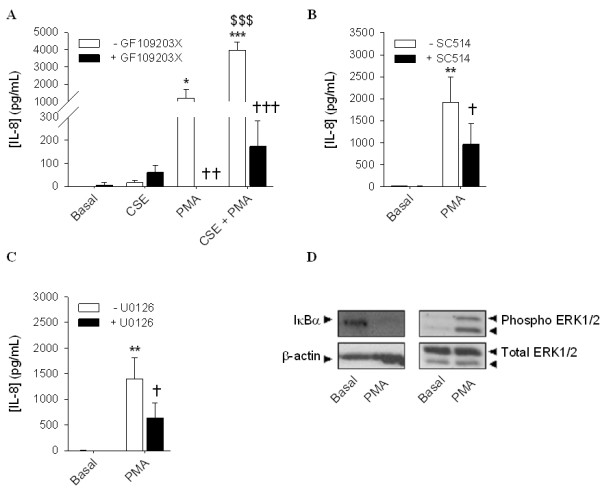
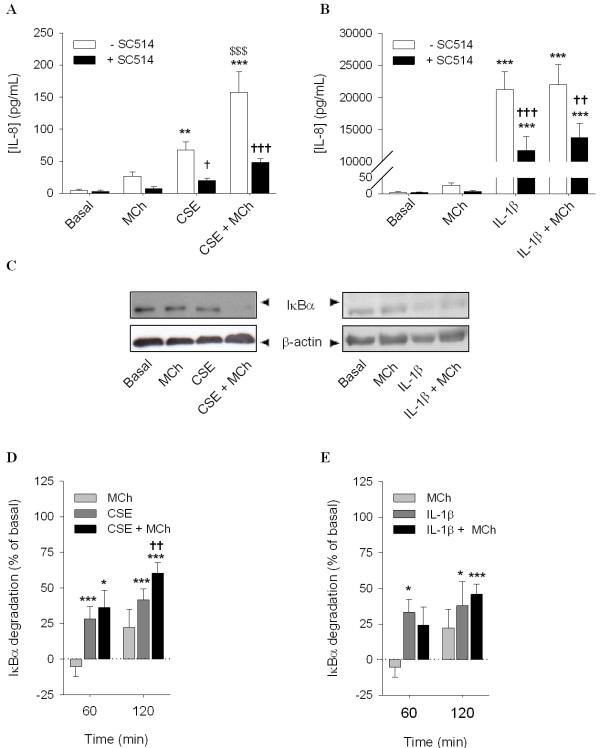
Muscarinic receptor stimulation induced modest IL-8 secretion by itself, yet augmented IL-8 secretion in combination with CSE, TNF-α or PDGF-AB, but not with IL-1β. Pretreatment with GF109203X, a protein kinase C (PKC) inhibitor, completely normalized the effect of methacholine on CSE-induced IL-8 secretion, whereas PMA, a PKC activator, mimicked the effects of methacholine, inducing IL-8 secretion and augmenting the effects of CSE. Similar inhibition was observed using inhibitors of IκB-kinase-2 (SC514) and MEK1/2 (U0126), both downstream effectors of PKC. Accordingly, western blot analysis revealed that methacholine augmented the degradation of IκBα and the phosphorylation of ERK1/2 in combination with CSE, but not with IL-1β in hASMc.
We conclude that muscarinic receptors facilitate CSE-induced IL-8 secretion by hASMc via PKC dependent activation of IκBα and ERK1/2. This mechanism could be of importance for COPD patients using anticholinergics.
乙酰胆碱是气道中的主要副交感神经递质,在支气管收缩和黏液产生中发挥重要作用。最近,研究表明,乙酰胆碱通过作用于毒蕈碱受体,也参与气道炎症和重塑。然而,毒蕈碱受体调节炎症反应的机制尚不清楚。
本研究旨在描述毒蕈碱受体刺激对人气道平滑肌细胞(hASMc)细胞因子分泌的影响,并剖析涉及的细胞内信号转导机制。用毒蕈碱受体激动剂乙酰甲胆碱单独或与香烟烟雾提取物(CSE)、TNF-α、PDGF-AB 或 IL-1β 联合刺激表达功能性毒蕈碱 M2 和 M3 受体的 hASMc。
毒蕈碱受体刺激本身可诱导适度的 IL-8 分泌,但与 CSE、TNF-α 或 PDGF-AB 联合刺激时可增强 IL-8 分泌,但与 IL-1β 联合刺激时则不会。用蛋白激酶 C(PKC)抑制剂 GF109203X 预处理可完全使乙酰甲胆碱对 CSE 诱导的 IL-8 分泌的作用正常化,而 PKC 激活剂 PMA 则模拟了乙酰甲胆碱的作用,诱导 IL-8 分泌并增强 CSE 的作用。用 PKC 的下游效应物 IκB-激酶-2(SC514)和 MEK1/2(U0126)抑制剂观察到类似的抑制作用。相应地,Western blot 分析显示,乙酰甲胆碱与 CSE 联合使用时可增强 IκBα 的降解和 ERK1/2 的磷酸化,但与 IL-1β 联合使用时则不会。
我们的结论是,毒蕈碱受体通过 PKC 依赖性激活 IκBα 和 ERK1/2 促进 CSE 诱导的 hASMc 中 IL-8 的分泌。这种机制对于使用抗胆碱能药物的 COPD 患者可能很重要。