Utrecht University, Utrecht, the Netherlands.
Emerg Infect Dis. 2010 Oct;16(10):1562-8. doi: 10.3201/eid1610.091412.
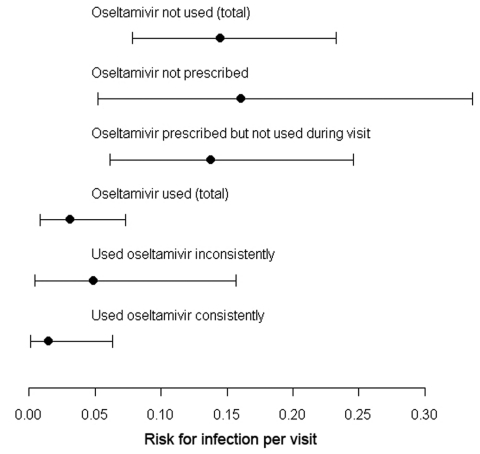
We analyzed the effectiveness of personal protective equipment and oseltamivir use during the 2003 avian influenza A (H7N7) epidemic in the Netherlands by linking databases containing information about farm visits, human infections, and use of oseltamivir and personal protective equipment. Using a stringent case definition, based on self-reported conjunctivitis combined with a positive hemagglutination-inhibition assay, we found that prophylactic treatment with oseltamivir significantly reduced the risk for infection per farm visit from 0.145 (95% confidence interval [CI] 0.078-0.233) to 0.031 (95% CI 0.008-0.073). The protective effect was ≈79% (95% CI 40%-97%). These results are comparable with the reported effect of prophylactic treatment with oseltamivir on human seasonal influenza. No significant protective effect was found for use of respirators or safety glasses, possibly because of limitations of the data.
我们通过将包含有关农场访问、人类感染以及奥司他韦和个人防护设备使用信息的数据库进行链接,分析了 2003 年荷兰甲型 H7N7 禽流感疫情中个人防护设备和奥司他韦使用的效果。使用基于自我报告的结膜炎结合血凝抑制试验阳性的严格病例定义,我们发现奥司他韦预防性治疗可使每一次农场访问的感染风险从 0.145(95%置信区间 0.078-0.233)降低到 0.031(95%置信区间 0.008-0.073)。保护效果约为 79%(95%置信区间 40%-97%)。这些结果与奥司他韦预防性治疗对季节性流感的报告效果相当。对于使用呼吸器或安全眼镜,没有发现明显的保护效果,可能是因为数据存在局限性。