Alvarez Julio, Boklund Anette, Dippel Sabine, Dórea Fernanda, Figuerola Jordi, Herskin Mette S, Michel Virginie, Miranda Chueca Miguel Ángel, Nannoni Eleonora, Nielsen Søren Saxmose, Nonno Romolo, Riber Anja B, Stegeman Jan Arend, Ståhl Karl, Thulke Hans-Hermann, Tuyttens Frank, Winckler Christoph, Brugerolles Claire, Wolff Thorsten, Parys Anna, Lindh Erika, Latorre-Margalef Neus, Rameix Welti Marie-Anne, Dürrwald Ralf, Trebbien Ramona, Van der Werf Sylvie, Gisslén Magnus, Monne Isabella, Fusaro Alice, Guinat Claire, Bortolami Alessio, Alexakis Leonidas, Enkirch Theresa, Svartstrom Olov, Willgert Katriina, Baldinelli Francesca, Preite Ludovica, Grant Malin, Broglia Alessandro, Melidou Angeliki
EFSA Panel on Animal Health and Animal Welfare members.
ECDC external experts.
EFSA J. 2025 Jan 29;23(1):e9191. doi: 10.2903/j.efsa.2025.9191. eCollection 2025 Jan.
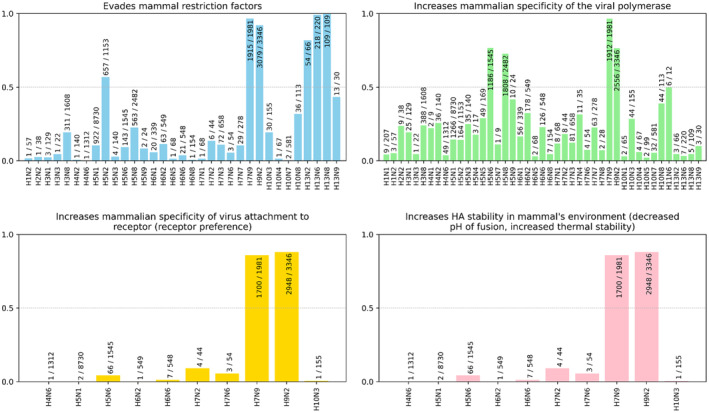
A risk assessment framework was developed to evaluate the zoonotic potential of avian influenza (AI), focusing on virus mutations linked to phenotypic traits related to mammalian adaptation identified in the literature. Virus sequences were screened for the presence of these mutations and their geographical, temporal and subtype-specific trends. Spillover events to mammals (including humans) and human seroprevalence studies were also reviewed. Thirty-four mutations associated with five phenotypic traits (increased receptor specificity, haemagglutinin stability, neuraminidase specificity, enhanced polymerase activity and evasion of innate immunity) were shortlisted. AI viruses (AIVs) carrying multiple adaptive mutations and traits belonged to both low and highly pathogenic subtypes, mainly to A(H9N2), A(H7N9), A(H5N6) and A(H3N8), were sporadic and primarily detected in Asia. In the EU/EEA, H5Nx viruses of clade 2.3.4.4b, which have increased opportunities for evolution due to widespread circulation in birds and occasional cases/outbreaks in mammals, have acquired the highest number of zoonotic traits. Adaptive traits, such as enhanced polymerase activity and immune evasion, were frequently acquired, while receptor-specific mutations remained rare. Globally, human cases remain rare, with the majority overall due to A(H5N1), A(H5N6), A(H7N9) and A(H9N2) that are among the subtypes that tend to have a higher number of adaptive traits. The main drivers of mammalian adaptation include virus and host characteristics, and external factors increasing AIV exposure of mammals and humans to wild and domestic birds (e.g. human activities and ecological factors). Comprehensive surveillance of AIVs targeting adaptive mutations with whole genome sequencing in animals and humans is essential for early detection of zoonotic AIVs and efficient implementation of control measures. All preparedness, preventive and control measures must be implemented under a One Health framework and tailored to the setting and the epidemiological situation; in particular, enhanced monitoring, biosecurity, genomic surveillance and global collaboration are critical for mitigating the zoonotic risks of AIV.
开发了一个风险评估框架,以评估禽流感(AI)的人畜共患病潜力,重点关注与文献中确定的与哺乳动物适应性相关的表型特征相关的病毒突变。筛查病毒序列中这些突变的存在情况及其地理、时间和亚型特异性趋势。还审查了向哺乳动物(包括人类)的溢出事件和人类血清学流行率研究。筛选出与五个表型特征(增加受体特异性、血凝素稳定性、神经氨酸酶特异性、增强聚合酶活性和逃避先天免疫)相关的34个突变。携带多种适应性突变和特征的禽流感病毒(AIV)属于低致病性和高致病性亚型,主要是A(H9N2)、A(H7N9)、A(H5N6)和A(H3N8),呈散发性,主要在亚洲被检测到。在欧盟/欧洲经济区,2.3.4.4b分支的H5Nx病毒由于在鸟类中广泛传播以及在哺乳动物中偶尔出现病例/疫情而有更多的进化机会,获得了最多的人畜共患病特征。适应性特征,如增强的聚合酶活性和免疫逃避,经常出现,而受体特异性突变仍然很少见。在全球范围内,人类病例仍然很少见,总体上大多数是由A(H5N1)、A(H5N6)、A(H7N9)和A(H9N2)引起的,这些亚型往往具有较多的适应性特征。哺乳动物适应的主要驱动因素包括病毒和宿主特征,以及增加AIV使哺乳动物和人类接触野生和家养鸟类的外部因素(如人类活动和生态因素)。对动物和人类进行全基因组测序,针对适应性突变对AIV进行全面监测,对于早期发现人畜共患AIV和有效实施控制措施至关重要。所有防范、预防和控制措施都必须在“同一健康”框架下实施,并根据具体情况和流行病学形势进行调整;特别是,加强监测、生物安全、基因组监测和全球合作对于减轻AIV的人畜共患病风险至关重要。