The Center for Molecular Medicine and Genetics, C.S. Mott Center, Wayne State University of Medicine, 275 East Hancock, Detroit, MI 48201, USA.
Reproduction. 2011 Jan;141(1):21-36. doi: 10.1530/REP-10-0322. Epub 2010 Sep 27.
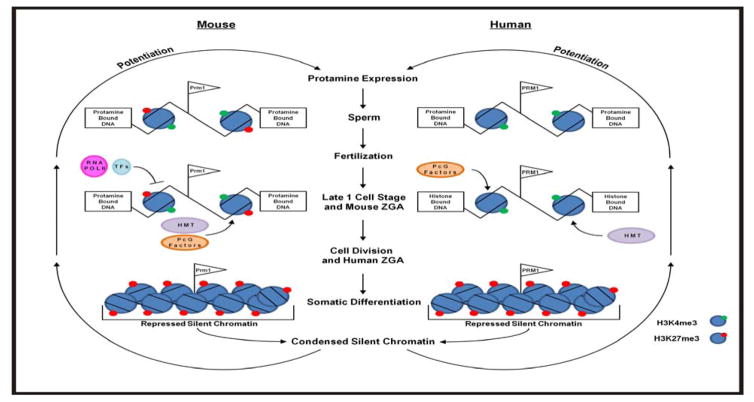
Within the sperm nucleus, the paternal genome remains functionally inert and protected following protamination. This is marked by a structural morphogenesis that is heralded by a striking reduction in nuclear volume. Despite these changes, both human and mouse spermatozoa maintain low levels of nucleosomes that appear non-randomly distributed throughout the genome. These regions may be necessary for organizing higher order genomic structure through interactions with the nuclear matrix. The promoters of this transcriptionally quiescent genome are differentially marked by modified histones that may poise downstream epigenetic effects. This notion is supported by increasing evidence that the embryo inherits these differing levels of chromatin organization. In concert with the suite of RNAs retained in the mature sperm, they may synergistically interact to direct early embryonic gene expression. Irrespective, these features reflect the transcriptional history of spermatogenic differentiation. As such, they may soon be utilized as clinical markers of male fertility. In this review, we explore and discuss how this may be orchestrated.
在精子核内,组蛋白化后父系基因组保持功能惰性并受到保护。这一过程伴随着结构形态发生,表现为核体积显著减小。尽管发生了这些变化,人和小鼠的精子仍维持着低水平的核小体,这些核小体似乎在基因组中呈非随机分布。这些区域可能通过与核基质的相互作用对于组织更高阶的基因组结构是必需的。转录沉默基因组的启动子通过修饰的组蛋白进行差异标记,这些组蛋白可能为下游的表观遗传效应做好准备。越来越多的证据支持这一观点,即胚胎继承了这些不同水平的染色质组织。与成熟精子中保留的一套 RNA 一起,它们可能协同相互作用以指导早期胚胎基因表达。无论如何,这些特征反映了精子发生分化的转录历史。因此,它们可能很快被用作男性生育力的临床标志物。在这篇综述中,我们探讨并讨论了这种情况是如何发生的。