Monell Chemical Senses Center, 3500 Market Street, Philadelphia, PA 19104-3308, USA.
Chem Senses. 2011 Jan;36(1):9-17. doi: 10.1093/chemse/bjq081. Epub 2010 Sep 27.
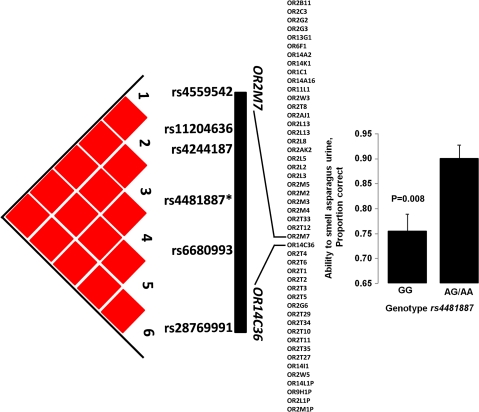
The urine of people who have recently eaten asparagus has a sulfurous odor, which is distinct and similar to cooked cabbage. Using a 2-alternative forced-choice procedure, we examined individual differences in both the production of the odorants and the perception of this asparagus odor in urine. We conclude that individual differences exist in both odorant production and odor perception. The biological basis for the inability to produce the metabolite in detectable quantities is unknown, but the inability to smell the odor is associated with a single nucleotide polymorphism (rs4481887) within a 50-gene cluster of olfactory receptors.
刚吃过芦笋的人尿液有一种硫磺气味,这种气味很明显,类似于煮过的卷心菜。我们采用二选一的强制选择程序,研究了个体在尿液中产生这些气味物质和感知这种芦笋气味方面的差异。我们得出的结论是,在气味物质的产生和感知方面都存在个体差异。无法产生可检测数量代谢物的生物学基础尚不清楚,但无法闻到这种气味与嗅觉受体 50 个基因簇内的一个单核苷酸多态性(rs4481887)有关。