Oubel Estanislao, Koob Meriam, Studholme Colin, Dietemann Jean-Louis, Rousseau François
LSIIT, UMR 7005, CNRS-Université de Strasbourg, France.
Med Image Comput Comput Assist Interv. 2010;13(Pt 1):574-81. doi: 10.1007/978-3-642-15705-9_70.
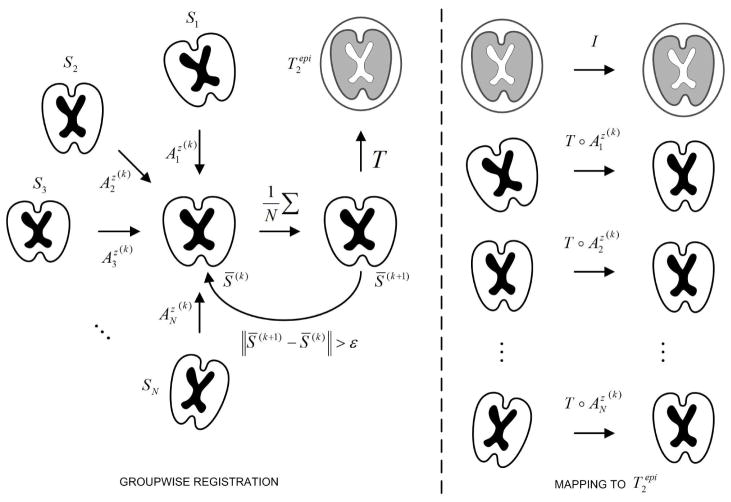
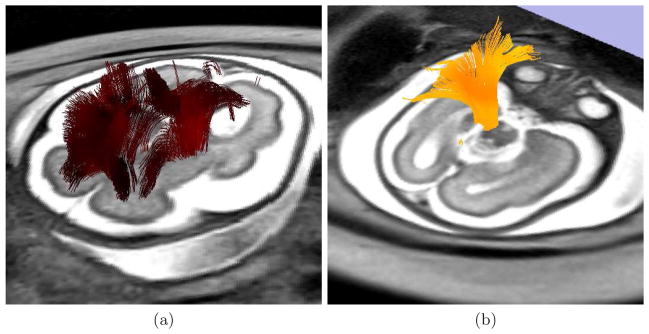
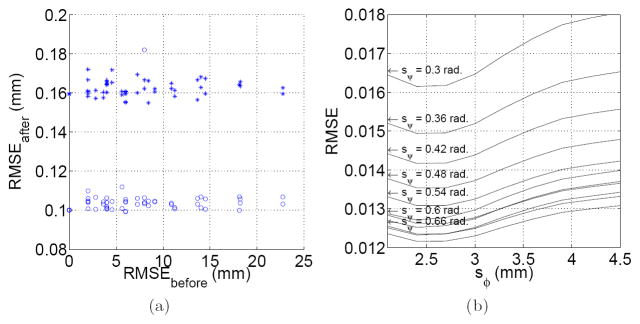
In this paper we present a method for reconstructing D-MRI data on regular grids from sparse data without assuming specific diffusion models. This is particularly important when studying the fetal brain in utero, since registration methods applied for movement and distortion correction produce scattered data in spatial and angular (gradient) domains. We propose the use of a groupwise registration method, and a dual spatio-angular interpolation by using radial basis functions (RBF). Experiments performed on adult data showed a high accuracy of the method when estimating diffusion images in unavailable directions. The application to fetal data showed an improvement in the quality of the sequences according to criteria based on fractional anisotropy (FA) maps, and differences in the tractography results.
在本文中,我们提出了一种从稀疏数据重建规则网格上的扩散磁共振成像(D-MRI)数据的方法,且无需假设特定的扩散模型。这在研究子宫内胎儿大脑时尤为重要,因为用于运动和畸变校正的配准方法会在空间和角度(梯度)域中产生分散的数据。我们建议使用分组配准方法,并通过使用径向基函数(RBF)进行双空间角度插值。对成人数据进行的实验表明,该方法在估计不可用方向上的扩散图像时具有很高的准确性。将该方法应用于胎儿数据时,根据基于分数各向异性(FA)图的标准以及纤维束成像结果的差异,序列质量得到了改善。