Department of Medical Entomology and Zoology, National Institute of Virology, 20-A, Dr. Ambedkar Road, Pune 411001, India.
J Insect Sci. 2010;10:138. doi: 10.1673/031.010.13801.
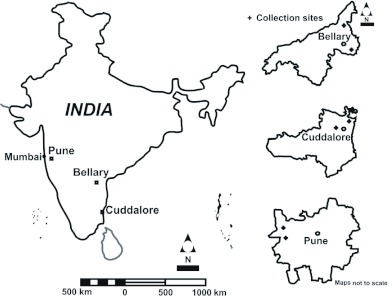
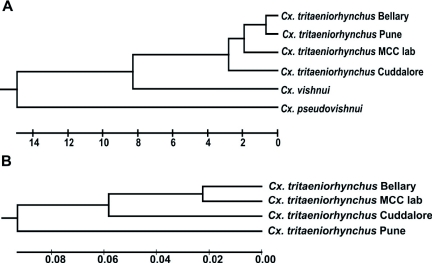
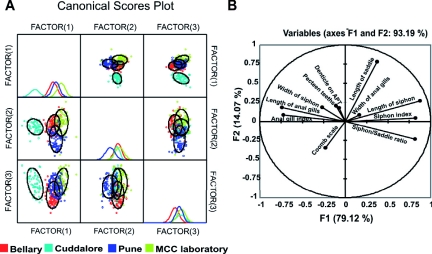
Four populations of Culex tritaeniorhynchus (Giles) (Diptera: Culicidae), collected from Bellary, Cuddalore, Pune, and the Microbial Containment Complex laboratory culture in India were analyzed for morphological and allozyme variation. Multivariate analysis based on eight morphological characteristics and three morphometric indices was used to investigate the morphological variations among the four populations. Principal component analysis of the data suggested that siphon, saddle, and anal gills related variables were most important. Discriminant factor analysis of morphological data revealed that the four populations form significantly different clusters which can be differentiated from each other based on siphon, saddle, and pectin teeth related variables. Allozyme electrophoresis of the four populations revealed that the mean heterozygosity per locus value had high variation, ranging from 0.0879 to 1.794. Fst values between 0 and 0.519 suggested genetic differentiation within these populations. Fis values ranged from 0 to 1 with most of the values closer to 1. The allelic frequencies and Nei's genetic identity values showed that genetic differences between populations were small, but significant. Some of the morphological and allozyme variations in the Cx. tritaeniorhynchus populations could be partly attributed to the environmental conditions. The findings suggested that transition of morphological characters and allozyme variations in Cx. tritaeniorhynchus populations seem to be consequences of influence and selection by the environmental conditions. These results indicated that populations of Cx. tritaeniorhynchus in non-endemic areas of Japanese encephalitis (JE) virus infection have higher adaptability as compared to endemic areas of JE infection.
从印度的 Bellary、Cuddalore、Pune 和微生物 containment complex 实验室培养的四个库蚊属三带喙库蚊种群中采集了样本,对其进行形态和同工酶变异分析。基于 8 个形态特征和 3 个形态计量指数的多元分析用于研究四个种群之间的形态变化。数据分析的主成分分析表明,虹吸管、鞍座和尾鳃相关变量是最重要的。形态数据的判别因子分析表明,四个种群形成明显不同的聚类,可以根据虹吸管、鞍座和盾片齿相关变量来区分。四个种群的同工酶电泳显示,每个位点的平均杂合度值变化很大,范围从 0.0879 到 1.794。0 到 0.519 之间的 Fst 值表明这些种群内部存在遗传分化。Fis 值范围从 0 到 1,大多数值更接近 1。等位基因频率和 Nei 的遗传同一性值表明种群之间的遗传差异很小,但很显著。库蚊种群的一些形态和同工酶变异部分归因于环境条件。研究结果表明,库蚊种群形态特征和同工酶变异的转变似乎是环境条件影响和选择的结果。这些结果表明,与日本脑炎(JE)病毒感染的非流行地区相比,非流行地区的三带喙库蚊种群具有更高的适应性。