
根据发育阶段评估胎盘间充质干细胞的干性:与成人骨髓间充质干细胞的比较。
Stemness evaluation of mesenchymal stem cells from placentas according to developmental stage: comparison to those from adult bone marrow.
机构信息
Institute of Stem Cell Research, Korea University, Seoul, Korea.
出版信息
J Korean Med Sci. 2010 Oct;25(10):1418-26. doi: 10.3346/jkms.2010.25.10.1418. Epub 2010 Sep 17.
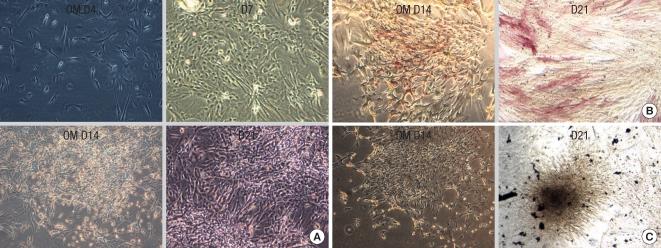
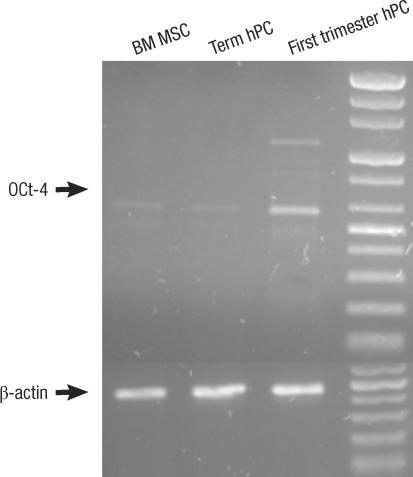
This study was done to evaluate the stemness of human mesenchymal stem cells (hMSCs) derived from placenta according to the development stage and to compare the results to those from adult bone marrow (BM). Based on the source of hMSCs, three groups were defined: group I included term placentas, group II included first-trimester placentas, and group III included adult BM samples. The stemness was evaluated by the proliferation capacity, immunophenotypic expression, mesoderm differentiation, expression of pluripotency markers including telomerase activity. The cumulative population doubling, indicating the proliferation capacity, was significantly higher in group II (P<0.001, 31.7±5.8 vs. 15.7±6.2 with group I, 9.2±4.9 with group III). The pattern of immunophenotypic expression and mesoderm differentiation into adipocytes and osteocytes were similar in all three groups. The expression of pluripotency markers including ALP, SSEA-4, TRA-1-60, TRA-1-81, Oct-4, and telomerase were strongly positive in group II, but very faint positive in the other groups. In conclusions, hMSCs from placentas have different characteristics according to their developmental stage and express mesenchymal stemness potentials similar to those from adult human BMs.
本研究旨在根据发育阶段评估源自胎盘的人间质干细胞(hMSC)的干性,并将结果与源自成人骨髓(BM)的结果进行比较。基于 hMSC 的来源,将其分为三组:I 组包括足月胎盘,II 组包括早孕期胎盘,III 组包括成人 BM 样本。通过增殖能力、免疫表型表达、中胚层分化、端粒酶活性等多能性标志物的表达来评估干性。增殖能力的累积群体倍增(indicating the proliferation capacity)在 II 组中显著更高(P<0.001,31.7±5.8 与 I 组相比,9.2±4.9 与 III 组相比)。三组中免疫表型表达和向成脂细胞和成骨细胞分化的模式相似。多能性标志物的表达,包括碱性磷酸酶(ALP)、SSEA-4、TRA-1-60、TRA-1-81、Oct-4 和端粒酶,在 II 组中呈强阳性,但在其他组中呈弱阳性。总之,源自胎盘的 hMSC 根据其发育阶段具有不同的特征,并表达类似于成人 BM 的间充质干性潜能。




 Zotero 插件