Children's Hospital Oakland Research Institute, 5700 Martin Luther King Jr. Way, Oakland, California, 94609-1673, USA.
Adv Exp Med Biol. 2010;688:185-205. doi: 10.1007/978-1-4419-6741-1_13.
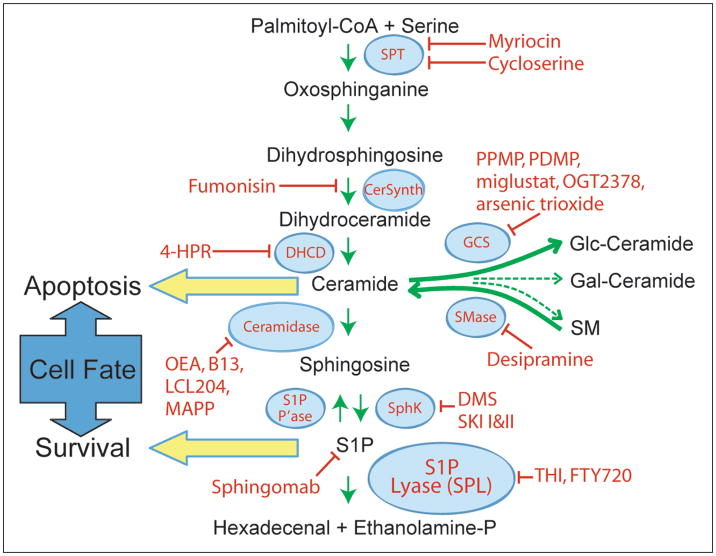
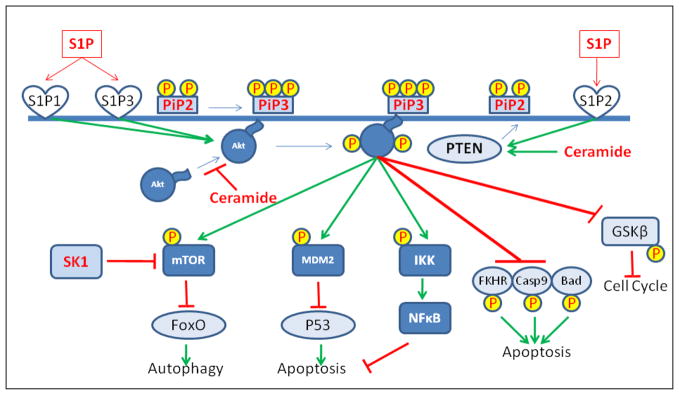
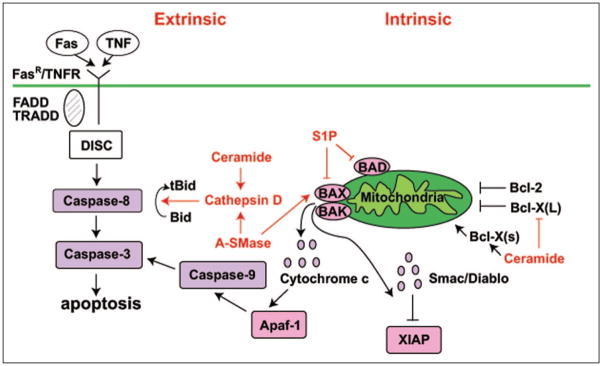
Ceramide and sphingosine-1-phosphate are related sphingolipid metabolites that can be generated through a de novo biosynthetic route or derived from the recycling of membrane sphingomyelin. Both these lipids regulate cellular responses to stress, with generally opposing effects. Sphingosine-1-phosphate functions as a growth and survival factor, acting as a ligand for a family of G protein-coupled receptors, whereas ceramide activates intrinsic and extrinsic apoptotic pathways through receptor-independent mechanisms. A growing body of evidence has implicated ceramide, sphingosine-1-phosphate and the genes involved in their synthesis, catabolism and signaling in various aspects of oncogenesis, cancer progression and drug- and radiation resistance. This may be explained in part by the finding that both lipids impinge upon the PI3K/ AKT pathway, which represses apoptosis and autophagy. In addition, sphingolipids influence cell cycle progression, telomerase function, cell migration and stem cell biology. Considering the central role of ceramide in mediating physiological as well as pharmacologically stimulated apoptosis, ceramide can be considered a tumor-suppressor lipid. In contrast, sphingosine-1-phosphate can be considered a tumor-promoting lipid, and the enzyme responsible for its synthesis functions as an oncogene. Not surprisingly, genetic mutations that result in reduced ceramide generation, increased sphingosine-1-phosphate synthesis or which reduce steady state ceramide levels and increase sphingosine-1-phosphate levels have been identified as mechanisms of tumor progression and drug resistance in cancer cells. Pharmacological tools for modulating sphingolipid pathways are being developed and represent novel therapeutic strategies for the treatment of cancer.
神经酰胺和 1-磷酸鞘氨醇是相关的鞘脂代谢物,可以通过从头生物合成途径生成,也可以从膜鞘磷脂的再循环中衍生而来。这两种脂质都调节细胞对压力的反应,通常具有相反的作用。1-磷酸鞘氨醇作为生长和存活因子发挥作用,作为一组 G 蛋白偶联受体的配体,而神经酰胺通过受体非依赖性机制激活内在和外在的凋亡途径。越来越多的证据表明,神经酰胺、1-磷酸鞘氨醇以及参与其合成、分解代谢和信号转导的基因,参与了肿瘤发生、癌症进展以及药物和辐射耐药性的各个方面。这部分可以通过发现这两种脂质都影响 PI3K/AKT 途径来解释,该途径抑制细胞凋亡和自噬。此外,鞘脂还影响细胞周期进程、端粒酶功能、细胞迁移和干细胞生物学。鉴于神经酰胺在介导生理和药理学刺激的凋亡中起着核心作用,神经酰胺可以被认为是一种肿瘤抑制脂质。相比之下,1-磷酸鞘氨醇可以被认为是一种促进肿瘤的脂质,其合成酶作为一种癌基因发挥作用。毫不奇怪,导致神经酰胺生成减少、1-磷酸鞘氨醇合成增加或降低稳态神经酰胺水平并增加 1-磷酸鞘氨醇水平的遗传突变已被确定为癌细胞肿瘤进展和耐药的机制。用于调节鞘脂途径的药理学工具正在开发中,代表了癌症治疗的新的治疗策略。