Pardeshi Geeta S
Department of Preventive and Social Medicine, Dr. Shankarrao Chavan Government Medical College, Nanded, Maharashtra, India.
J Glob Infect Dis. 2010 Sep;2(3):226-30. doi: 10.4103/0974-777X.68533.
Default remains an important challenge for the Revised National Tuberculosis Control Programme, which has achieved improved cure rates.
This study describes the pattern of time of default in patients on DOTS.
Tuberculosis Unit in District Tuberculosis Centre, Yavatmal, India; Retrospective cohort study.
This analysis was done among the cohort of patients of registered at the Tuberculosis Unit during the year 2004. The time of default was assessed from the tuberculosis register. The sputum smear conversion and treatment outcome were also assessed.
Kaplan-Meier plots and log rank tests.
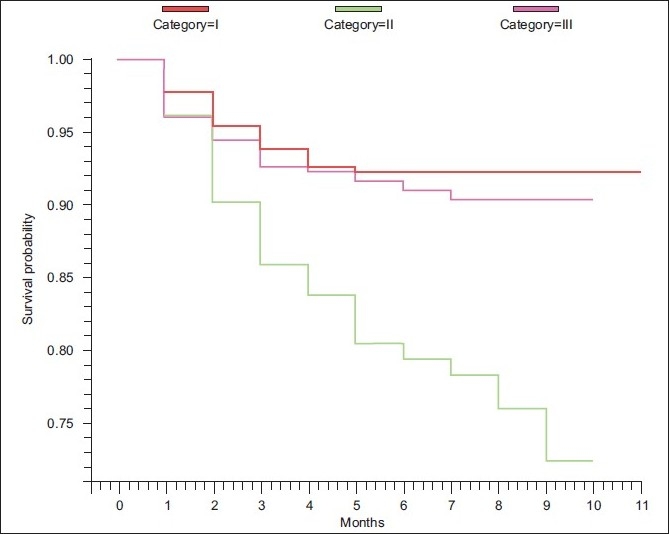
Overall, the default rate amongst the 716 patients registered at the Tuberculosis Unit was 10.33%. There was a significant difference in the default rate over time between the three DOTS categories (log rank statistic= 15.49, P=0.0004). Amongst the 331 smear-positive patients, the cumulative default rates at the end of intensive phase were 4% and 16%; while by end of treatment period, the default rates were 6% and 31% in category I and category II, respectively. A majority of the smear-positive patients in category II belonged to the group 'treatment after default' (56/95), and 30% of them defaulted during re-treatment. The sputum smear conversion rate at the end of intensive phase was 84%. Amongst 36 patients without smear conversion at the end of intensive phase, 55% had treatment failure.
Patients defaulting in intensive phase of treatment and without smear conversion at the end of intensive phase should be retrieved on a priority basis. Default constitutes not only a major reason for patients needing re-treatment but also a risk for repeated default.
对于已提高治愈率的修订后的国家结核病控制规划而言,失访仍然是一项重大挑战。
本研究描述了直接观察下的短程化疗(DOTS)患者的失访时间模式。
印度亚瓦特马尔区结核病中心结核病科;回顾性队列研究。
本分析针对2004年在结核病科登记的患者队列进行。从结核病登记册中评估失访时间。还评估了痰涂片转阴情况和治疗结果。
Kaplan-Meier曲线和对数秩检验。
总体而言,在结核病科登记的716例患者中,失访率为10.33%。三种DOTS类别之间的失访率随时间有显著差异(对数秩统计量=15.49,P=0.0004)。在331例涂片阳性患者中,强化期末的累积失访率分别为4%和16%;而到治疗期末,I类和II类的失访率分别为6%和31%。II类中的大多数涂片阳性患者属于“失访后治疗”组(56/95),其中30%在再治疗期间失访。强化期末的痰涂片转阴率为84%。在强化期末痰涂片未转阴的36例患者中,55%治疗失败。
应优先找回在治疗强化期失访且强化期末痰涂片未转阴的患者。失访不仅是患者需要再治疗的主要原因,也是再次失访的风险因素。