Instituto Gulbenkian de Ciência, Oeiras, Portugal.
PLoS One. 2010 Sep 28;5(9):e13037. doi: 10.1371/journal.pone.0013037.
Microtubule-targeting drugs induce mitotic delay at pro-metaphase by preventing the spindle assembly checkpoint to be satisfied. However, especially after prolonged treatments, cells can escape this arrest in a process called mitotic slippage. The mechanisms underlying the spindle assembly checkpoint and slippage are not fully understood. It has been generally accepted that during mitosis there is a temporary shutdown of high-energy-consuming processes, such as transcription and translation. However, the synthesis of specific proteins is maintained or up-regulated since protein synthesis is necessary for entry into and progression through mitosis.
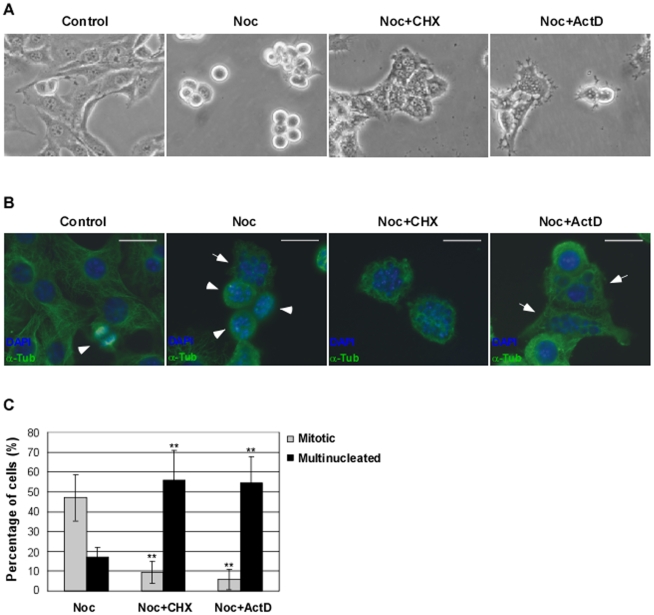
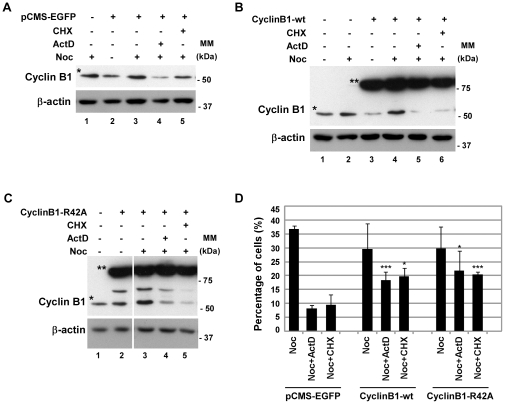
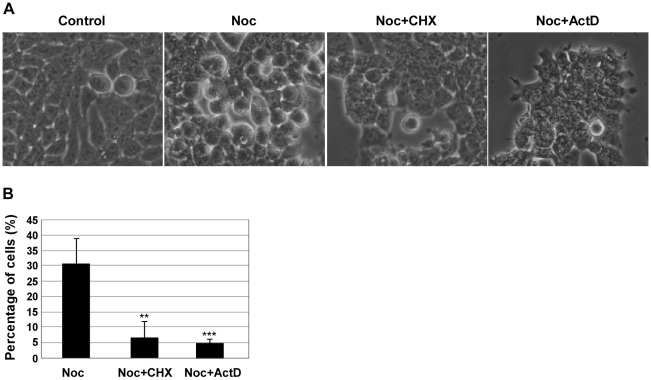
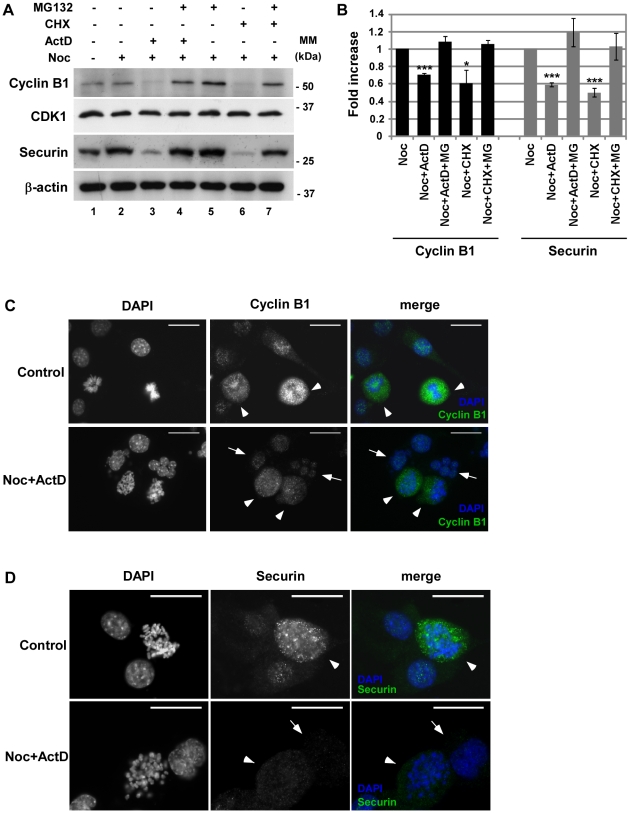
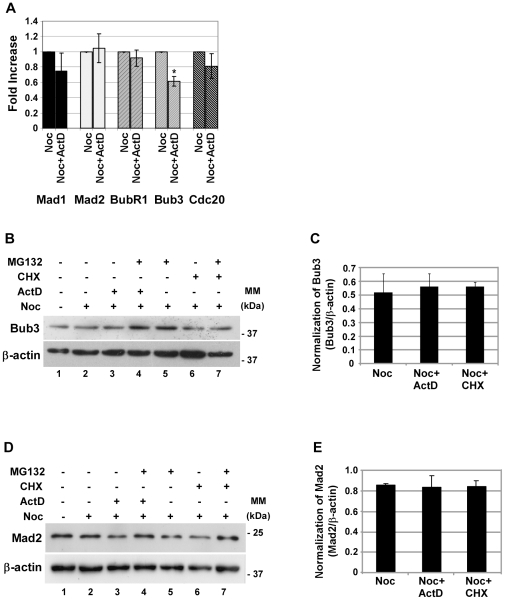
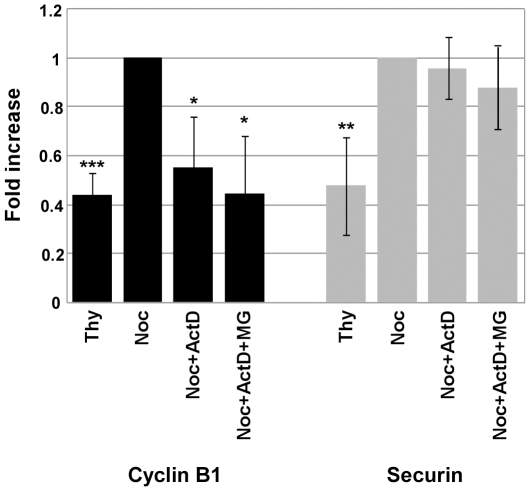
METHODOLOGY/PRINCIPAL FINDINGS: In this work we investigated whether the mitotic arrest caused by the mitotic checkpoint is independent of transcription and translation. By using immunofluorescent microscopy and western blotting, we demonstrate that inhibition of either of these processes induces a shortening of the mitotic arrest caused by the nocodazole treatment, and ultimately leads to mitotic slippage. Our western blotting and RTQ-PCR results show that inhibition of transcription during mitotic arrest does not affect the expression of the spindle checkpoint proteins, whereas it induces a significant decrease in the mRNA and protein levels of Cyclin B1. The exogenous expression of Cyclin B1 substantially rescued the mitotic phenotype in nocodazole cells treated with the inhibitors of transcription and translation.
CONCLUSIONS/SIGNIFICANCE: This work emphasizes the importance of transcription and translation for the maintenance of the spindle assembly checkpoint, suggesting the existence of a mechanism dependent on cyclin B1 gene regulation during mitosis. We propose that continuous transcription of mitotic regulators is required to sustain the activation of the spindle assembly checkpoint.
微管靶向药物通过阻止纺锤体装配检查点的满足来在前期延迟有丝分裂。然而,特别是在长时间治疗后,细胞可以在称为有丝分裂滑溜的过程中逃脱这种阻滞。纺锤体装配检查点和滑溜的机制尚未完全理解。人们普遍认为,在有丝分裂期间,会暂时关闭高能耗过程,如转录和翻译。然而,由于蛋白质合成对于进入和通过有丝分裂是必需的,因此特定蛋白质的合成仍得以维持或上调。
方法/主要发现:在这项工作中,我们研究了有丝分裂检查点引起的有丝分裂阻滞是否独立于转录和翻译。通过使用免疫荧光显微镜和 Western blot,我们证明抑制这些过程中的任何一个都会导致由诺考达唑处理引起的有丝分裂阻滞缩短,并最终导致有丝分裂滑溜。我们的 Western blot 和 RTQ-PCR 结果表明,在有丝分裂阻滞期间抑制转录不会影响纺锤体检查点蛋白的表达,而会导致细胞周期蛋白 B1 的 mRNA 和蛋白水平显著下降。在转录和翻译抑制剂处理的诺考达唑细胞中,外源性表达细胞周期蛋白 B1 可显著挽救有丝分裂表型。
结论/意义:这项工作强调了转录和翻译对于维持纺锤体装配检查点的重要性,表明存在一种依赖于细胞周期蛋白 B1 基因调控的机制。我们提出,有丝分裂调节剂的连续转录对于维持纺锤体装配检查点的激活是必需的。