Institute of Physiology, Justus Liebig University Giessen, Germany.
Diabetes. 2011 Jan;60(1):157-67. doi: 10.2337/db10-0331. Epub 2010 Oct 7.
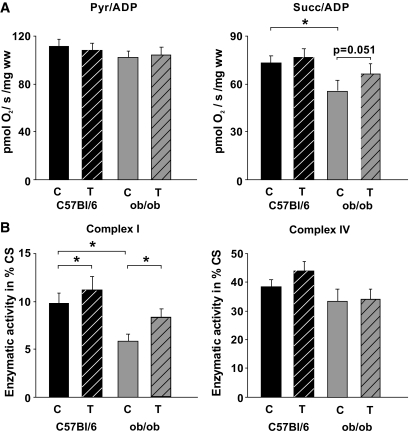
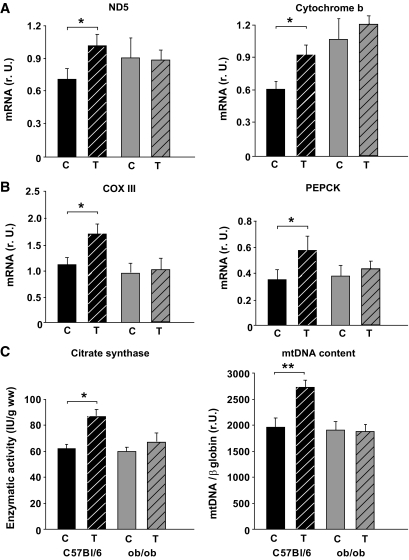
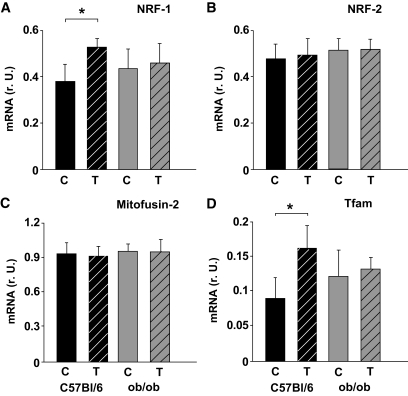
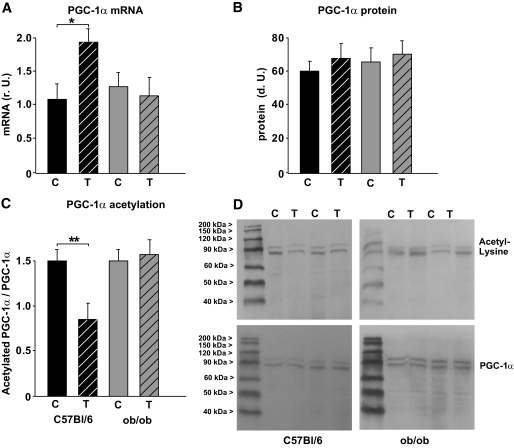
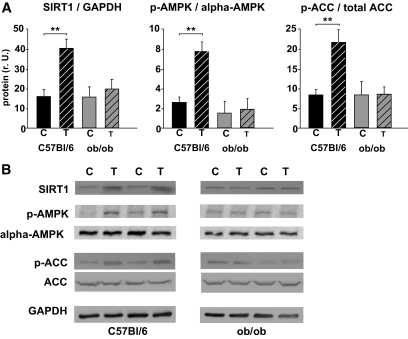
OBJECTIVE Transcriptional peroxisome proliferator-activated receptor-γ coactivator-1α (PGC-1α) plays a key role in mitochondrial biogenesis and energy metabolism and is suggested to be involved in the exercise-induced increase in mitochondrial content. PGC-1α activity is regulated by posttranslational modifications, among them acetylation or phosphorylation. Accordingly, the deacetylase SIRT1 and the kinase AMPK increase PGC-1α activity. RESEARCH DESIGN AND METHODS We tested whether chronic treadmill exercise or a single exercise session modifies PGC-1α activation and mitochondrial biogenesis differentially in obese ob/ob mice with dysregulated adiponectin/leptin-mediated AMPK activation compared with C57BL/6J wild-type mice. RESULTS Exercise training (12 weeks) induced adiponectin and lowered plasma insulin and glucose, suggesting improved insulin sensitivity in wild-type mice. It enhanced mitochondrial biogenesis in red gastrocnemius muscle, as indicated by increased mRNA expression of transcriptional regulators and primary mitochondrial transcripts, increased mtDNA content, and citrate synthase activity. Parallel to this, we observed AMPK activation, PGC-1α deacetylation, and SIRT1 induction in trained wild-type mice. Although none of these exercise-induced changes were detected in ob/ob mice, comparable effects on mitochondrial respiration were observed. A single exercise session resulted in comparable changes in wild-type mice. These changes remained detectable 6 h after the exercise session but had disappeared after 24 h. Treatment of C2C12 myoblasts with leptin or adiponectin resulted in increased AMPK phosphorylation and PGC-1α deacetylation. CONCLUSIONS Chronic exercise induces mitochondrial biogenesis in wild-type mice, which may require intact AMPK activation by adipocytokines and involve SIRT1-dependent PGC-1α deacetylation. Trained ob/ob mice appear to have partially adapted to reduced mitochondrial biogenesis by AMPK/SIRT1/PGC-1α-independent mechanisms without mtDNA replication.
转录过氧化物酶体增殖物激活受体-γ共激活因子-1α(PGC-1α)在线粒体生物发生和能量代谢中发挥关键作用,并被认为参与了运动引起的线粒体含量增加。PGC-1α 的活性受翻译后修饰的调节,其中包括乙酰化或磷酸化。相应地,去乙酰化酶 SIRT1 和激酶 AMPK 增加 PGC-1α 的活性。
我们测试了慢性跑步机运动或单次运动是否会以不同的方式调节肥胖 ob/ob 小鼠中 PGC-1α 的激活和线粒体生物发生,与 C57BL/6J 野生型小鼠相比,肥胖 ob/ob 小鼠的脂联素/瘦素介导的 AMPK 激活失调。
运动训练(12 周)诱导了脂联素的产生,降低了血浆胰岛素和血糖,表明野生型小鼠的胰岛素敏感性得到了改善。它增强了红比目鱼肌中的线粒体生物发生,表现为转录调节因子和主要线粒体转录物的 mRNA 表达增加、mtDNA 含量增加和柠檬酸合酶活性增加。与此平行,我们观察到训练后的野生型小鼠 AMPK 的激活、PGC-1α 的去乙酰化和 SIRT1 的诱导。尽管在 ob/ob 小鼠中没有检测到这些运动引起的变化,但观察到了类似的线粒体呼吸变化。单次运动在野生型小鼠中也产生了类似的变化。这些变化在运动后 6 小时仍然可以检测到,但在 24 小时后已经消失。用瘦素或脂联素处理 C2C12 成肌细胞导致 AMPK 磷酸化和 PGC-1α 去乙酰化增加。
慢性运动诱导野生型小鼠的线粒体生物发生,这可能需要完整的脂联素/瘦素激活的 AMPK 和涉及 SIRT1 依赖性 PGC-1α 去乙酰化。经过训练的 ob/ob 小鼠似乎已经通过 AMPK/SIRT1/PGC-1α 非依赖性机制部分适应了线粒体生物发生的减少,而没有 mtDNA 复制。