The Department of Community and Family Medicine, Dartmouth Medical School, Hanover, NH, USA.
Osteoporos Int. 2011 Jun;22(6):1855-62. doi: 10.1007/s00198-010-1423-y. Epub 2010 Oct 9.
To advance our understanding of the burden of fractures among men, we studied a group of men at high risk for low bone strength due to lung disease. We found high rates of fractures but low rates of bone density testing that could predict fracture before it occurs.
To advance understanding of the burden of fragility fractures and attention to bone health among men with chronic obstructive lung disease (COPD), we quantified rates of fragility fracture, bone density testing, and anti-resorptive treatment and calculated the number needed to screen (NNS) to prevent one hip fracture in a cohort of men with COPD.
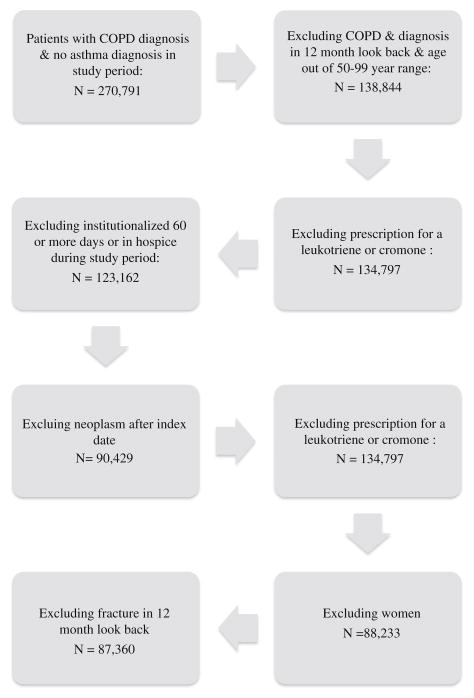
Veterans Administration (VA) and VA-Medicare administrative data permitted a retrospective cohort study of 87,360 men aged 50 and older, newly diagnosed with COPD between 1999 and 2003. Logistic regression models including patient characteristics, morbidities, and medication use assessed the effect of covariates on fracture and probability of testing or treatment.
Mean age was 66.8. Hip and wrist fracture rates were 3.99 and 1.31 per 1,000 person years, respectively. Mean follow-up was 2.67 years; 4.4% underwent bone densitometry; 2.8% filled anti-resorptive prescriptions. Age, white race/ethnicity, more COPD exacerbations, barbiturate use, and anti-Parkinson's drug use were significantly associated with fracture. Age, and systemic corticosteroids were most significantly associated with testing or treatment. Based on published adherence and treatment effects, the cohort's calculated NNS to prevent one hip fracture is 432.
Fracture rate was high and testing and treatment uncommon. The NNS of 432 to prevent one hip fracture is smaller than 731, the NNS for women aged 65-69 for whom universal screening is recommended. Attention to the bone health of this population is warranted. Future research must determine how testing and treatment impact overall quality of life and mortality of men with COPD.
为了深入了解男性骨折的负担,我们研究了一组因肺部疾病而导致骨强度较低的男性。我们发现骨折发生率较高,但骨密度检测率较低,而骨密度检测可以在骨折发生前预测骨折。
为了提高对慢性阻塞性肺疾病(COPD)男性脆性骨折负担和对骨骼健康关注度的认识,我们量化了脆性骨折、骨密度检测和抗吸收治疗的发生率,并计算了在 COPD 男性队列中筛查以预防一例髋部骨折所需的人数(NNS)。
退伍军人事务部(VA)和 VA-医疗保险管理数据允许对 1999 年至 2003 年间新诊断为 COPD 的 87360 名年龄在 50 岁及以上的男性进行回顾性队列研究。包括患者特征、合并症和药物使用在内的逻辑回归模型评估了协变量对骨折和检测或治疗概率的影响。
平均年龄为 66.8 岁。髋部和腕部骨折发生率分别为 3.99 和 1.31/1000 人年。平均随访时间为 2.67 年;4.4%接受了骨密度检测;2.8%开了抗吸收药物。年龄、白种人/种族、更多的 COPD 加重、巴比妥类药物使用和抗帕金森药物使用与骨折显著相关。年龄和全身皮质类固醇与检测或治疗最显著相关。根据已发表的依从性和治疗效果,该队列预防一例髋部骨折的 NNS 为 432。
骨折发生率较高,检测和治疗率较低。预防一例髋部骨折的 NNS 为 432,小于推荐对 65-69 岁女性进行普遍筛查的 NNS731。因此,有必要关注这一人群的骨骼健康。未来的研究必须确定检测和治疗如何影响 COPD 男性的整体生活质量和死亡率。