Department of Primary Industries, Biosciences Research Division, Victorian AgriBiosciences Centre, 1 Park Drive, La Trobe University Research and Development Park, Bundoora, Victoria 3083, Australia.
BMC Evol Biol. 2010 Oct 12;10:303. doi: 10.1186/1471-2148-10-303.
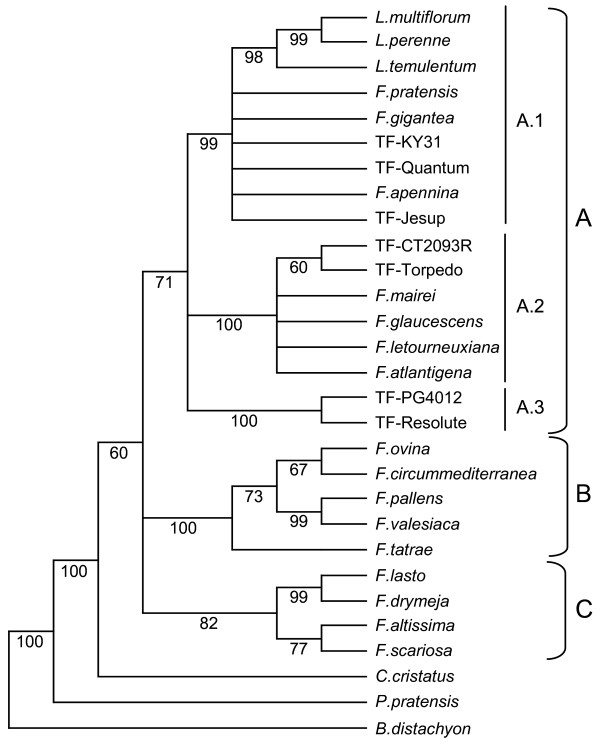
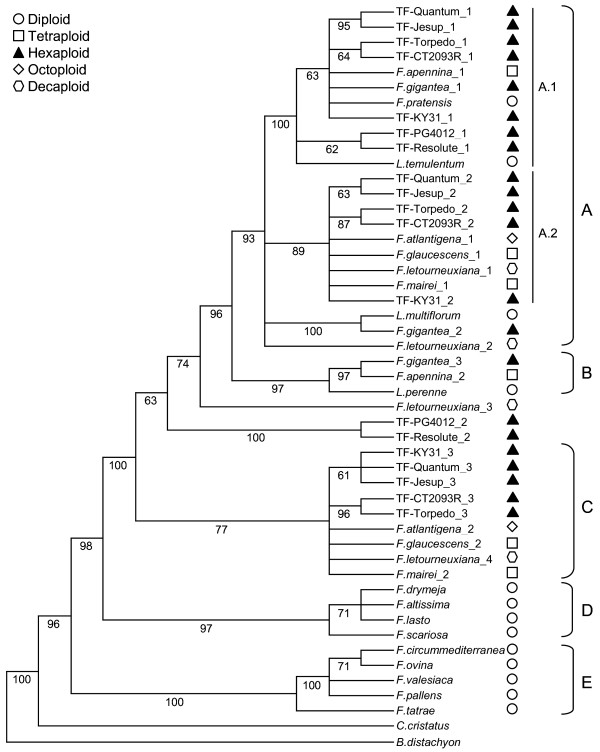
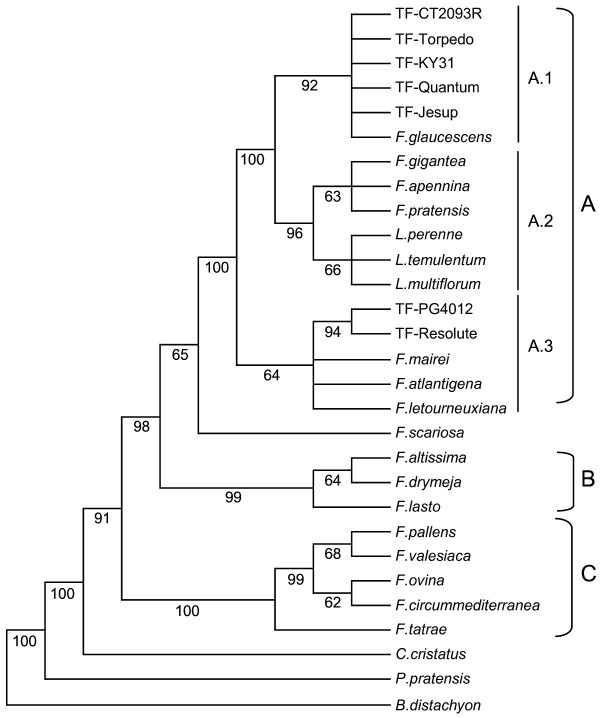
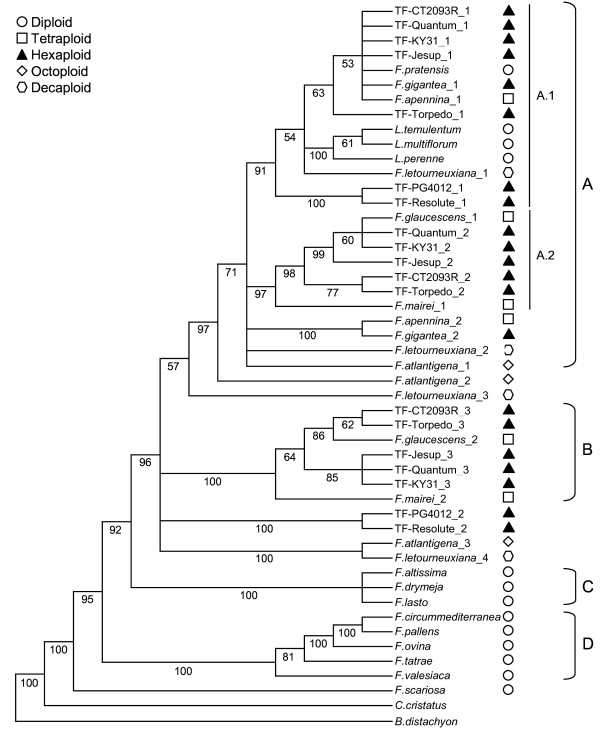
The agriculturally important pasture grass tall fescue (Festuca arundinacea Schreb. syn. Lolium arundinaceum (Schreb.) Darbysh.) is an outbreeding allohexaploid, that may be more accurately described as a species complex consisting of three major (Continental, Mediterranean and rhizomatous) morphotypes. Observation of hybrid infertility in some crossing combinations between morphotypes suggests the possibility of independent origins from different diploid progenitors. This study aims to clarify the evolutionary relationships between each tall fescue morphotype through phylogenetic analysis using two low-copy nuclear genes (encoding plastid acetyl-CoA carboxylase [Acc1] and centroradialis [CEN]), the nuclear ribosomal DNA internal transcribed spacer (rDNA ITS) and the chloroplast DNA (cpDNA) genome-located matK gene. Other taxa within the closely related Lolium-Festuca species complex were also included in the study, to increase understanding of evolutionary processes in a taxonomic group characterised by multiple inter-specific hybridisation events.
Putative homoeologous sequences from both nuclear genes were obtained from each polyploid species and compared to counterparts from 15 diploid taxa. Phylogenetic reconstruction confirmed F. pratensis and F. arundinacea var. glaucescens as probable progenitors to Continental tall fescue, and these species are also likely to be ancestral to the rhizomatous morphotype. However, these two morphotypes are sufficiently distinct to be located in separate clades based on the ITS-derived data set. All four of the generated data sets suggest independent evolution of the Mediterranean and Continental morphotypes, with minimal affinity between cognate sequence haplotypes. No obvious candidate progenitor species for Mediterranean tall fescues were identified, and only two putative sub-genome-specific haplotypes were identified for this morphotype.
This study describes the first phylogenetic analysis of the Festuca genus to include representatives of each tall fescue morphotype, and to use low copy nuclear gene-derived sequences to identify putative progenitors of the polyploid species. The demonstration of distinct tall fescue lineages has implications for both taxonomy and molecular breeding strategies, and may facilitate the generation of morphotype and/or sub-genome-specific molecular markers.
农业上重要的牧草高羊茅(Festuca arundinacea Schreb. syn. Lolium arundinaceum (Schreb.) Darbysh.)是一种异花授粉的六倍体,更准确地说,它可能是一个由三个主要形态型(大陆型、地中海型和根茎型)组成的物种复合体。观察到某些形态型之间的杂交不育性表明,它们可能是由不同的二倍体祖先独立起源的。本研究旨在通过使用两个低拷贝核基因(编码质体乙酰辅酶 A 羧化酶[Acc1]和中辐[CEN])、核核糖体 DNA 内转录间隔区(rDNA ITS)和叶绿体 DNA(cpDNA)基因组定位的 matK 基因对每个高羊茅形态型进行系统发育分析,以阐明它们之间的进化关系。研究还包括亲缘关系密切的Lolium-Festuca 种复合体中的其他分类群,以增加对一个以多种种间杂交事件为特征的分类群进化过程的理解。
从每个多倍体物种中获得了两个核基因的假定同源序列,并与 15 个二倍体分类群的对应序列进行了比较。系统发育重建证实,F. pratensis 和 F. arundinacea var. glaucescens 可能是大陆型高羊茅的祖先,这两个物种也可能是根茎型的祖先。然而,基于 ITS 衍生数据集,这两个形态型足够独特,可以位于不同的分支中。四个生成的数据集中都表明地中海型和大陆型形态型是独立进化的,同源序列单倍型之间的亲和力最小。没有明显的候选祖先物种被确定为地中海型高羊茅的起源,并且仅为这个形态型鉴定出两个假定的亚基因组特异性单倍型。
本研究首次对高羊茅的每个形态型进行了 Festuca 属的系统发育分析,并使用低拷贝核基因衍生序列来鉴定多倍体物种的可能祖先。对高羊茅不同谱系的证明对分类学和分子育种策略都有影响,并可能有助于产生形态型和/或亚基因组特异性分子标记。