Key Laboratory of Bioengineering, Henan Normal University, Henan, China.
Biol Direct. 2010 Oct 12;5:59. doi: 10.1186/1745-6150-5-59.
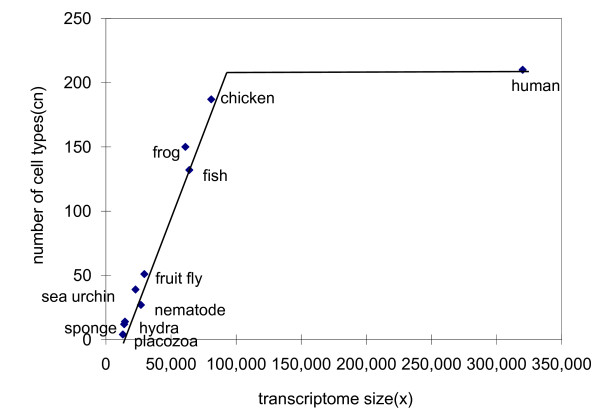
It is difficult to measure precisely the phenotypic complexity of living organisms. Here we propose a method to calculate the minimal amount of genomic information needed to construct organism (effective information) as a measure of organismal complexity, by using permutation and combination formulas and Shannon's information concept.
The results demonstrate that the calculated information correlates quite well with the intuitive organismal phenotypic complexity defined by traditional taxonomy and evolutionary theory. From viruses to human beings, the effective information gradually increases, from thousands of bits to hundreds of millions of bits. The simpler the organism is, the less the information; the more complex the organism, the more the information. About 13% of human genome is estimated as effective information or functional sequence.
The effective information can be used as a quantitative measure of phenotypic complexity of living organisms and also as an estimate of functional fraction of genome.
精确衡量生物体的表型复杂性具有一定难度。本文通过使用排列组合公式和香农信息论,提出了一种计算构建生物体所需的最小基因组信息量(有效信息量)的方法,以此作为衡量生物体复杂性的指标。
研究结果表明,计算出的信息量与传统分类学和进化理论所定义的生物体表型复杂性具有很好的相关性。从病毒到人,有效信息量逐渐增加,从几千比特到几亿比特。生物体越简单,信息量越少;生物体越复杂,信息量越大。人类基因组的大约 13%被估计为有效信息或功能序列。
有效信息量可用作衡量生物体表型复杂性的定量指标,也可用作基因组功能部分的估计。