School of Social Work, University of Washington, Seattle, WA 98105-6299, USA.
Exp Clin Psychopharmacol. 2010 Oct;18(5):418-28. doi: 10.1037/a0020510.
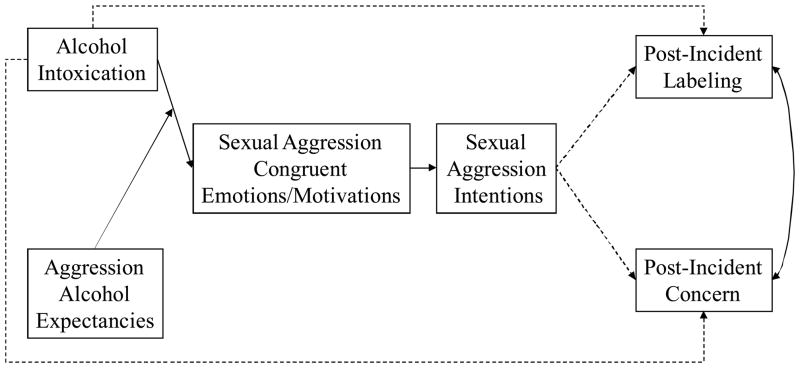
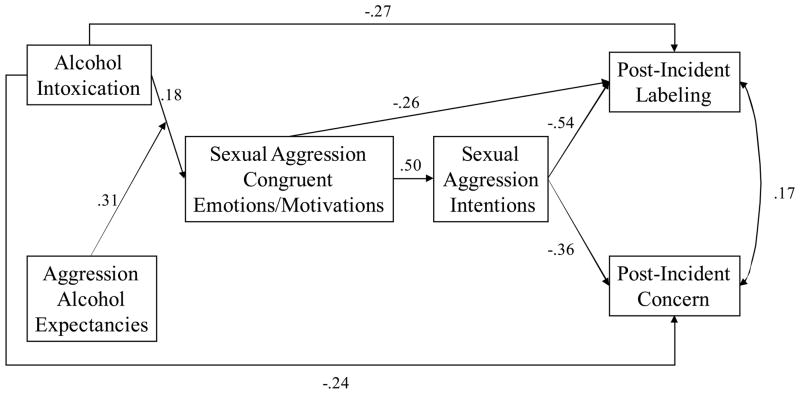
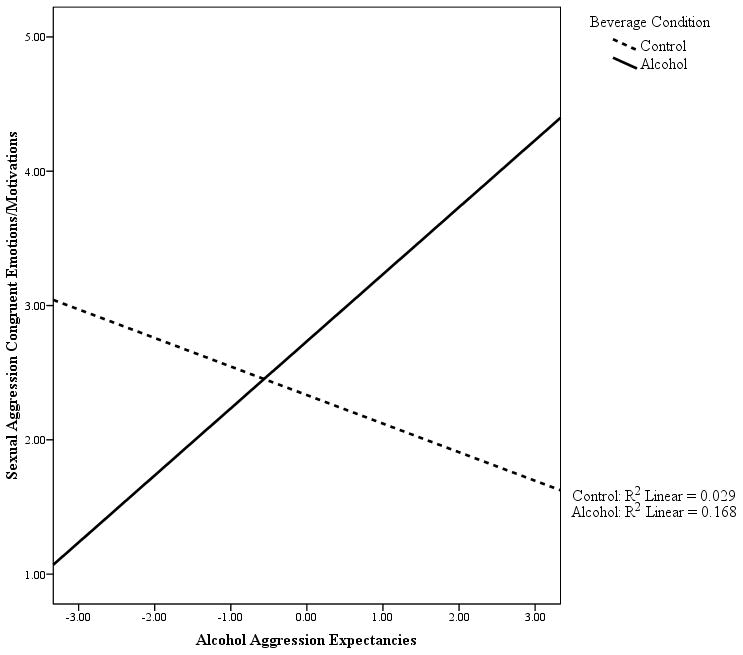
An experiment tested the pathways through which alcohol expectancies and intoxication influenced men's self-reported sexual aggression intentions during an unprotected sexual encounter. After a questionnaire session, male social drinkers (N = 124) were randomly assigned to either an alcohol condition (target peak BAC = .08%) or a control condition. Upon completion of beverage consumption, participants read a description of a sexual encounter in which the female partner refused to have unprotected sexual intercourse. Participants then rated their emotional state, their intentions to have unprotected sex with the unwilling partner, and their postincident perceptions of the encounter. Structural equation modeling indicated that intoxicated men reported feeling stronger sexual aggression congruent emotions/motivations such as arousal and anger; however, this effect was moderated by alcohol expectancies. Intoxicated participants with stronger alcohol-aggression expectancies reported greater sexual aggression congruent emotions/motivations than did intoxicated participants with weaker alcohol-aggression expectancies. For sober participants, alcohol-aggression expectancies did not influence emotions/motivations. In turn, stronger sexual assault congruent emotions/motivations predicted greater sexual aggression intentions. Men with greater sexual aggression intentions were less likely to label the situation as a sexual assault and reported less concern about their intended actions. These findings underscore the relevance of both alcohol expectancies and alcohol intoxication to sexual aggression perpetration and highlight the importance of including information about alcohol's influence on both emotional and cognitive responses in sexual aggression prevention work.
一项实验测试了酒精期望和醉酒如何通过特定的途径影响男性在无保护性行为中自我报告的性侵犯意图。在问卷调查环节后,男性社交饮酒者(N=124)被随机分配到酒精组(目标峰值 BAC=0.08%)或对照组。在喝完饮料后,参与者阅读了一段关于性接触的描述,其中女性伴侣拒绝进行无保护的性行为。参与者随后对自己的情绪状态、与不情愿的伴侣发生无保护性行为的意图,以及对事件后的看法进行了评价。结构方程模型表明,醉酒的男性报告感到更强烈的性侵犯相关情绪/动机,如兴奋和愤怒;但这种影响受到酒精期望的调节。与酒精-攻击期望较弱的醉酒参与者相比,具有较强酒精-攻击期望的醉酒参与者报告的性侵犯相关情绪/动机更强。对于清醒的参与者,酒精-攻击期望不会影响情绪/动机。相反,更强的性侵犯相关情绪/动机预测了更大的性侵犯意图。性侵犯意图较强的男性不太可能将这种情况视为性侵犯,也不太关心自己的意图行为。这些发现强调了酒精期望和醉酒对性侵犯行为的相关性,并突出了在性侵犯预防工作中纳入有关酒精对情绪和认知反应影响的信息的重要性。