London School of Hygiene and Tropical Medicine, London, UK.
BMC Public Health. 2010 Oct 12;10:601. doi: 10.1186/1471-2458-10-601.
Routine ART programme statistics generally only provide information about individuals who start treatment. We aimed to investigate the outcome of those who are eligible but do not start ART in the Malawi programme, factors associated with this dropout, and reasons for not starting treatment, in a prospective cohort study.
Individuals having a first screening visit at the ART clinic at Karonga District Hospital, northern Malawi, between September 2005 and July 2006 were interviewed. Study follow-up to identify treatment outcomes was conducted at the clinic and in the community. Logistic regression models were used to identify factors associated with dropout before ART initiation among participants identified as clinically eligible for ART.
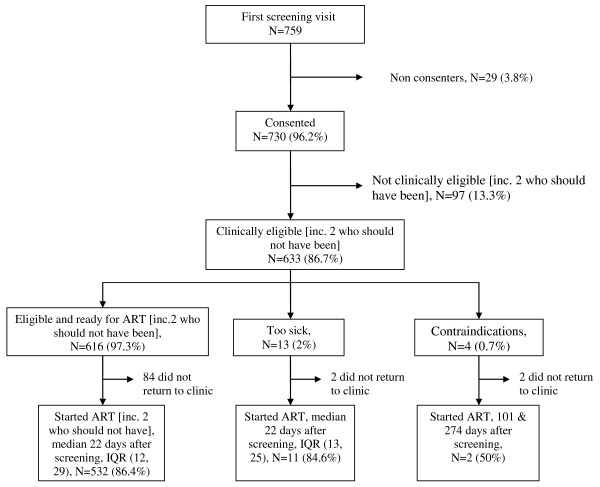
88 participants eligible for ART at their first screening visit (out of 633, 13.9%) defaulted before starting ART. Participants with less education, difficulties in dressing, a more delayed ART initiation appointment, and mid-upper arm circumference (MUAC) < 22 cm were significantly less likely to have visited the clinic subsequently. Thirty-five (58%) of the 60 participants who defaulted and were tracked at home had died, 21 before their ART initiation appointment.
MUAC and reported difficulties in dressing may provide useful screening indicators to identify sicker ART-eligible individuals at high risk of dropping out of the programme who might benefit from being brought back quickly or admitted to hospital for observation. Individuals with less education may need adapted health information at screening. Deaths of ART-eligible individuals occurring prior to ART initiation are not included in routine programme statistics. Considering all those who are eligible for ART as a denominator for programme indicators would help to highlight this vulnerable group, in order to identify new opportunities for further improving ART programmes.
常规抗逆转录病毒疗法(ART)项目统计数据通常仅提供开始治疗的个体信息。我们旨在通过前瞻性队列研究,调查马拉维项目中符合条件但未开始接受 ART 的个体的结局、与这种脱落相关的因素以及未开始治疗的原因。
2005 年 9 月至 2006 年 7 月期间,在马拉维北部卡龙加区医院的 ART 诊所首次接受筛查的个体接受了访谈。在诊所和社区进行了研究随访,以确定治疗结局。采用逻辑回归模型,确定在首次筛查时被认为有临床接受 ART 条件的参与者中,在开始 ART 治疗之前脱落的相关因素。
88 名在首次筛查时符合 ART 条件的参与者(633 名中的 13.9%)在开始 ART 治疗前失访。文化程度较低、穿衣困难、ART 开始预约延迟以及中上臂围(MUAC)<22cm 的参与者随后到诊所就诊的可能性显著降低。在因失访而在家中追踪的 60 名参与者中,有 35 名(58%)已经死亡,其中 21 名在其 ART 开始预约前死亡。
MUAC 和报告的穿衣困难可能是有用的筛选指标,可以识别出病情较重、更有可能从项目中脱落的符合 ART 条件的高风险个体,这些个体可能需要尽快带回诊所或入院观察。文化程度较低的个体在筛查时可能需要接受适应性更强的健康信息。在开始 ART 治疗之前死亡的符合 ART 条件的个体未被纳入常规项目统计数据。将所有符合 ART 条件的个体作为项目指标的分母考虑,可以帮助突出这一脆弱群体,从而为进一步改善 ART 项目提供新的机会。