Infinity Pharmaceuticals, Cambridge, Massachusetts 02139, USA.
J Biol Chem. 2010 Dec 17;285(51):39835-43. doi: 10.1074/jbc.M110.141580. Epub 2010 Oct 12.
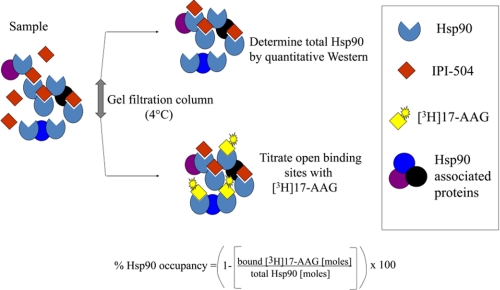
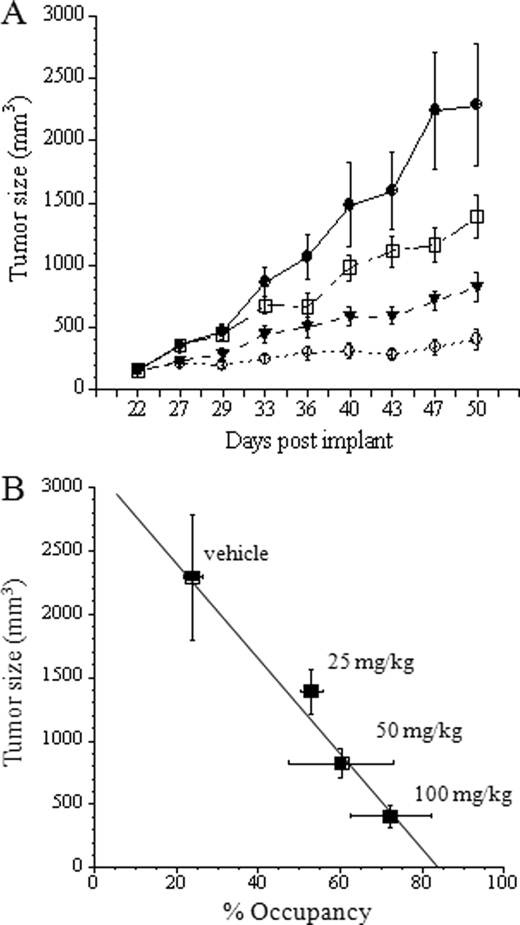
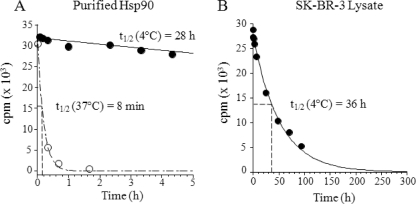
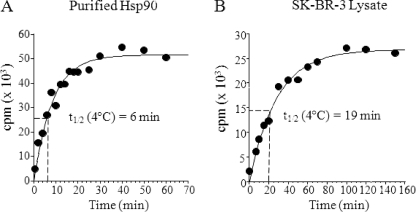
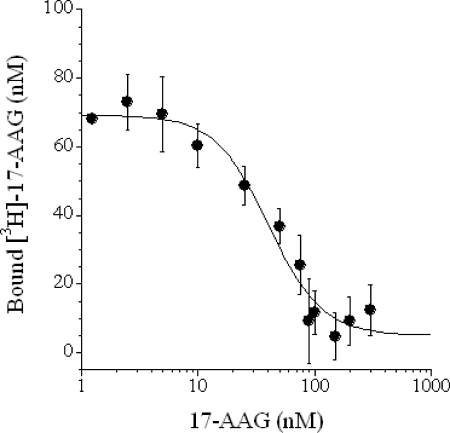
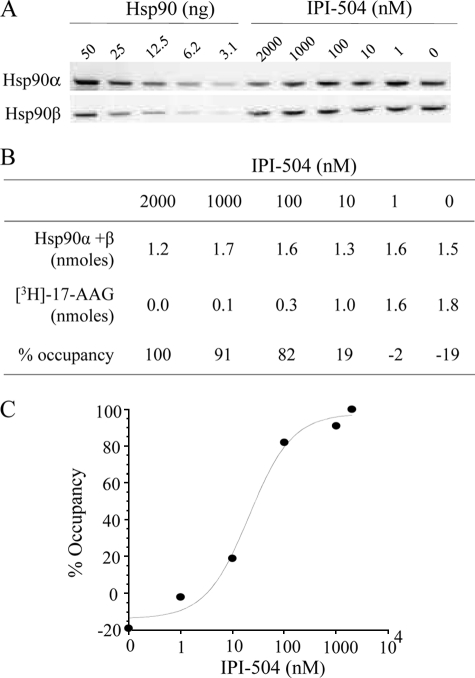
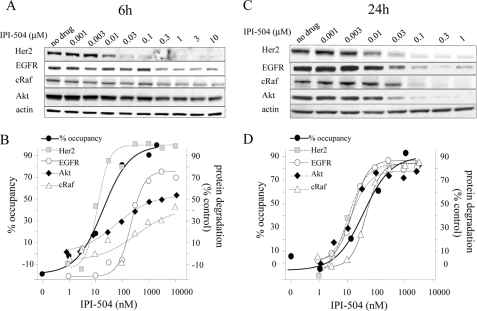
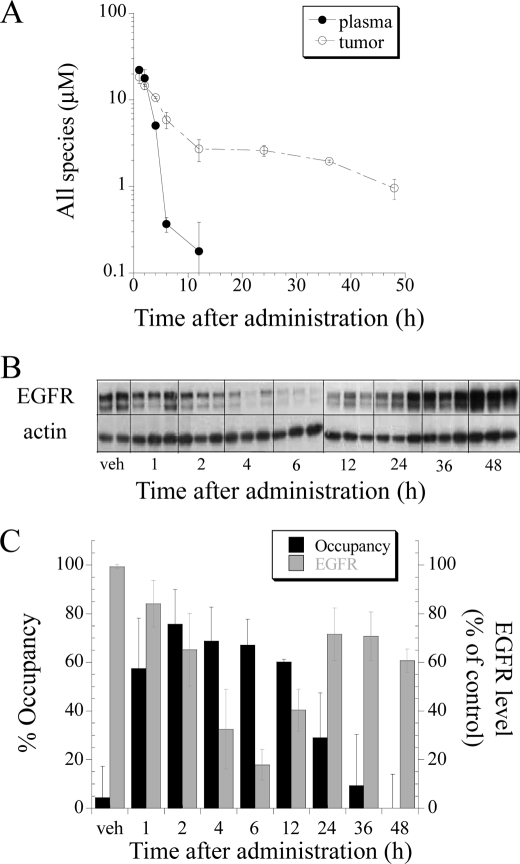
Several Hsp90 (heat shock protein 90) inhibitors are currently under clinical evaluation as anticancer agents. However, the correlation between the duration and magnitude of Hsp90 inhibition and the downstream effects on client protein degradation and cancer cell growth inhibition has not been thoroughly investigated. To investigate the relationship between Hsp90 inhibition and cellular effects, we developed a method that measures drug occupancy on Hsp90 after treatment with the Hsp90 inhibitor IPI-504 in living cells and in tumor xenografts. In cells, we find the level of Hsp90 occupancy to be directly correlated with cell growth inhibition. At the molecular level, the relationship between Hsp90 occupancy and Hsp90 client protein degradation was examined for different client proteins. For sensitive Hsp90 clients (e.g. HER2 (human epidermal growth factor receptor 2), client protein levels directly mirror Hsp90 occupancy at all time points after IPI-504 administration. For insensitive client proteins, we find that protein abundance matches Hsp90 occupancy only after prolonged incubation with drug. Additionally, we investigate the correlation between plasma pharmacokinetics (PK), tumor PK, pharmacodynamics (PD) (client protein degradation), tumor growth inhibition, and Hsp90 occupancy in a xenograft model of human cancer. Our results indicate Hsp90 occupancy to be a better predictor of PD than either plasma PK or tumor PK. In the nonsmall cell lung cancer xenograft model studied, a linear correlation between Hsp90 occupancy and tumor growth inhibition was found. This novel binding assay was evaluated both in vitro and in vivo and could be used as a pharmacodynamic readout in the clinic.
几种 Hsp90(热休克蛋白 90)抑制剂目前正在临床评估中作为抗癌药物。然而,Hsp90 抑制的持续时间和程度与客户蛋白降解和癌细胞生长抑制的下游效应之间的相关性尚未得到彻底研究。为了研究 Hsp90 抑制与细胞效应之间的关系,我们开发了一种方法,该方法可测量在活细胞和肿瘤异种移植物中用 Hsp90 抑制剂 IPI-504 处理后 Hsp90 上的药物占有率。在细胞中,我们发现 Hsp90 占据水平与细胞生长抑制直接相关。在分子水平上,研究了不同客户蛋白的 Hsp90 占据与 Hsp90 客户蛋白降解之间的关系。对于敏感的 Hsp90 客户(例如 HER2(人表皮生长因子受体 2)),在 IPI-504 给药后所有时间点客户蛋白水平都直接反映了 Hsp90 占据。对于不敏感的客户蛋白,我们发现只有在用药物孵育延长后,蛋白质丰度才与 Hsp90 占据相匹配。此外,我们在人癌症异种移植模型中研究了血浆药代动力学(PK)、肿瘤 PK、药效学(PD)(客户蛋白降解)、肿瘤生长抑制与 Hsp90 占据之间的相关性。我们的结果表明,Hsp90 占据比血浆 PK 或肿瘤 PK 更能预测 PD。在所研究的非小细胞肺癌异种移植模型中,发现 Hsp90 占据与肿瘤生长抑制之间存在线性相关性。该新型结合测定法已在体外和体内进行了评估,可作为临床药效学读出。