Department of Medical Psychology/J3-211, Academic Medical Center, University of Amsterdam, Meibergdreef 15, 1105 AZ, Amsterdam, The Netherlands.
Qual Life Res. 2010 Dec;19(10):1395-403. doi: 10.1007/s11136-010-9759-5. Epub 2010 Oct 14.
There is emerging evidence for a genetic basis of patient-reported quality-of-life (QOL) outcomes that can ultimately be incorporated into clinical research and practice. Objectives are (1) to provide arguments for the timeliness of investigating the genetic basis of QOL given the scientific advances in genetics and patient-reported QOL research; (2) to describe the clinical implications of such investigations; (3) to present a theoretical foundation for investigating the genetic underpinnings of QOL; and (4) to describe a series of papers resulting from the GENEQOL Consortium that was established to move this work forward.
Discussion of scientific advances based on relevant literature.
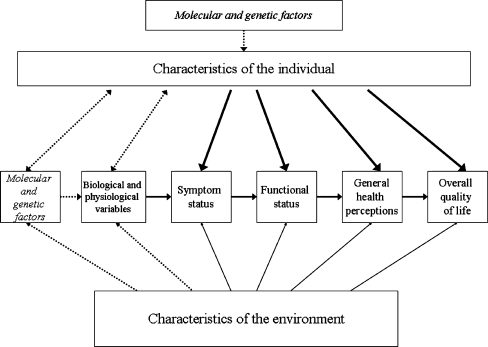
In genetics, technological advances allow for increases in speed and efficiency and decreases in costs in exploring the genetic underpinnings of disease processes, drug metabolism, treatment response, and survival. In patient-based research, advances yield empirically based and stringent approaches to measurement that are scientifically robust. Insights into the genetic basis of QOL will ultimately allow early identification of patients susceptible to QOL deficits and to target care. The Wilson and Cleary model for patient-reported outcomes was refined by incorporating the genetic underpinnings of QOL.
This series of papers provides a path for QOL and genetics researchers to work together to move this field forward and to unravel the intricate interplay of the genetic underpinnings of patient-reported QOL outcomes. The ultimate result will be a greater understanding of the process relating disease, patient, and doctor that will have the potential to lead to improved survival, QOL, and health services delivery.
越来越多的证据表明患者报告的生活质量(QOL)结果存在遗传基础,最终可以将其纳入临床研究和实践中。目的是:(1) 鉴于遗传学和患者报告的 QOL 研究方面的科学进展,为研究 QOL 的遗传基础提供时机的论据;(2) 描述此类研究的临床意义;(3) 为研究 QOL 的遗传基础提供理论基础;(4) 描述为推进这项工作而成立的 GENEQOL 联盟的一系列论文。
根据相关文献讨论科学进展。
在遗传学中,技术进步使探索疾病过程、药物代谢、治疗反应和生存的遗传基础的速度、效率提高,成本降低。在基于患者的研究中,进展产生了基于经验和严格的测量方法,具有科学的稳健性。对 QOL 遗传基础的深入了解最终将允许早期识别易出现 QOL 缺陷的患者,并针对这些患者进行治疗。Wilson 和 Cleary 患者报告结果模型通过纳入 QOL 的遗传基础得到了完善。
这一系列论文为 QOL 和遗传学研究人员提供了一条共同努力推动该领域前进并揭示患者报告的 QOL 结果遗传基础复杂相互作用的道路。最终的结果将是对与疾病、患者和医生相关的过程的更深入理解,有可能导致改善生存、QOL 和卫生服务的提供。