Senri Chuo Hospital, Toyonaka, Japan.
Drugs R D. 2010;10(3):155-63. doi: 10.2165/11586550-000000000-00000.
Stroke patients with severe leg paralysis are often bedridden in the acute and subacute phase, which increases the risk of disuse muscle atrophy in the chronic phase. The evidence to date indicates that oxidative stress plays an important role in the mechanism of disuse muscle atrophy. Therefore, the aim of this study was to determine if long-term radical scavenger treatment with edaravone following an acute stroke prevents the progression of disuse muscle atrophy and improves leg locomotor function in the chronic phase.
This randomized controlled pilot study was conducted at 19 acute stroke and rehabilitation centers across Japan. Forty-seven ischemic stroke patients with at least leg motor weakness admitted within 24 hours of onset were randomly assigned to receive continuous intravenous infusions of edaravone 30 mg twice daily for 3 days (short-term group) or 10-14 days (long-term group). The primary endpoints of the study included the degree of leg disuse muscle atrophy, as measured by the percentage change from baseline in femoral muscle circumference 15 cm above the knee, and the improvement in leg locomotor function, as assessed by the maximum walking speed over 10 m, 3 months after the onset of stroke.
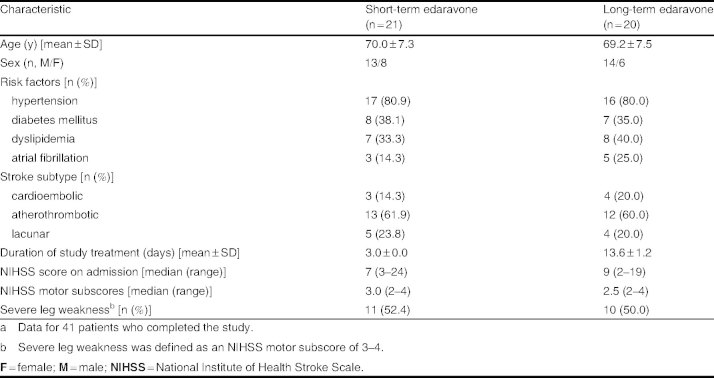
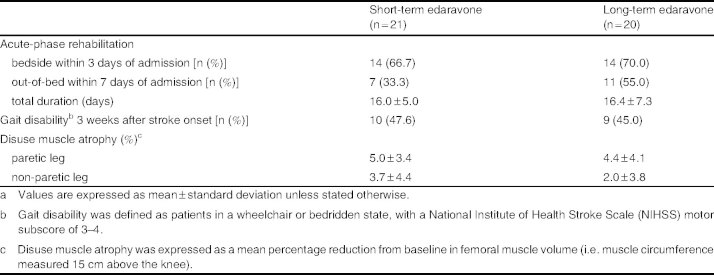
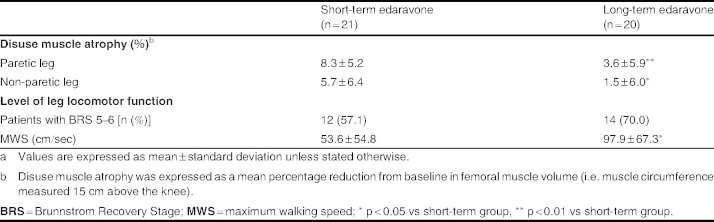
Three-month follow-up was completed by a total of 41 patients (21 in the short-term group and 20 in the long-term group). On admission, there was no significant difference in the severity of stroke or the grade of leg paresis between the two treatment groups. The grade of disuse muscle atrophy and incidence of gait impairment 3 weeks after stroke onset were also similar between the short- and long-term groups. However, disuse muscle atrophy of the paretic and non-paretic legs was significantly less severe in the long-term versus the short-term treatment group (3.6 ± 5.9% and 1.5 ± 6.0% vs 8.3 ± 5.2% and 5.7 ± 6.4%; p < 0.01 and p < 0.05) 3 months after stroke onset. Additionally, the maximum walking speed over a distance of 10 m was significantly greater in the long-term group (98 ± 67 vs 54 ± 55 cm/sec; p < 0.05).
Edaravone treatment for up to 14 days suppresses the progression of disuse muscle atrophy and improves leg locomotor function to a greater extent than shorter-term treatment in acute stroke patients. This suggests that the management of stroke may be improved with long-term edaravone therapy by providing myoprotective effects that ameliorate functional outcome in the chronic phase.
患有严重腿部瘫痪的中风患者在急性期和亚急性期经常卧床不起,这增加了慢性期废用性肌肉萎缩的风险。目前的证据表明,氧化应激在废用性肌肉萎缩的机制中起重要作用。因此,本研究旨在确定急性中风后长期使用依达拉奉作为自由基清除剂治疗是否可以防止废用性肌肉萎缩的进展,并改善慢性期腿部运动功能。
这项随机对照的初步研究在日本的 19 个急性中风和康复中心进行。47 例发病后 24 小时内至少有腿部运动无力的缺血性中风患者被随机分配接受连续静脉输注依达拉奉 30 mg,每日 2 次,持续 3 天(短期组)或 10-14 天(长期组)。研究的主要终点包括从基线测量的膝关节上方 15cm 处股部肌肉周长的百分比变化,即腿部废用性肌肉萎缩的程度,以及中风发病 3 个月后通过 10m 最大步行速度评估的腿部运动功能的改善。
共有 41 例患者完成了 3 个月的随访(短期组 21 例,长期组 20 例)。入院时,两组患者的中风严重程度或腿部瘫痪程度无显著差异。两组之间在中风发病后 3 周时废用性肌肉萎缩的程度和步态障碍的发生率也相似。然而,与短期治疗组相比,长期治疗组的患侧和非患侧腿部废用性肌肉萎缩程度明显较轻(3.6±5.9%和 1.5±6.0%比 8.3±5.2%和 5.7±6.4%;p<0.01 和 p<0.05),中风发病 3 个月后。此外,长期组的 10m 最大步行速度明显更快(98±67 比 54±55cm/sec;p<0.05)。
依达拉奉治疗长达 14 天可抑制废用性肌肉萎缩的进展,并比急性中风患者的短期治疗更能改善腿部运动功能。这表明,通过提供改善慢性期功能结局的肌肉保护作用,长期依达拉奉治疗可能改善中风的管理。