ToxStrategies, Inc., Katy, Texas 77494, USA.
Toxicol Sci. 2011 Jan;119(1):20-40. doi: 10.1093/toxsci/kfq320. Epub 2010 Oct 14.
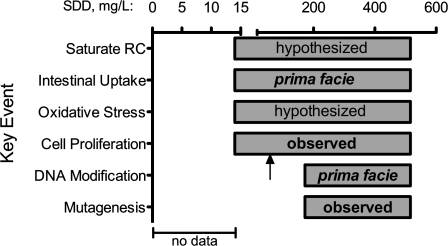
Mode of action (MOA) analysis provides a systematic description of key events leading to adverse health effects in animal bioassays for the purpose of informing human health risk assessment. Uncertainties and data gaps identified in the MOA analysis may also be used to guide future research to improve understanding of the MOAs underlying a specific toxic response and foster development of toxicokinetic and toxicodynamic models. An MOA analysis, consistent with approaches outlined in the MOA Framework as described in the Guidelines for Carcinogen Risk Assessment, was conducted to evaluate small intestinal tumors observed in mice chronically exposed to relatively high concentrations of hexavalent chromium (Cr(VI)) in drinking water. Based on review of the literature, key events in the MOA are hypothesized to include saturation of the reductive capacity of the upper gastrointestinal tract, absorption of Cr(VI) into the intestinal epithelium, oxidative stress and inflammation, cell proliferation, direct and/or indirect DNA modification, and mutagenesis. Although available data generally support the plausibility of these key events, several unresolved questions and data gaps were identified, highlighting the need for obtaining critical toxicokinetic and toxicodynamic data in the target tissue and in the low-dose range. Experimental assays that can address these data gaps are discussed along with strategies for comparisons between responsive and nonresponsive tissues and species. This analysis provides a practical application of MOA Framework guidance and is instructive for the design of studies to improve upon the information available for quantitative risk assessment.
作用模式(MOA)分析为动物生物测定中导致不良健康影响的关键事件提供了系统描述,目的是为人类健康风险评估提供信息。在 MOA 分析中确定的不确定性和数据缺口也可用于指导未来的研究,以增进对特定毒性反应的作用模式的理解,并促进毒代动力学和毒效动力学模型的开发。根据致癌风险评估指南中所述的 MOA 框架中的方法,进行了作用模式分析,以评估长期暴露于饮用水中相对高浓度六价铬(Cr(VI))的小鼠中小肠肿瘤的情况。基于文献综述,作用模式中的关键事件假设包括上胃肠道还原性的饱和、Cr(VI)被吸收到肠上皮细胞、氧化应激和炎症、细胞增殖、直接和/或间接的 DNA 修饰以及致突变性。尽管现有数据通常支持这些关键事件的合理性,但仍确定了几个未解决的问题和数据缺口,突出表明需要在靶组织和低剂量范围内获得关键的毒代动力学和毒效动力学数据。讨论了可以解决这些数据缺口的实验方法,并提出了在有反应和无反应组织和物种之间进行比较的策略。该分析提供了 MOA 框架指导的实际应用,对于设计研究以改善定量风险评估的信息具有指导意义。