Elton Terry S, Sansom Sarah E, Martin Mickey M
Davis Heart and Lung Research Institute, The Ohio State University, DHLRI 515, Columbus, OH 43210, USA.
Int J Hypertens. 2010 Aug 4;2010:281692. doi: 10.4061/2010/281692.
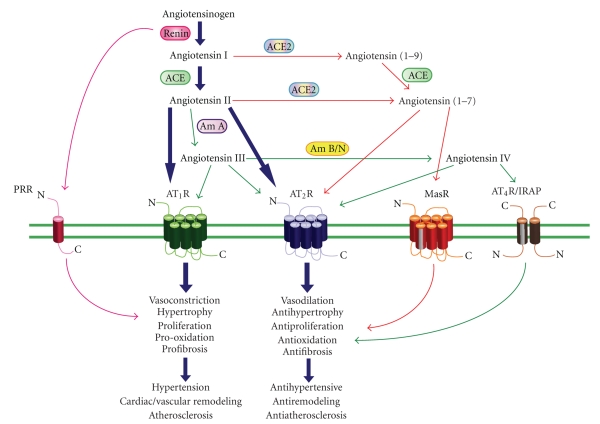
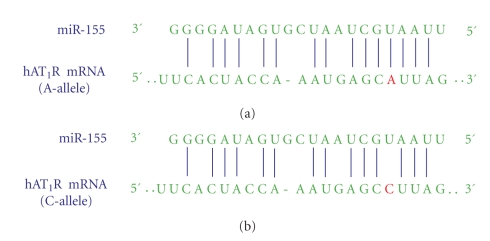
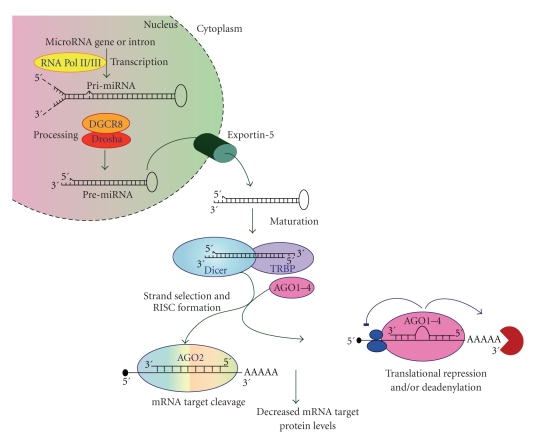
Essential hypertension is a complex disorder, caused by the interplay between many genetic variants, gene-gene interactions, and environmental factors. Given that the renin-angiotensin system (RAS) plays an important role in blood pressure (BP) control, cardiovascular regulation, and cardiovascular remodeling, special attention has been devoted to the investigation of single-nucleotide polymorphisms (SNP) harbored in RAS genes that may be associated with hypertension and cardiovascular disease. MicroRNAs (miRNAs) are a family of small, ∼21-nucleotide long, and nonprotein-coding RNAs that recognize target mRNAs through partial complementary elements in the 3'-untranslated region (3'-UTR) of mRNAs and inhibit gene expression by targeting mRNAs for translational repression or destabilization. Since miRNA SNPs (miRSNPs) can create, destroy, or modify miRNA binding sites, this review focuses on the hypothesis that transcribed target SNPs harbored in RAS mRNAs, that alter miRNA gene regulation and consequently protein expression, may contribute to cardiovascular disease susceptibility.
原发性高血压是一种复杂的疾病,由多种基因变异、基因-基因相互作用和环境因素之间的相互作用引起。鉴于肾素-血管紧张素系统(RAS)在血压(BP)控制、心血管调节和心血管重塑中起重要作用,人们对RAS基因中可能与高血压和心血管疾病相关的单核苷酸多态性(SNP)的研究给予了特别关注。微小RNA(miRNA)是一类小的、约21个核苷酸长的非蛋白质编码RNA,它们通过mRNA 3'-非翻译区(3'-UTR)中的部分互补元件识别靶mRNA,并通过靶向mRNA进行翻译抑制或使其不稳定来抑制基因表达。由于miRNA单核苷酸多态性(miRSNP)可以创建、破坏或修饰miRNA结合位点,本综述聚焦于这样一种假说:RAS mRNA中携带的转录靶SNP会改变miRNA基因调控,进而影响蛋白质表达,这可能会导致心血管疾病易感性。