Laboratory of Drug Metabolism and Pharmacokinetics, Showa Pharmaceutical University, 3-3165 Higashi-Tamagawa Gakuen, Machida, Tokyo 194-8543, Japan.
Int J Environ Res Public Health. 2010 Sep;7(9):3406-21. doi: 10.3390/ijerph7093406. Epub 2010 Sep 1.
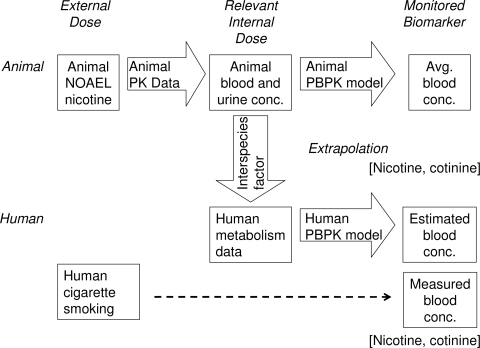
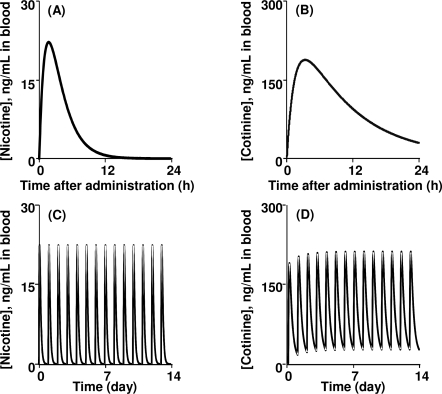
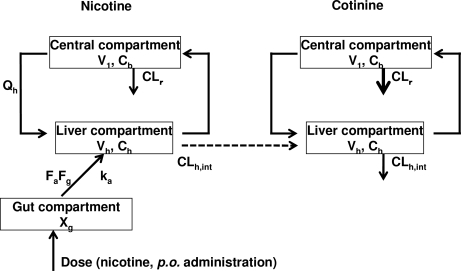
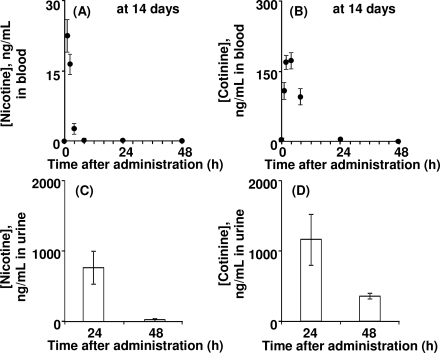
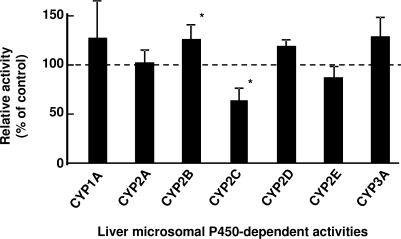
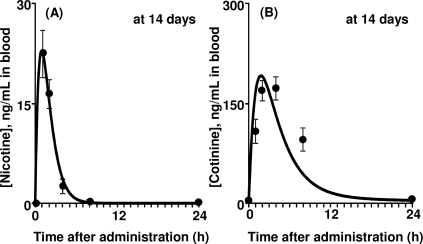
The present study defined a simplified physiologically based pharmacokinetic (PBPK) model for nicotine and its primary metabolite cotinine in humans, based on metabolic parameters determined in vitro using relevant liver microsomes, coefficients derived in silico, physiological parameters derived from the literature, and an established rat PBPK model. The model consists of an absorption compartment, a metabolizing compartment, and a central compartment for nicotine and three equivalent compartments for cotinine. Evaluation of a rat model was performed by making comparisons with predicted concentrations in blood and in vivo experimental pharmacokinetic values obtained from rats after oral treatment with nicotine (1.0 mg/kg, a no-observed-adverseeffect level) for 14 days. Elimination rates of nicotine in vitro were established from data from rat liver microsomes and from human pooled liver microsomes. Human biomonitoring data (17 ng nicotine and 150 ng cotinine per mL plasma 1 h after smoking) from pooled five male Japanese smokers (daily intake of 43 mg nicotine by smoking) revealed that these blood concentrations could be calculated using a human PBPK model. These results indicate that a simplified PBPK model for nicotine/cotinine is useful for a forward dosimetry approach in humans and for estimating blood concentrations of other related compounds resulting from exposure to low chemical doses.
本研究基于相关肝微粒体体外测定的代谢参数、通过计算机模拟获得的系数、文献中推导的生理参数以及已建立的大鼠 PBPK 模型,定义了一种简化的尼古丁及其主要代谢物可的宁的生理药代动力学(PBPK)模型。该模型由吸收室、代谢室和尼古丁的中央室以及三个等效的可的宁室组成。通过与大鼠口服尼古丁(1.0 mg/kg,无观察到不良反应水平)14 天后血药浓度的预测值和体内实验药代动力学值进行比较,对大鼠模型进行了评估。体外尼古丁的消除率是根据大鼠肝微粒体和人混合肝微粒体的数据确定的。来自五个日本男性吸烟者(每天通过吸烟摄入 43 毫克尼古丁)的人体生物监测数据(吸烟后 1 小时血浆中 17 纳克尼古丁和 150 纳克可的宁)表明,这些血液浓度可以用人 PBPK 模型计算。这些结果表明,尼古丁/可的宁的简化 PBPK 模型可用于人体的正向剂量测定方法,并可估计暴露于低化学剂量时其他相关化合物的血液浓度。