Centro Interdipartimentale Museo di Storia Naturale e del Territorio, Università di Pisa, Pisa, Italy.
PLoS One. 2010 Oct 7;5(10):e13218. doi: 10.1371/journal.pone.0013218.
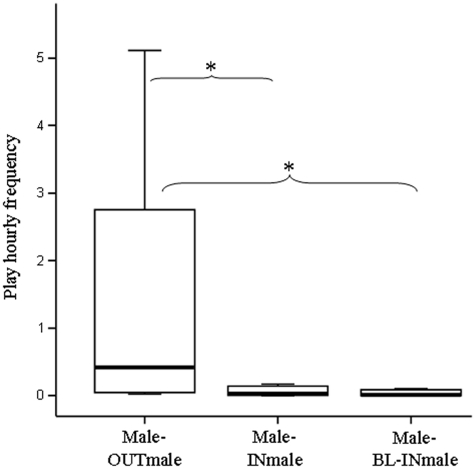
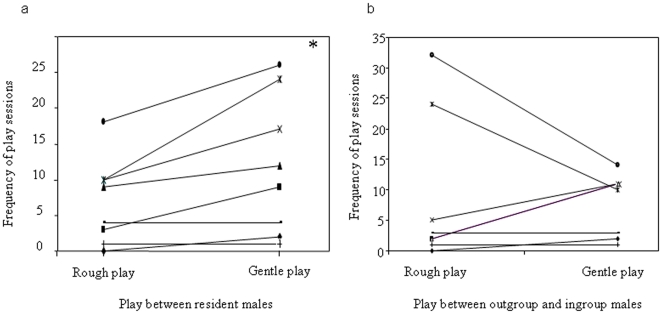
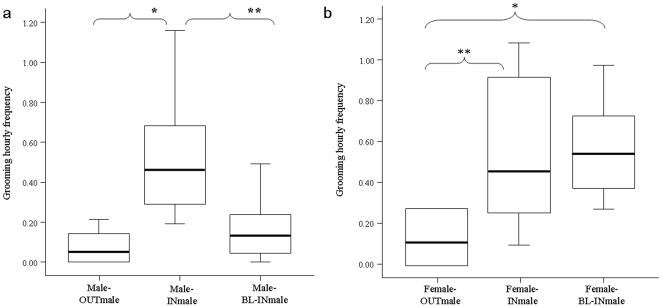
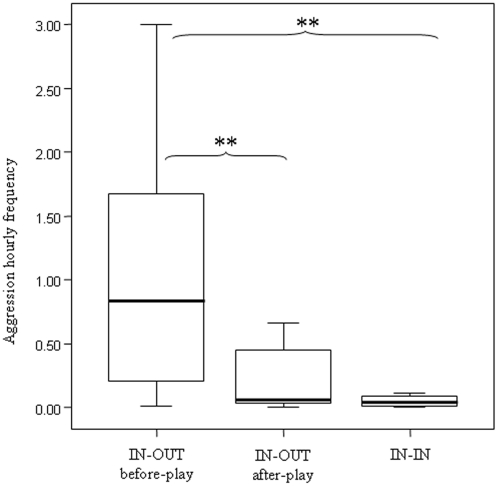
The power of play in limiting xenophobia is a well-known phenomenon in humans. Yet, the evidence in social animals remains meager. Here, we aim to determine whether play promotes social tolerance toward strangers in one of the most basal group of primates, the strepsirhines. We observed two groups of wild lemurs (Propithecus verreauxi, Verreaux's sifaka) during the mating season. Data were also collected on nine visiting, outgroup males. We compared the distribution of play, grooming, and aggressive interactions across three conditions: OUT (resident/outgroup interactions), IN (resident/resident interactions in presence of outgroups) and BL-IN (baseline of resident/resident interactions in absence of outgroups). Play frequency between males was higher in OUT than in IN and BL-IN conditions; whereas, grooming was more frequent in IN than in OUT and BL-IN conditions. Aggression rates between resident and outgroup males were significantly higher than those between residents. However, aggressions between resident and outgroup males significantly decreased after the first play session and became comparable with resident-resident aggression levels. The presence of strangers in a well-established group implies the onset of novel social circumstances, which sifaka males cope with by two different tactics: grooming with ingroup males and playing with outgroup ones. The grooming peak, concurrently with the visit of outgroups, probably represents a social shield adopted by resident males to make their pre-existing affiliation more evident to the stranger "audience". Being mostly restricted to unfamiliar males, adult play in sifaka appears to have a role in managing new social situations more than in maintaining old relationships. In particular, our results indicate not only that play is the interface between strangers but also that it has a specific function in reducing xenophobia. In conclusion, play appears to be an ice-breaker mechanism in the critical process that "upgrades" an individual from stranger to familiar.
玩耍在限制仇外心理方面的作用在人类中是众所周知的现象。然而,在社交动物中的证据仍然很少。在这里,我们旨在确定玩耍是否能促进灵长类动物中最基础的群体之一,即懒猴科,对陌生者的社会容忍度。我们在交配季节观察了两组野生狐猴(Propithecus verreauxi,Verreaux 的指猴)。还收集了九只来访的外群雄性的数据。我们比较了玩耍、梳理和攻击行为在三种情况下的分布:OUT(本地居民/外群互动)、IN(外群存在时本地居民/本地居民互动)和 BL-IN(外群不存在时本地居民/本地居民互动的基线)。雄性之间的玩耍频率在 OUT 条件下高于 IN 和 BL-IN 条件;而梳理在 IN 条件下比 OUT 和 BL-IN 条件下更频繁。本地居民和外群雄性之间的攻击率明显高于居民之间的攻击率。然而,在第一次玩耍后,本地居民和外群雄性之间的攻击明显减少,并与居民与居民之间的攻击水平相当。在一个成熟的群体中存在陌生人意味着出现了新的社交环境,指猴雄性通过两种不同的策略来应对:与本群雄性梳理和与外群雄性玩耍。在外地群体来访时,梳理高峰可能代表了本地雄性采用的一种社交盾牌,以使陌生“观众”更明显地感受到他们现有的关系。成年指猴的玩耍主要限于不熟悉的雄性,因此在管理新的社交情况方面比维持旧关系更有作用。特别是,我们的结果不仅表明玩耍是陌生者之间的界面,而且表明它在减少仇外心理方面具有特定的功能。总之,玩耍似乎是打破陌生人之间隔阂的机制,也是将个体从陌生人升级为熟人的关键过程中的特定功能。