Division of Conservation Biology, Institute of Ecology and Evolution, University of Bern, Bern, Switzerland.
PLoS One. 2010 Oct 6;5(10):e13115. doi: 10.1371/journal.pone.0013115.
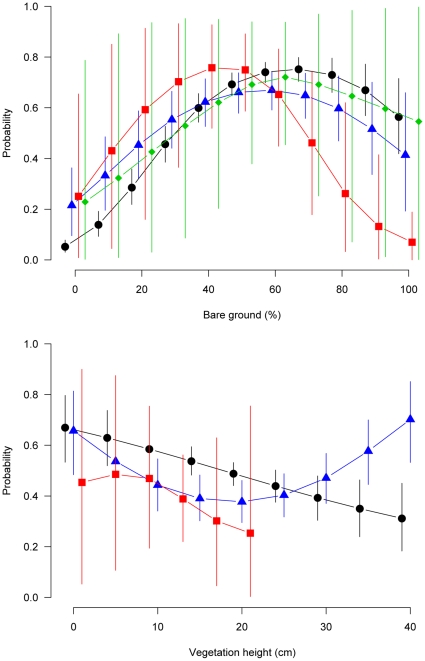
Conceived to combat widescale biodiversity erosion in farmland, agri-environment schemes have largely failed to deliver their promises despite massive financial support. While several common species have shown to react positively to existing measures, rare species have continued to decline in most European countries. Of particular concern is the status of insectivorous farmland birds that forage on the ground. We modelled the foraging habitat preferences of four declining insectivorous bird species (hoopoe, wryneck, woodlark, common redstart) inhabiting fruit tree plantations, orchards and vineyards. All species preferred foraging in habitat mosaics consisting of patches of grass and bare ground, with an optimal, species-specific bare ground coverage of 30-70% at the foraging patch scale. In the study areas, birds thrived in intensively cultivated farmland where such ground vegetation mosaics existed. Not promoted by conventional agri-environment schemes until now, patches of bare ground should be implemented throughout grassland in order to prevent further decline of insectivorous farmland birds.
为了应对农田中广泛存在的生物多样性丧失问题,农业环境计划得到了大力支持,但它们在很大程度上未能实现其承诺。尽管一些常见物种对现有措施表现出积极的反应,但在大多数欧洲国家,稀有物种仍在继续减少。特别令人关注的是在地面觅食的食虫性农田鸟类的状况。我们对栖息在果园、果园和葡萄园中的四种食虫性鸟类(戴胜、斑鸫、云雀、红尾鸲)的觅食生境偏好进行了建模。所有物种都更喜欢在由草地和裸露地面斑块组成的生境镶嵌体中觅食,在觅食斑块尺度上,最佳的、特定于物种的裸露地面覆盖率为 30-70%。在研究区域中,鸟类在存在这种地面植被镶嵌体的集约化农田中茁壮成长。直到现在,传统的农业环境计划都没有推广这种做法,但应该在整个草地中实施裸露斑块,以防止食虫性农田鸟类的进一步减少。