• 文献检索
  • 文档翻译
  • 深度研究
  • 学术资讯
  • Suppr Zotero 插件Zotero 插件
  • 邀请有礼
  • 套餐&价格
  • 历史记录
应用&插件
Suppr Zotero 插件Zotero 插件浏览器插件Mac 客户端Windows 客户端微信小程序
定价
高级版会员购买积分包购买API积分包
服务
文献检索文档翻译深度研究API 文档MCP 服务
关于我们
关于 Suppr公司介绍联系我们用户协议隐私条款
关注我们

Suppr 超能文献

核心技术专利:CN118964589B侵权必究
粤ICP备2023148730 号-1Suppr @ 2026

文献检索

告别复杂PubMed语法,用中文像聊天一样搜索,搜遍4000万医学文献。AI智能推荐,让科研检索更轻松。

立即免费搜索

文件翻译

保留排版,准确专业,支持PDF/Word/PPT等文件格式,支持 12+语言互译。

免费翻译文档

深度研究

AI帮你快速写综述,25分钟生成高质量综述,智能提取关键信息,辅助科研写作。

立即免费体验

危重症成人复苏液使用情况:391 个重症监护病房的国际横断面研究。

Resuscitation fluid use in critically ill adults: an international cross-sectional study in 391 intensive care units.

机构信息

Critical Care and Trauma Division, The George Institute for International Health, PO Box M201, Missenden Road, NSW 2050, Australia.

出版信息

Crit Care. 2010;14(5):R185. doi: 10.1186/cc9293. Epub 2010 Oct 15.

DOI:10.1186/cc9293
PMID:20950434
原文链接:https://pmc.ncbi.nlm.nih.gov/articles/PMC3219291/
Abstract

INTRODUCTION

Recent evidence suggests that choice of fluid used for resuscitation may influence mortality in critically ill patients.

METHODS

We conducted a cross-sectional study in 391 intensive care units across 25 countries to describe the types of fluids administered during resuscitation episodes. We used generalized estimating equations to examine the association between patient, prescriber and geographic factors and the type of fluid administered (classified as crystalloid, colloid or blood products).

RESULTS

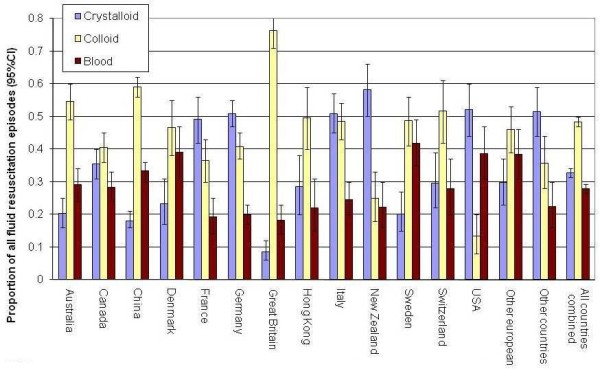
During the 24-hour study period, 1,955 of 5,274 (37.1%) patients received resuscitation fluid during 4,488 resuscitation episodes. The main indications for administering crystalloid or colloid were impaired perfusion (1,526/3,419 (44.6%) of episodes), or to correct abnormal vital signs (1,189/3,419 (34.8%)). Overall, colloid was administered to more patients (1,234 (23.4%) versus 782 (14.8%)) and during more episodes (2,173 (48.4%) versus 1,468 (32.7%)) than crystalloid. After adjusting for patient and prescriber characteristics, practice varied significantly between countries with country being a strong independent determinant of the type of fluid prescribed. Compared to Canada where crystalloid, colloid and blood products were administered in 35.5%, 40.6% and 28.3% of resuscitation episodes respectively, odds ratios for the prescription of crystalloid in China, Great Britain and New Zealand were 0.46 (95% confidence interval (CI) 0.30 to 0.69), 0.18 (0.10 to 0.32) and 3.43 (1.71 to 6.84) respectively; odds ratios for the prescription of colloid in China, Great Britain and New Zealand were 1.72 (1.20 to 2.47), 4.72 (2.99 to 7.44) and 0.39 (0.21 to 0.74) respectively. In contrast, choice of fluid was not influenced by measures of illness severity (for example, Acute Physiology and Chronic Health Evaluation (APACHE) II score).

CONCLUSIONS

Administration of resuscitation fluid is a common intervention in intensive care units and choice of fluid varies markedly between countries. Although colloid solutions are more expensive and may possibly be harmful in some patients, they were administered to more patients and during more resuscitation episodes than crystalloids were.

摘要

简介

最近的证据表明,复苏时选择的液体可能会影响危重症患者的死亡率。

方法

我们在 25 个国家的 391 个重症监护病房进行了一项横断面研究,以描述复苏期间使用的液体类型。我们使用广义估计方程来检查患者、处方者和地理因素与所使用的液体类型(分为晶体液、胶体液或血制品)之间的关联。

结果

在 24 小时的研究期间,5274 例患者中有 1955 例(37.1%)在 4488 例复苏中接受了复苏液。给予晶体液或胶体液的主要指征是灌注受损(1526/3419[44.6%])或纠正异常生命体征(1189/3419[34.8%])。总体而言,胶体液的使用量更大(1234 例[23.4%]比 782 例[14.8%]),使用的复苏次数也更多(2173 例[48.4%]比 1468 例[32.7%])。在调整了患者和处方者特征后,各国之间的实践差异很大,国家是处方类型的重要独立决定因素。与加拿大相比,在加拿大,晶体液、胶体液和血制品分别在 35.5%、40.6%和 28.3%的复苏中使用,中国、英国和新西兰晶体液处方的比值比分别为 0.46(95%置信区间为 0.30 至 0.69)、0.18(0.10 至 0.32)和 3.43(1.71 至 6.84);中国、英国和新西兰胶体液处方的比值比分别为 1.72(1.20 至 2.47)、4.72(2.99 至 7.44)和 0.39(0.21 至 0.74)。相比之下,液体的选择不受疾病严重程度的衡量标准(例如,急性生理学和慢性健康评估(APACHE)Ⅱ评分)的影响。

结论

复苏液的使用是重症监护病房的常见干预措施,各国之间的液体选择差异很大。尽管胶体溶液更昂贵,并且在某些患者中可能有害,但它们在更多的患者中使用,并且在更多的复苏中使用,而不是晶体液。

https://cdn.ncbi.nlm.nih.gov/pmc/blobs/e001/3219291/e82c330980c6/cc9293-3.jpg
https://cdn.ncbi.nlm.nih.gov/pmc/blobs/e001/3219291/2d2579fe8981/cc9293-1.jpg
https://cdn.ncbi.nlm.nih.gov/pmc/blobs/e001/3219291/cb798425b215/cc9293-2.jpg
https://cdn.ncbi.nlm.nih.gov/pmc/blobs/e001/3219291/e82c330980c6/cc9293-3.jpg
https://cdn.ncbi.nlm.nih.gov/pmc/blobs/e001/3219291/2d2579fe8981/cc9293-1.jpg
https://cdn.ncbi.nlm.nih.gov/pmc/blobs/e001/3219291/cb798425b215/cc9293-2.jpg
https://cdn.ncbi.nlm.nih.gov/pmc/blobs/e001/3219291/e82c330980c6/cc9293-3.jpg

相似文献

1
Resuscitation fluid use in critically ill adults: an international cross-sectional study in 391 intensive care units.危重症成人复苏液使用情况:391 个重症监护病房的国际横断面研究。
Crit Care. 2010;14(5):R185. doi: 10.1186/cc9293. Epub 2010 Oct 15.
2
Patterns of intravenous fluid resuscitation use in adult intensive care patients between 2007 and 2014: An international cross-sectional study.2007年至2014年间成年重症监护患者静脉输液复苏的使用模式:一项国际横断面研究。
PLoS One. 2017 May 12;12(5):e0176292. doi: 10.1371/journal.pone.0176292. eCollection 2017.
3
Colloids versus crystalloids for fluid resuscitation in critically ill patients.胶体液与晶体液用于危重症患者液体复苏的比较
Cochrane Database Syst Rev. 2013 Feb 28(2):CD000567. doi: 10.1002/14651858.CD000567.pub6.
4
Colloids versus crystalloids for fluid resuscitation in critically ill patients.胶体液与晶体液用于危重症患者液体复苏的比较
Cochrane Database Syst Rev. 2012 Jun 13(6):CD000567. doi: 10.1002/14651858.CD000567.pub5.
5
Colloids versus crystalloids for fluid resuscitation in critically ill patients.胶体液与晶体液用于危重症患者液体复苏的比较
Cochrane Database Syst Rev. 2007 Oct 17(4):CD000567. doi: 10.1002/14651858.CD000567.pub3.
6
Colloids versus crystalloids for fluid resuscitation in critically ill patients.胶体液与晶体液用于危重症患者液体复苏的比较
Cochrane Database Syst Rev. 2011 Mar 16(3):CD000567. doi: 10.1002/14651858.CD000567.pub4.
7
Rational or rationalized choices in fluid resuscitation?液体复苏中的理性选择还是合理化选择?
Crit Care. 2010;14(6):1006. doi: 10.1186/cc9305. Epub 2010 Nov 9.
8
Colloids versus crystalloids for fluid resuscitation in critically ill patients.用于危重症患者液体复苏的胶体液与晶体液对比
Cochrane Database Syst Rev. 2004 Oct 18(4):CD000567. doi: 10.1002/14651858.CD000567.pub2.
9
Colloids versus crystalloids for fluid resuscitation in critically ill patients.胶体液与晶体液用于危重症患者液体复苏的比较
Cochrane Database Syst Rev. 2000(2):CD000567. doi: 10.1002/14651858.CD000567.
10
Resuscitation fluid use in Australian and New Zealand Intensive Care Units between 2007 and 2013.2007 年至 2013 年期间澳大利亚和新西兰重症监护病房复苏液的使用情况。
Intensive Care Med. 2015 Sep;41(9):1611-9. doi: 10.1007/s00134-015-3878-y. Epub 2015 Jun 3.

引用本文的文献

1
Protocolized REDUction of Non-Resuscitation Fluids in SEptic Shock Patients. A Protocol for the REDUSE Randomized Clinical Trial.脓毒症休克患者非复苏液体的标准化减量。REDUSE随机临床试验方案。
Acta Anaesthesiol Scand. 2025 Aug;69(7):e70095. doi: 10.1111/aas.70095.
2
Retrospective Evaluation of Risk Factors and Outcome in Dogs With and Without Fluid Overload During Hospitalization.住院期间伴有和不伴有液体超负荷的犬的危险因素及预后的回顾性评估
J Vet Intern Med. 2025 Jul-Aug;39(4):e70132. doi: 10.1111/jvim.70132.
3
Early initiated noradrenaline versus fluid therapy for hypotension and shock in the emergency department (VASOSHOCK): a protocol for a pragmatic, multi-center, superiority, randomized controlled trial.

本文引用的文献

1
The risk associated with hyperoncotic colloids in patients with shock.休克患者使用高渗胶体的相关风险。
Intensive Care Med. 2008 Dec;34(12):2157-68. doi: 10.1007/s00134-008-1225-2. Epub 2008 Aug 7.
2
Colloid solutions for fluid resuscitation.用于液体复苏的胶体溶液。
Cochrane Database Syst Rev. 2008 Jan 23(1):CD001319. doi: 10.1002/14651858.CD001319.pub2.
3
Intensive insulin therapy and pentastarch resuscitation in severe sepsis.严重脓毒症的强化胰岛素治疗与羟乙基淀粉复苏
急诊科早期应用去甲肾上腺素与液体疗法治疗低血压和休克(VASOSHOCK):一项实用、多中心、优效性、随机对照试验方案
Scand J Trauma Resusc Emerg Med. 2025 Apr 7;33(1):59. doi: 10.1186/s13049-025-01369-4.
4
Normosol-R vs Lactated Ringers in the Critically Ill: A Randomized Trial.危重症患者中Normosol-R与乳酸林格氏液的比较:一项随机试验
Chest. 2025 Aug;168(2):336-345. doi: 10.1016/j.chest.2025.02.008. Epub 2025 Feb 17.
5
Lactated Ringer's or Normal Saline for Initial Fluid Resuscitation in Sepsis-Induced Hypotension.乳酸林格氏液或生理盐水用于脓毒症诱发低血压的初始液体复苏
Crit Care Med. 2025 May 1;53(5):e1140-e1144. doi: 10.1097/CCM.0000000000006601. Epub 2025 Feb 19.
6
Eight rules for the haemodynamic management of traumatic brain-injured patients.创伤性脑损伤患者血流动力学管理的八条规则。
Eur J Anaesthesiol Intensive Care. 2023 Jun 22;2(4):e0029. doi: 10.1097/EA9.0000000000000029. eCollection 2023 Aug.
7
Salt Based or BaLanced SolUtion-Trends Existing in Indian Intensive Care Units: A Multicenter Prospective Observational Cohort Study (SOLUTE Study).印度重症监护病房中基于盐溶液或平衡溶液的趋势:一项多中心前瞻性观察队列研究(溶质研究)
Indian J Crit Care Med. 2024 Nov;28(11):1028-1037. doi: 10.5005/jp-journals-10071-24825. Epub 2024 Oct 30.
8
Practice of Fluid and Vasopressor Therapy in Critically Ill Invasively Ventilated Patients (PRoFLUID)-study protocol for an international multicenter observational cohort study.重症有创通气患者液体与血管活性药物治疗实践(PRoFLUID)——一项国际多中心观察性队列研究的研究方案
Ann Transl Med. 2024 Oct 20;12(5):92. doi: 10.21037/atm-23-1957. Epub 2024 Sep 12.
9
Ringer's lactate administered at 15 °C leads to a greater and more prolonged increase in blood pressure compared to 37 °C.林格氏乳酸液在 15°C 时输注会比在 37°C 时导致更大且更持久的血压升高。
Sci Rep. 2024 Oct 26;14(1):25592. doi: 10.1038/s41598-024-76858-0.
10
Comparison of balanced crystalloids versus normal saline in patients with diabetic ketoacidosis: a meta-analysis of randomized controlled trials.平衡晶体液与生理盐水在糖尿病酮症酸中毒患者中的比较:一项随机对照试验的荟萃分析。
Front Endocrinol (Lausanne). 2024 May 21;15:1367916. doi: 10.3389/fendo.2024.1367916. eCollection 2024.
N Engl J Med. 2008 Jan 10;358(2):125-39. doi: 10.1056/NEJMoa070716.
4
Colloids versus crystalloids for fluid resuscitation in critically ill patients.胶体液与晶体液用于危重症患者液体复苏的比较
Cochrane Database Syst Rev. 2007 Oct 17(4):CD000567. doi: 10.1002/14651858.CD000567.pub3.
5
Saline or albumin for fluid resuscitation in patients with traumatic brain injury.生理盐水或白蛋白用于创伤性脑损伤患者的液体复苏。
N Engl J Med. 2007 Aug 30;357(9):874-84. doi: 10.1056/NEJMoa067514.
6
Comparison of two fluid-management strategies in acute lung injury.急性肺损伤中两种液体管理策略的比较
N Engl J Med. 2006 Jun 15;354(24):2564-75. doi: 10.1056/NEJMoa062200. Epub 2006 May 21.
7
Evidence-based colloid use in the critically ill: American Thoracic Society Consensus Statement.危重症患者基于证据的胶体使用:美国胸科学会共识声明
Am J Respir Crit Care Med. 2004 Dec 1;170(11):1247-59. doi: 10.1164/rccm.200208-909ST.
8
Preferred plasma volume expanders for critically ill patients: results of an international survey.危重症患者首选的血浆容量扩充剂:一项国际调查结果
Intensive Care Med. 2004 Dec;30(12):2222-9. doi: 10.1007/s00134-004-2415-1. Epub 2004 Sep 28.
9
A comparison of albumin and saline for fluid resuscitation in the intensive care unit.重症监护病房中白蛋白与生理盐水用于液体复苏的比较。
N Engl J Med. 2004 May 27;350(22):2247-56. doi: 10.1056/NEJMoa040232.
10
Influences on physicians' choices of intravenous colloids.对医生选择静脉用胶体液的影响。
Intensive Care Med. 2002 Jul;28(7):917-24. doi: 10.1007/s00134-002-1337-z. Epub 2002 May 30.