British Antarctic Survey, High Cross, Madingley Road, Cambridge CB30ET, UK.
BMC Genomics. 2010 Oct 19;11:582. doi: 10.1186/1471-2164-11-582.
All crustaceans periodically moult to renew their exoskeleton. In krill this involves partial digestion and resorption of the old exoskeleton and synthesis of new cuticle. Molecular events that underlie the moult cycle are poorly understood in calcifying crustaceans and even less so in non-calcifying organisms such as krill. To address this we constructed an Antarctic krill cDNA microarray in order to generate gene expression profiles across the moult cycle and identify possible activation pathways.
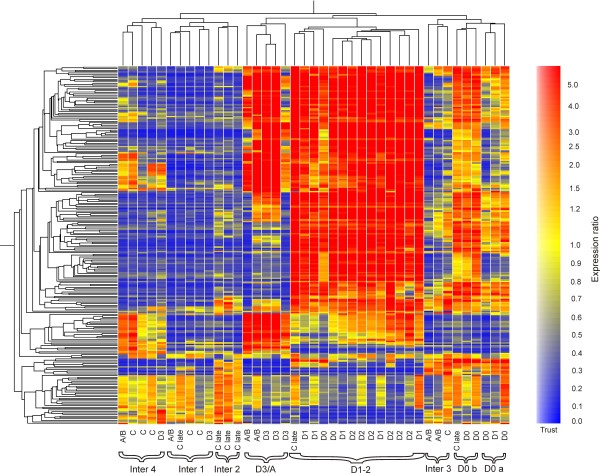
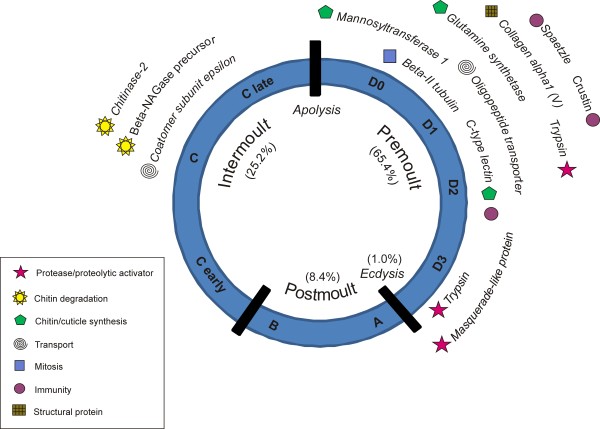
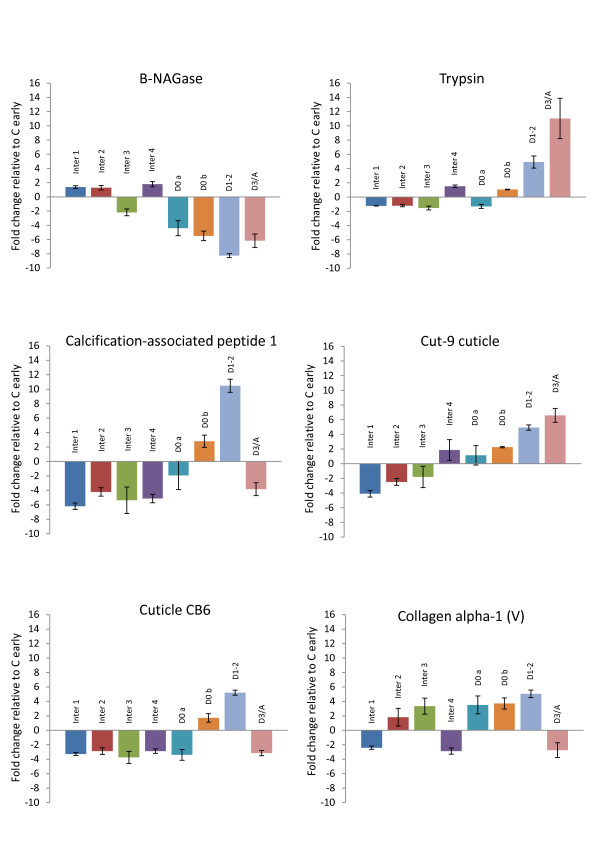
A total of 26 different cuticle genes were identified that showed differential gene expression across the moult cycle. Almost all cuticle genes were up regulated during premoult and down regulated during late intermoult. There were a number of transcripts with significant sequence homology to genes potentially involved in the synthesis, breakdown and resorption of chitin. During early premoult glutamine synthetase, a gene involved in generating an amino acid used in the synthesis of glucosamine, a constituent of chitin, was up regulated more than twofold. Mannosyltransferase 1, a member of the glycosyltransferase family of enzymes that includes chitin synthase was also up regulated during early premoult. Transcripts homologous to a β-N-acetylglucosaminidase (β-NAGase) precursor were expressed at a higher level during late intermoult (prior to apolysis) than during premoult. This observation coincided with the up regulation during late intermoult, of a coatomer subunit epsilon involved in the production of vesicles that maybe used to transport the β-NAGase precursors into the exuvial cleft. Trypsin, known to activate the β-NAGase precursor, was up regulated more than fourfold during premoult. The up regulation of a predicted oligopeptide transporter during premoult may allow the transport of chitin breakdown products across the newly synthesised epi- and exocuticle layers.
We have identified many genes differentially expressed across the moult cycle of krill that correspond with known phenotypic structural changes. This study has provided a better understanding of the processes involved in krill moulting and how they may be controlled at the gene expression level.
所有甲壳类动物都会定期蜕皮以更新外骨骼。在磷虾中,这涉及到旧外骨骼的部分消化和吸收以及新表皮的合成。在钙化甲壳类动物中,蜕皮周期的分子事件了解甚少,在非钙化生物如磷虾中则更是如此。为了解决这个问题,我们构建了南极磷虾 cDNA 微阵列,以生成整个蜕皮周期的基因表达谱,并确定可能的激活途径。
总共鉴定出 26 种不同的表皮基因,这些基因在蜕皮周期中表现出差异表达。几乎所有的表皮基因在蜕皮前都上调,在晚期间蜕皮时下调。有一些转录本与可能参与几丁质合成、分解和吸收的基因具有显著的序列同源性。在早期蜕皮前,参与生成用于合成几丁质(构成几丁质的葡萄糖胺)的氨基酸的谷氨酰胺合成酶上调了两倍以上。甘露糖基转移酶 1 是糖基转移酶家族的一个成员,包括几丁质合成酶,也在早期蜕皮前上调。与β-N-乙酰氨基葡萄糖苷酶(β-NAGase)前体同源的转录本在晚期间蜕皮(在蜕皮前)的表达水平高于蜕皮前。这一观察结果与晚期间蜕皮时参与产生囊泡的衣壳蛋白亚基 ε的上调相吻合,这些囊泡可能用于将β-NAGase 前体运输到蜕皮裂隙中。已知能激活β-NAGase 前体的胰蛋白酶在蜕皮前上调了四倍以上。在蜕皮前,预测的寡肽转运体的上调可能允许几丁质分解产物穿过新合成的表皮和外骨骼层运输。
我们已经鉴定出许多在磷虾蜕皮周期中差异表达的基因,这些基因与已知的表型结构变化相对应。这项研究提供了对磷虾蜕皮过程的更好理解,以及它们如何在基因表达水平上被控制。