Department of Plant Pathology, University of Kentucky, Lexington, KY 40546, USA.
Adv Virus Res. 2010;76:123-77. doi: 10.1016/S0065-3527(10)76004-8. Epub 2010 Mar 31.
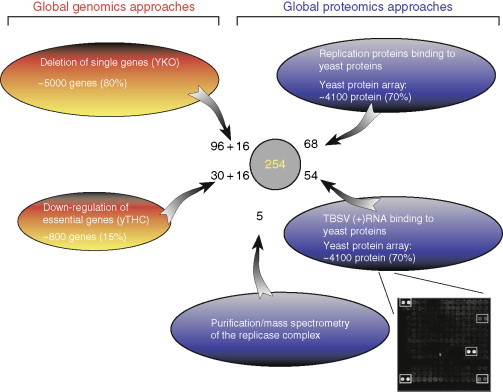
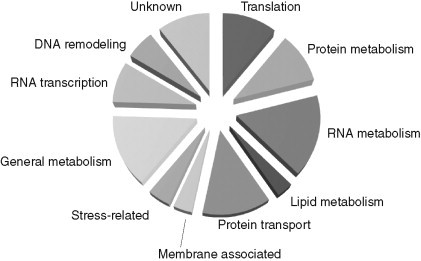
The success of RNA viruses as pathogens of plants, animals, and humans depends on their ability to reprogram the host cell metabolism to support the viral infection cycle and to suppress host defense mechanisms. Plus-strand (+)RNA viruses have limited coding potential necessitating that they co-opt an unknown number of host factors to facilitate their replication in host cells. Global genomics and proteomics approaches performed with Tomato bushy stunt virus (TBSV) and yeast (Saccharomyces cerevisiae) as a model host have led to the identification of 250 host factors affecting TBSV RNA replication and recombination or bound to the viral replicase, replication proteins, or the viral RNA. The roles of a dozen host factors involved in various steps of the replication process have been validated in yeast as well as a plant host. Altogether, the large number of host factors identified and the great variety of cellular functions performed by these factors indicate the existence of a truly complex interaction between TBSV and the host cell. This review summarizes the advantages of using a simple plant virus and yeast as a model host to advance our understanding of virus-host interactions at the molecular and cellular levels. The knowledge of host factors gained can potentially be used to inhibit virus replication via gene silencing, expression of dominant negative mutants, or design of specific chemical inhibitors leading to novel specific or broad-range resistance and antiviral tools against (+)RNA plant viruses.
正链(+)RNA 病毒的编码能力有限,这使得它们需要利用大量未知的宿主因子来促进其在宿主细胞中的复制。利用番茄丛矮病毒 (TBSV) 和酵母 (酿酒酵母) 作为模型宿主进行的全局基因组学和蛋白质组学方法研究,已经鉴定出 250 种宿主因子,这些因子影响 TBSV RNA 的复制和重组,或者与病毒复制酶、复制蛋白或病毒 RNA 结合。十几个涉及复制过程各个步骤的宿主因子的作用已在酵母和植物宿主中得到验证。总之,大量鉴定出的宿主因子以及这些因子所执行的各种细胞功能表明,TBSV 与宿主细胞之间存在着真正复杂的相互作用。本文综述了利用简单的植物病毒和酵母作为模型宿主来推进我们对病毒-宿主相互作用在分子和细胞水平上的理解的优势。获得的宿主因子知识可用于通过基因沉默、显性负突变体的表达或特定化学抑制剂的设计来抑制病毒复制,从而产生针对(+)RNA 植物病毒的新型特异性或广谱抗性和抗病毒工具。