Influenza Division, National Center for Immunization and Respiratory Diseases, Centers for Disease Control and Prevention, Atlanta, Georgia, United States of America.
PLoS One. 2010 Oct 12;5(10):e13293. doi: 10.1371/journal.pone.0013293.
The emergence and rapid spread of the 2009 H1N1 pandemic influenza A virus (H1N1pdm) in humans highlights the importance of enhancing the capability of existing influenza surveillance systems with tools for rapid identification of emerging and re-emerging viruses. One of the new approaches is the RT-PCR electrospray ionization mass spectrometry (RT-PCR/ESI-MS) technology, which is based on analysis of base composition (BC) of RT-PCR amplicons from influenza "core" genes. Combination of the BC signatures represents a "genomic print" of an influenza A virus.
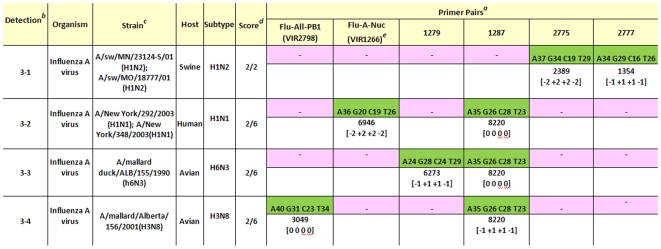
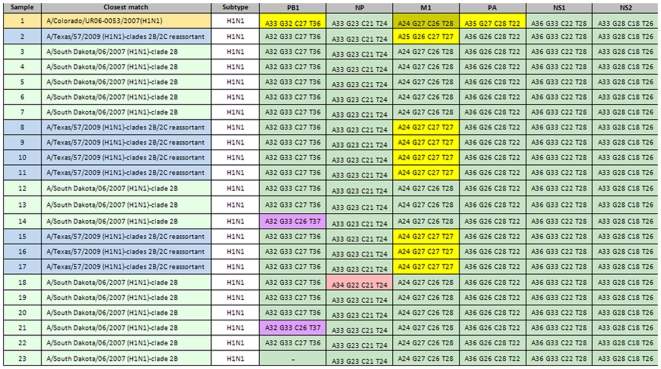
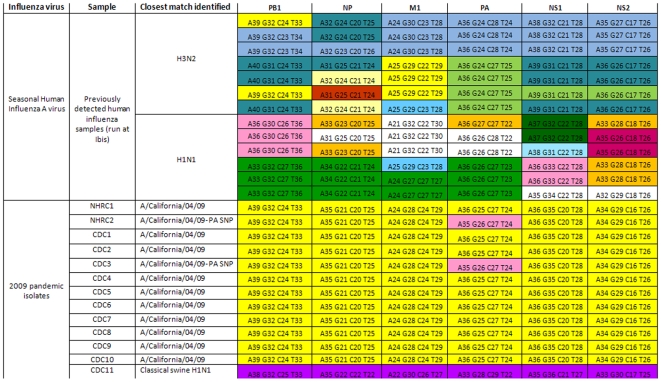
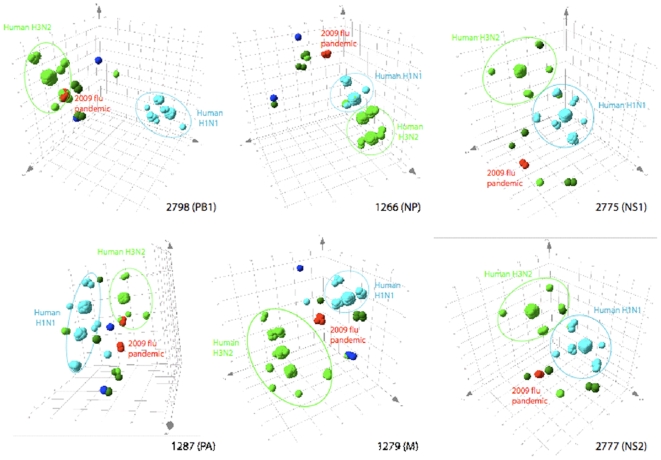
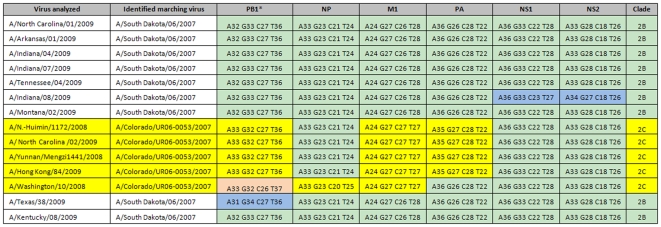
METHODOLOGY/PRINCIPAL FINDINGS: Here, 757 samples collected between 2006 and 2009 were tested, including 302 seasonal H1N1, 171 H3N2, 7 swine triple reassortants, and 277 H1N1pdm viruses. Of the 277 H1N1pdm samples, 209 were clinical specimens (throat, nasal and nasopharyngeal swabs, nasal washes, blood and sputum). BC signatures for the clinical specimen from one of the first cases of the 2009 pandemic, A/California/04/2009, confirmed it as an unusual, previously unrecognized influenza A virus, with "core" genes related to viruses of avian, human and swine origins. Subsequent analysis of additional 276 H1N1pdm samples revealed that they shared the genomic print of A/California/04/2009, which differed from those of North American swine triple reassortant viruses, seasonal H1N1 and H3N2 and other viruses tested. Moreover, this assay allowed distinction between "core" genes of co-circulating groups of seasonal H1N1, such as clades 2B, 2C, and their reassortants with dual antiviral resistance to adamantanes and oseltamivir.
CONCLUSIONS/SIGNIFICANCE: The RT-PCR/ESI-MS assay is a broad range influenza identification tool that can be used directly on clinical specimens for rapid and accurate detection of influenza virus genes. The assay differentiates the H1N1pdm from seasonal and other nonhuman hosts viruses. Although not a diagnostic tool, this assay demonstrates its usefulness and robustness in influenza virus surveillance and detection of novel and unusual viruses with previously unseen genomic prints.
2009 年甲型 H1N1 流感病毒(H1N1pdm)在人类中的出现和迅速传播突出表明,需要利用能够快速识别新出现和重现的病毒的工具,来增强现有的流感监测系统的能力。新方法之一是基于流感“核心”基因 RT-PCR 扩增子碱基组成(BC)分析的 RT-PCR 电喷雾电离质谱(RT-PCR/ESI-MS)技术。BC 特征的组合代表了流感 A 病毒的“基因组指纹”。
方法/主要发现:在这里,对 2006 年至 2009 年间收集的 757 个样本进行了测试,包括 302 个季节性 H1N1、171 个 H3N2、7 个猪三重重组体和 277 个 H1N1pdm 病毒。在 277 个 H1N1pdm 样本中,有 209 个是临床标本(咽喉、鼻腔和鼻咽拭子、鼻腔冲洗液、血液和痰液)。对 2009 年大流行首例病例之一的临床标本的 BC 特征进行分析,证实其为一种不寻常的、以前未被识别的流感 A 病毒,其“核心”基因与禽、人源和猪源病毒有关。对另外 276 个 H1N1pdm 样本的后续分析表明,它们共享 A/California/04/2009 的基因组指纹,与北美的猪三重重组体病毒、季节性 H1N1 和 H3N2 以及其他测试的病毒不同。此外,该检测方法可区分循环的季节性 H1N1 病毒“核心”基因,例如 2B、2C 类及其对金刚烷胺和奥司他韦具有双重抗病毒耐药性的重组体。
结论/意义:RT-PCR/ESI-MS 检测法是一种广谱流感鉴定工具,可直接用于临床标本,用于快速准确地检测流感病毒基因。该检测方法可将 H1N1pdm 与季节性和其他非人类宿主病毒区分开来。虽然不是诊断工具,但该检测方法在流感病毒监测和检测具有以前未见基因组指纹的新型和异常病毒方面证明了其有用性和稳健性。