Dresch Jacqueline M, Liu Xiaozhou, Arnosti David N, Ay Ahmet
Department of Biochemistry and Molecular Biology, Michigan State University, East Lansing, MI, USA.
BMC Syst Biol. 2010 Oct 24;4:142. doi: 10.1186/1752-0509-4-142.
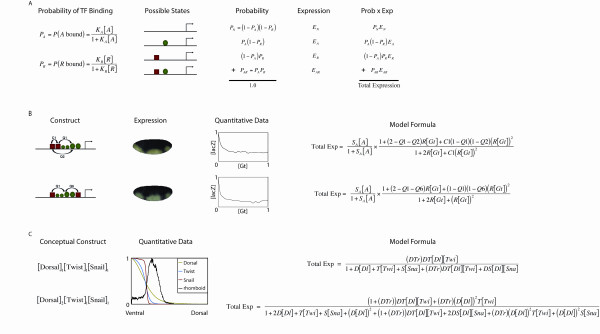
Quantitative models of gene expression generate parameter values that can shed light on biological features such as transcription factor activity, cooperativity, and local effects of repressors. An important element in such investigations is sensitivity analysis, which determines how strongly a model's output reacts to variations in parameter values. Parameters of low sensitivity may not be accurately estimated, leading to unwarranted conclusions. Low sensitivity may reflect the nature of the biological data, or it may be a result of the model structure. Here, we focus on the analysis of thermodynamic models, which have been used extensively to analyze gene transcription. Extracted parameter values have been interpreted biologically, but until now little attention has been given to parameter sensitivity in this context.
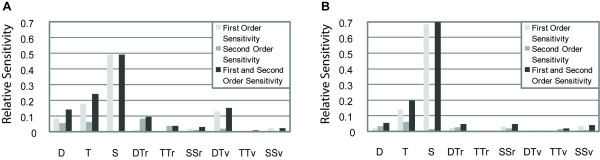
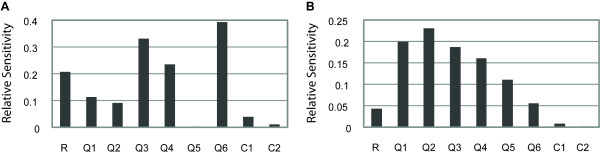
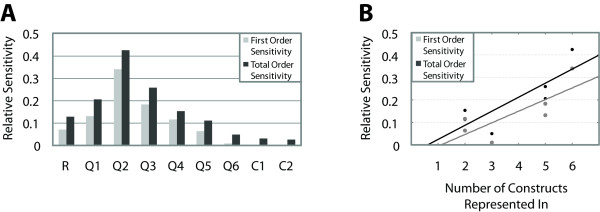
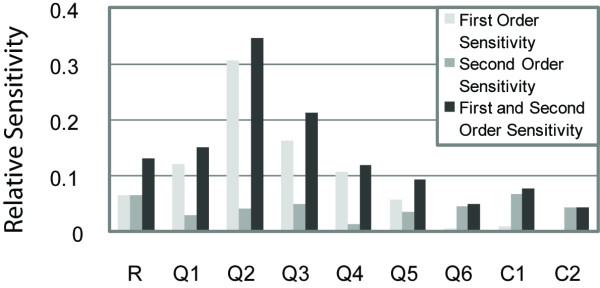
We apply local and global sensitivity analyses to two recent transcriptional models to determine the sensitivity of individual parameters. We show that in one case, values for repressor efficiencies are very sensitive, while values for protein cooperativities are not, and provide insights on why these differential sensitivities stem from both biological effects and the structure of the applied models. In a second case, we demonstrate that parameters that were thought to prove the system's dependence on activator-activator cooperativity are relatively insensitive. We show that there are numerous parameter sets that do not satisfy the relationships proferred as the optimal solutions, indicating that structural differences between the two types of transcriptional enhancers analyzed may not be as simple as altered activator cooperativity.
Our results emphasize the need for sensitivity analysis to examine model construction and forms of biological data used for modeling transcriptional processes, in order to determine the significance of estimated parameter values for thermodynamic models. Knowledge of parameter sensitivities can provide the necessary context to determine how modeling results should be interpreted in biological systems.
基因表达的定量模型生成的参数值能够揭示诸如转录因子活性、协同性以及阻遏物的局部效应等生物学特征。此类研究中的一个重要因素是敏感性分析,它能确定模型输出对参数值变化的反应强度。低敏感性参数可能无法得到准确估计,从而导致不合理的结论。低敏感性可能反映了生物学数据的本质,也可能是模型结构所致。在此,我们聚焦于对热力学模型的分析,该模型已被广泛用于分析基因转录。提取的参数值已从生物学角度进行了解释,但迄今为止,在此背景下对参数敏感性的关注甚少。
我们对两个近期的转录模型应用局部和全局敏感性分析,以确定各个参数的敏感性。我们表明,在一种情况下,阻遏效率值非常敏感,而蛋白质协同性值则不然,并深入探讨了为何这些差异敏感性源于生物学效应和所应用模型的结构。在另一种情况下,我们证明了那些被认为可证明系统对激活剂 - 激活剂协同性有依赖性的参数相对不敏感。我们表明,存在众多参数集不满足作为最优解提出的关系,这表明所分析的两种转录增强子之间的结构差异可能不像激活剂协同性改变那么简单。
我们的结果强调了进行敏感性分析的必要性,以审视用于转录过程建模的模型构建和生物学数据形式,从而确定热力学模型估计参数值的意义。参数敏感性知识可为确定如何在生物系统中解释建模结果提供必要的背景信息。