Department of Environmental Health, Harvard School of Public Health, Boston, Massachusetts, United States of America.
PLoS One. 2010 Oct 18;5(10):e13423. doi: 10.1371/journal.pone.0013423.
The risk of indoor exposure to volatile organic compounds (VOCs) on allergic airway diseases in children remains unknown.
We examined the residential concentrations of VOCs, emitted from building materials, paints, furniture, and other lifestyle practices and the risks of multiple allergic diseases as well as the IgE-sensitization in pre-school age children in Sweden.
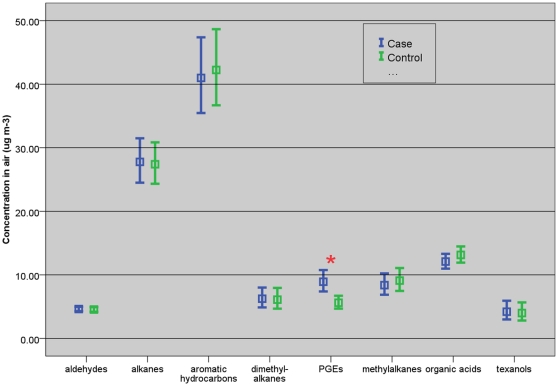
In a case-control investigation (198 case children with asthma and allergy and 202 healthy controls), air samples were collected in the room where the child slept. The air samples were analyzed for the levels of eight classes of VOCs.
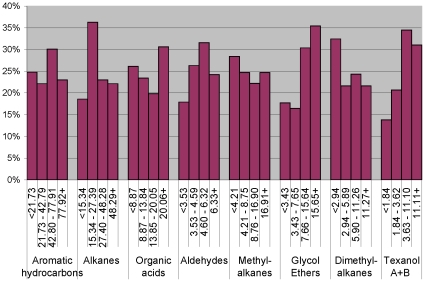
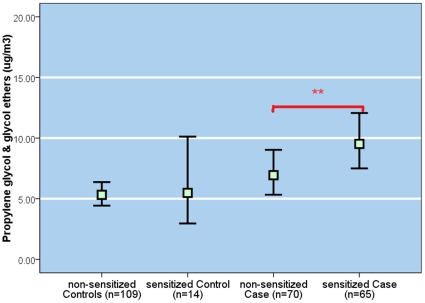
A natural-log unit of summed propylene glycol and glycol ethers (PGEs) in bedroom air (equal to interquartile range, or 3.43 - 15.65 µg/m(3)) was associated with 1.5-fold greater likelihood of being a case (95% CI, 1.1 - 2.1), 1.5-fold greater likelihood of asthma (95% CI, 1.0 - 2.3), 2.8-fold greater likelihood of rhinitis (95% CI, 1.6 - 4.7), and 1.6-fold greater likelihood of eczema (95% CI, 1.1 - 2.3), accounting for gender, secondhand smoke, allergies in both parents, wet cleaning with chemical agents, construction period of the building, limonene, cat and dog allergens, butyl benzyl phthalate (BBzP), and di(2-ethylhexyl)phthalate (DEHP). When the analysis was restricted to the cases, the same unit concentration was associated with 1.8-fold greater likelihood of IgE-sensitization (95% CI, 1.1 - 2.8) compared to the non-IgE sensitized cases. No similar associations were found for the other classes of VOCs.
We propose a novel hypothesis that PGEs in indoor air exacerbate and/or induce the multiple allergic symptoms, asthma, rhinitis and eczema, as well as IgE sensitization respectively.
室内接触挥发性有机化合物(VOCs)对儿童过敏性气道疾病的风险尚不清楚。
我们研究了来自建筑材料、油漆、家具和其他生活方式的 VOC 住宅浓度,以及瑞典学龄前儿童多种过敏性疾病的风险以及 IgE 致敏情况。
在病例对照研究(198 例哮喘和过敏儿童病例和 202 例健康对照)中,在儿童卧室采集空气样本。对空气样本进行了 8 类 VOC 水平的分析。
卧室空气中丙烯乙二醇和二醇醚总和(PGEs)的自然对数单位(等于四分位间距,即 3.43-15.65µg/m3)与成为病例的可能性增加 1.5 倍相关(95%CI,1.1-2.1)、哮喘的可能性增加 1.5 倍(95%CI,1.0-2.3)、鼻炎的可能性增加 2.8 倍(95%CI,1.6-4.7)、湿疹的可能性增加 1.6 倍(95%CI,1.1-2.3),这与性别、二手烟、父母双方过敏、使用化学剂湿式清洁、建筑物施工期、柠檬烯、猫和狗过敏原、丁基苄基邻苯二甲酸酯(BBzP)和邻苯二甲酸二(2-乙基己基)酯(DEHP)有关。当分析仅限于病例时,相同的单位浓度与 IgE 致敏的可能性增加 1.8 倍相关(95%CI,1.1-2.8),与非 IgE 致敏病例相比。其他类别的 VOCs 没有发现类似的关联。
我们提出了一个新的假设,即室内空气中的 PGEs 分别加重和/或诱发多种过敏症状、哮喘、鼻炎和湿疹以及 IgE 致敏。