Department of Pathology, Academic Medical Center, University of Amsterdam, Amsterdam, The Netherlands.
PLoS One. 2010 Oct 14;5(10):e13394. doi: 10.1371/journal.pone.0013394.
Inflammation is commonly followed by the release of endogenous proteins called danger associated molecular patterns (DAMPs) that are able to warn the host for eminent danger. S100A8/A9 subunits are DAMPs that belong to the S100 family of calcium binding proteins. S100A8/A9 complexes induce an inflammatory response and their expression correlates with disease severity in several inflammatory disorders. S100A8/A9 promote endotoxin- and Escherichia (E.) coli-induced sepsis showing its contribution in systemic infection. The role of S100A8/A9 during a local infection of the urinary tract system caused by E. coli remains unknown.
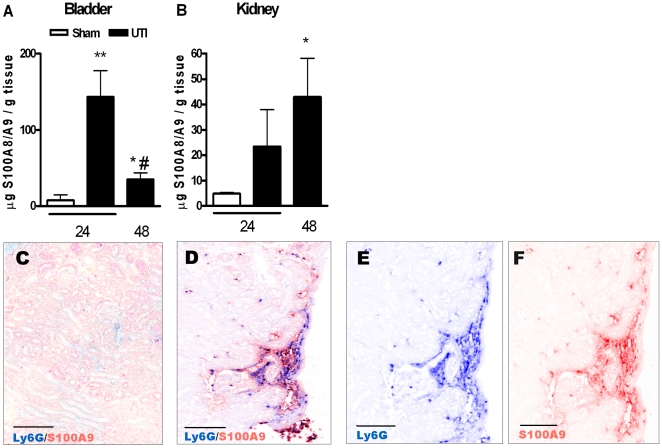
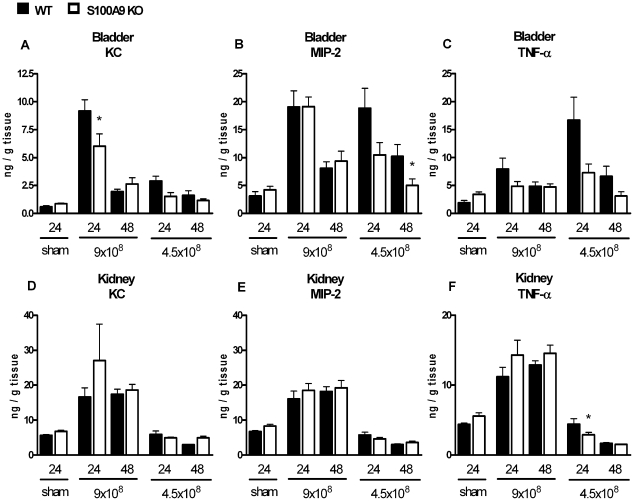
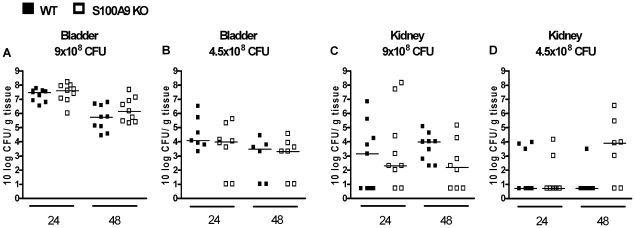
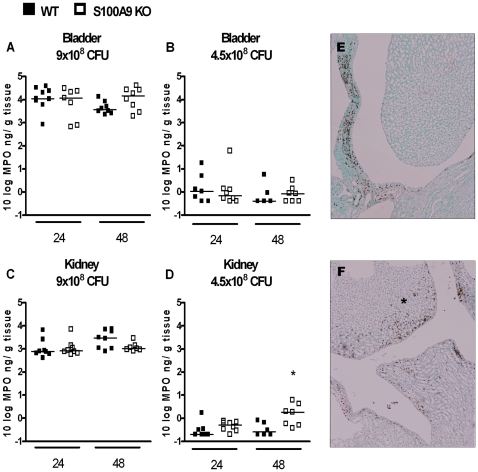
METHODOLOGY/PRINCIPAL FINDINGS: We investigated the contribution of S100A8/A9 in acute urinary tract infection (UTI) by instilling 2 different doses of uropathogenic E. coli transurethrally in wild type (WT) and S100A9 knockout (KO) mice. Subsequently, we determined bacterial outgrowth, neutrophilic infiltrate and inflammatory mediators in bladder and kidney 24 and 48 hours later. UTI resulted in a substantial increase of S100A8/A9 protein in bladder and kidney tissue of WT mice. S100A9 KO mice displayed similar bacterial load in bladder or kidney homogenate compared to WT mice using 2 different doses at 2 different time points. S100A9 deficiency had little effect on the inflammatory responses to E. Coli-induced UTI infection, as assessed by myeloperoxidase activity in bladder and kidneys, histopathologic analysis, and renal and bladder cytokine concentrations.
We show that despite high S100A8/A9 expression in bladder and kidney tissue upon UTI, S100A8/A9 does not contribute to an effective host response against E. Coli in the urinary tract system.
炎症通常伴随着被称为危险相关分子模式(DAMPs)的内源性蛋白的释放,这些蛋白能够为主机发出即将到来的危险警报。S100A8/A9 亚基是 DAMPs,属于钙结合蛋白 S100 家族。S100A8/A9 复合物诱导炎症反应,其表达与几种炎症性疾病的严重程度相关。S100A8/A9 促进内毒素和大肠杆菌(E. coli)诱导的败血症,表明其在全身感染中的作用。S100A8/A9 在由大肠杆菌引起的泌尿道系统局部感染中的作用尚不清楚。
方法/主要发现:我们通过经尿道向野生型(WT)和 S100A9 敲除(KO)小鼠注入 2 种不同剂量的泌尿道致病性大肠杆菌,研究了 S100A8/A9 在急性尿路感染(UTI)中的作用。随后,我们在 24 小时和 48 小时后测定膀胱和肾脏中的细菌生长、中性粒细胞浸润和炎症介质。UTI 导致 WT 小鼠膀胱和肾脏组织中 S100A8/A9 蛋白大量增加。S100A9 KO 小鼠在 2 个不同时间点使用 2 种不同剂量,在膀胱或肾脏匀浆中的细菌负荷与 WT 小鼠相似。S100A9 缺陷对大肠杆菌诱导的 UTI 感染的炎症反应影响不大,通过膀胱和肾脏中的髓过氧化物酶活性、组织病理学分析以及肾脏和膀胱细胞因子浓度来评估。
我们表明,尽管 UTI 时膀胱和肾脏组织中 S100A8/A9 表达水平较高,但 S100A8/A9 并不有助于宿主对泌尿道系统中大肠杆菌的有效反应。