Department of Clinical Sciences, Lund University Malmö, 205 02 Malmö, Sweden ; Cardiology Clinic, Skane University Hospital Malmö, Inga Marie Nilssons gata 46, Floor 2, 205 02 Malmö, Sweden.
Department of Cellular and Molecular Biology, University of Medicine and Pharmacy of Tîrgu Mureş, 540139 Tîrgu Mureş, Romania.
Mediators Inflamm. 2013;2013:828354. doi: 10.1155/2013/828354. Epub 2013 Dec 22.
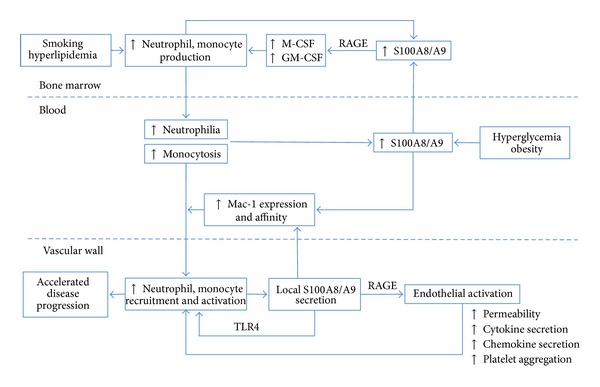
Amplification of innate immune responses by endogenous danger-associated molecular patterns (DAMPs) promotes inflammation. The involvement of S100A8 and S100A9, DAMPs belonging to the S100 calgranulin family, in the pathogenesis of cardiovascular disease is attracting an increasing amount of interest. S100A8 and S100A9 (also termed MRP8 and MRP14) preferentially form the S100A8/A9 heterodimer (MRP8/14 or calprotectin) and are constitutively expressed in myeloid cells. The levels of circulating S100A8/A9 in humans strongly correlate to blood neutrophil counts and are increased by traditional cardiovascular risk factors such as smoking, obesity, hyperglycemia, and dyslipidemia. S100A8/A9 is an endogenous ligand of toll-like receptor 4 (TLR4) and of the receptor for advanced glycation end products (RAGE) and has been shown to promote atherogenesis in mice. In humans, S100A8/A9 correlates with the extent of coronary and carotid atherosclerosis and with a vulnerable plaque phenotype. S100A8/A9 is locally released following myocardial infarction and amplifies the inflammatory responses associated with myocardial ischemia/reperfusion injury. Elevated plasma levels of S100A8/A9 are associated with increased risk of future coronary events in healthy individuals and in myocardial infarction survivors. Thus, S100A8/A9 might represent a useful biomarker and therapeutic target in cardiovascular disease. Importantly, S100A8/A9 blockers have been developed and are approved for clinical testing.
内源性危险相关分子模式 (DAMPs) 对固有免疫反应的放大作用促进了炎症的发生。属于 S100 钙结合蛋白家族的 DAMPs S100A8 和 S100A9 在心脑血管疾病发病机制中的作用越来越受到关注。S100A8 和 S100A9(也称为 MRP8 和 MRP14)优先形成 S100A8/A9 异二聚体(MRP8/14 或钙卫蛋白),并在髓样细胞中持续表达。人类循环中的 S100A8/A9 水平与血液中性粒细胞计数密切相关,并受传统心血管危险因素(如吸烟、肥胖、高血糖和血脂异常)的影响而增加。S100A8/A9 是 toll 样受体 4 (TLR4) 和晚期糖基化终产物受体 (RAGE) 的内源性配体,已被证明可促进小鼠动脉粥样硬化的形成。在人类中,S100A8/A9 与冠状动脉和颈动脉粥样硬化的程度以及易损斑块表型相关。心肌梗死后,S100A8/A9 局部释放,并放大与心肌缺血/再灌注损伤相关的炎症反应。在健康个体和心肌梗死后幸存者中,血浆 S100A8/A9 水平升高与未来发生冠状动脉事件的风险增加相关。因此,S100A8/A9 可能是心血管疾病的一个有用的生物标志物和治疗靶点。重要的是,S100A8/A9 抑制剂已被开发并获准进行临床测试。