Screening and Test Evaluation Program, Centre for Medical Psychology and Evidence-Based Decision-Making, Sydney School of Public Health, University of Sydney, NSW 2006, Australia.
BMJ. 2010 Oct 26;341:c5370. doi: 10.1136/bmj.c5370.
To determine whether a decision aid designed for adults with low education and literacy can support informed choice and involvement in decisions about screening for bowel cancer.
Randomised controlled trial.
Areas in New South Wales, Australia identified as socioeconomically disadvantaged (low education attainment, high unemployment, and unskilled occupations).
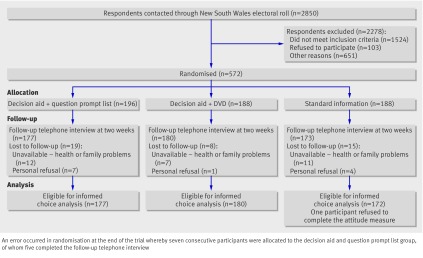
572 adults aged between 55 and 64 with low educational attainment, eligible for bowel cancer screening.
Patient decision aid comprising a paper based interactive booklet (with and without a question prompt list) and a DVD, presenting quantitative risk information on the possible outcomes of screening using faecal occult blood testing compared with no testing. The control group received standard information developed for the Australian national bowel screening programme. All materials and a faecal occult blood test kit were posted directly to people's homes.
Informed choice (adequate knowledge and consistency between attitudes and screening behaviour) and preferences for involvement in screening decisions.
Participants who received the decision aid showed higher levels of knowledge than the controls; the mean score (maximum score 12) for the decision aid group was 6.50 (95% confidence interval 6.15 to 6.84) and for the control group was 4.10 (3.85 to 4.36; P<0.001). Attitudes towards screening were less positive in the decision aid group, with 51% of the participants expressing favourable attitudes compared with 65% of participants in the control group (14% difference, 95% confidence interval 5% to 23%; P=0.002). The participation rate for screening was reduced in the decision aid group: completion of faecal occult blood testing was 59% v 75% in the control group (16% difference, 8% to 24%; P=0.001). The decision aid increased the proportion of participants who made an informed choice, from 12% in the control group to 34% in the decision aid group (22% difference, 15% to 29%; P<0.001). More participants in the decision aid group had no decisional conflict about the screening decision compared with the controls (51% v 38%; P=0.02). The groups did not differ for general anxiety or worry about bowel cancer.
Tailored decision support information can be effective in supporting informed choices and greater involvement in decisions about faecal occult blood testing among adults with low levels of education, without increasing anxiety or worry about developing bowel cancer. Using a decision aid to make an informed choice may, however, lead to lower uptake of screening. Trial registration ClinicalTrials.gov NCT00765869 and Australian New Zealand Clinical Trials Registry 12608000011381.
确定为受教育程度和读写能力较低的成年人设计的决策辅助工具是否可以支持知情选择并参与结直肠癌筛查决策。
随机对照试验。
澳大利亚新南威尔士州被确定为社会经济劣势地区(教育程度低、高失业率和非技术职业)。
572 名年龄在 55 岁至 64 岁之间、受教育程度较低、有资格进行结直肠癌筛查的成年人。
患者决策辅助工具包括一本基于纸张的交互式小册子(带和不带问题提示清单)和一张 DVD,使用粪便潜血检测比较筛查与不筛查的可能结果,呈现定量风险信息。对照组接受了为澳大利亚国家结直肠筛查计划开发的标准信息。所有材料和粪便潜血检测试剂盒都直接邮寄到人们的家中。
知情选择(充分的知识以及态度和筛查行为之间的一致性)和对筛查决策的参与偏好。
与对照组相比,使用决策辅助工具的参与者表现出更高的知识水平;决策辅助组的平均得分(最高得分为 12 分)为 6.50(95%置信区间为 6.15 至 6.84),对照组为 4.10(3.85 至 4.36;P<0.001)。决策辅助组对筛查的态度不太积极,51%的参与者表示赞成,而对照组为 65%(14%的差异,95%置信区间为 5%至 23%;P=0.002)。决策辅助组的筛查参与率降低:粪便潜血检测完成率为对照组的 75%,决策辅助组为 59%(16%的差异,8%至 24%;P=0.001)。决策辅助工具增加了做出知情选择的参与者比例,从对照组的 12%增加到决策辅助组的 34%(22%的差异,15%至 29%;P<0.001)。与对照组相比,决策辅助组中对筛查决策没有决策冲突的参与者比例更高(51%比 38%;P=0.02)。两组在一般焦虑或对结直肠癌的担忧方面没有差异。
针对受教育程度较低的成年人量身定制的决策支持信息可以有效地支持知情选择,并促进他们更多地参与粪便潜血检测决策,而不会增加对患结直肠癌的焦虑或担忧。使用决策辅助工具做出知情选择可能会导致筛查参与率降低。
ClinicalTrials.gov NCT00765869 和澳大利亚新西兰临床试验注册中心 12608000011381。