Bement W M, Capco D G
Department of Zoology, Arizona State University, Tempe 85287-1501.
Cell Regul. 1990 Feb;1(3):315-26. doi: 10.1091/mbc.1.3.315.
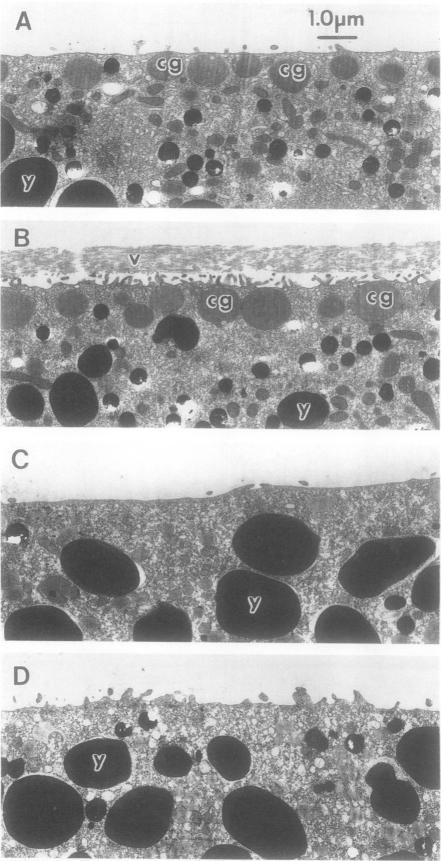
Transit into interphase of the first mitotic cell cycle in amphibian eggs is a process referred to as activation and is accompanied by an increase in intracellular free calcium [( Ca2+]i), which may be transduced into cytoplasmic events characteristic of interphase by protein kinase C (PKC). To investigate the respective roles of [Ca2+]i and PKC in Xenopus laevis egg activation, the calcium signal was blocked by microinjection of the calcium chelator BAPTA, or the activity of PKC was blocked by PKC inhibitors sphingosine or H7. Eggs were then challenged for activation by treatment with either calcium ionophore A23187 or the PKC activator PMA. BAPTA prevented cortical contraction, cortical granule exocytosis, and cleavage furrow formation in eggs challenged with A23187 but not with PMA. In contrast, sphingosine and H7 inhibited cortical granule exocytosis, cortical contraction, and cleavage furrow formation in eggs challenged with either A23187 or PMA. Measurement of egg [Ca2+]i with calcium-sensitive electrodes demonstrated that PMA treatment does not increase egg [Ca2+]i in BAPTA-injected eggs. Further, PMA does not increase [Ca2+]i in eggs that have not been injected with BAPTA. These results show that PKC acts downstream of the [Ca2+]i increase to induce cytoplasmic events of the first Xenopus mitotic cell cycle.
两栖类卵母细胞进入第一次有丝分裂细胞周期的间期这一过程被称为激活,同时伴随着细胞内游离钙([Ca2+]i)浓度的升高,而这一升高可能通过蛋白激酶C(PKC)转化为间期特有的细胞质事件。为了研究[Ca2+]i和PKC在非洲爪蟾卵母细胞激活过程中的各自作用,通过显微注射钙螯合剂BAPTA来阻断钙信号,或者用PKC抑制剂鞘氨醇或H7来阻断PKC的活性。然后用钙离子载体A23187或PKC激活剂PMA处理卵母细胞以激发其激活。BAPTA可阻止用A23187处理的卵母细胞发生皮质收缩、皮质颗粒胞吐作用和卵裂沟形成,但对用PMA处理的卵母细胞无此作用。相反,鞘氨醇和H7可抑制用A23187或PMA处理的卵母细胞的皮质颗粒胞吐作用、皮质收缩和卵裂沟形成。用钙敏感电极测量卵母细胞[Ca2+]i表明,PMA处理不会使注射了BAPTA的卵母细胞[Ca2+]i升高。此外,PMA也不会使未注射BAPTA的卵母细胞[Ca2+]i升高。这些结果表明,PKC在[Ca2+]i升高的下游起作用,以诱导非洲爪蟾第一次有丝分裂细胞周期的细胞质事件。